

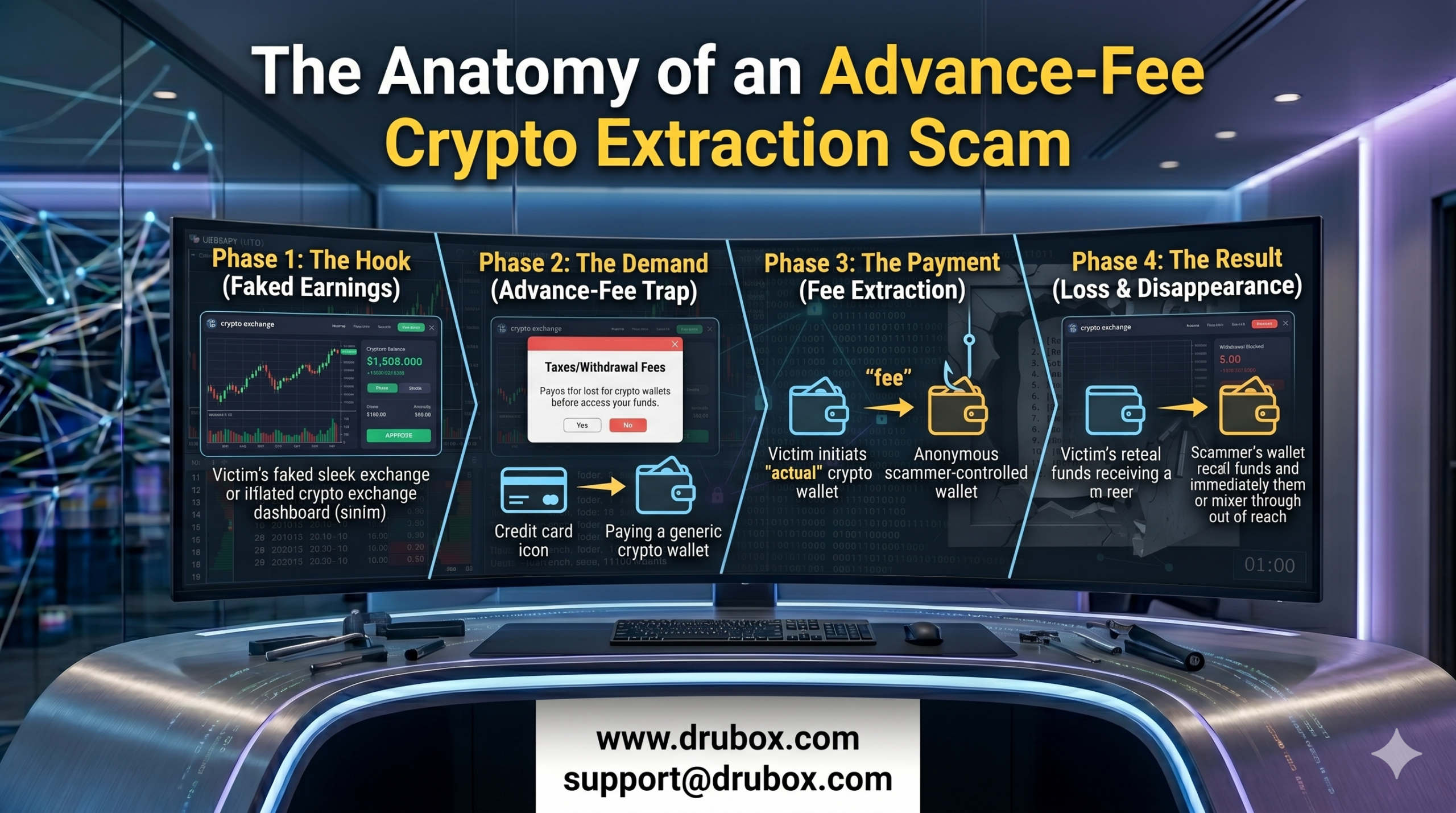
The Anatomy of an Advance-Fee Crypto Extraction: Withdrawal Taxes Explained
The transition from traditional centralized banking to decentralized finance (DeFi) has empowered retail investors with unprecedented financial autonomy. However, this same technological shift has given rise to sophisticated, multi-tiered extortion models engineered by transnational crime syndicates. The most devastating end-stage tactic deployed by these offshore fraud networks is the advance-fee crypto extraction. Rather than executing a simple “hit-and-run” theft where an initial deposit is stolen and communication is severed, this advanced mechanism weaponizes a victim’s perceived profits. It traps the investor in a continuous, agonizing cycle of fabricated compliance demands, leveraging their own money against them.
Understanding the architecture of this specific financial trap is the most critical component of digital asset security and threat mitigation. This definitive, comprehensive guide deconstructs the psychological manipulation, the technical illusions, and the regulatory fabrications behind cryptocurrency withdrawal taxes. By establishing a clear, objective framework, we provide definitive proof that fulfilling these extortionate demands will never result in the release of captive funds, and outline the necessary forensic steps required for actual law enforcement intervention.
The Genesis of the Trap: The Liquidity Illusion
To fully grasp why an advance-fee crypto extraction is so devastatingly effective, one must understand the environment in which it occurs. This extortion does not happen in a vacuum; it is the culmination of a meticulously engineered grooming process that spans weeks or even months. The syndicate’s primary objective during this phase is to build an impenetrable “Liquidity Illusion.”
Victims are typically funneled into a highly sophisticated, closed-loop trading environment. This might be a cloned version of a legitimate trading terminal like MetaTrader 5, a fabricated decentralized application (DApp), or a proprietary web-based exchange portal. Once the victim makes their initial capital deposits—often in the form of Bitcoin (BTC), Ethereum (ETH), or Tether (USDT)—the true psychological conditioning begins.
The platform’s administrators manipulate the backend database to simulate massive, unrealistic portfolio growth. A $10,000 deposit might artificially swell to $450,000 in a matter of weeks through “guaranteed algorithmic trades” or “insider liquidity pools.” During this phase, the victim is experiencing intense euphoria. They believe they are sitting on life-changing wealth. This establishes deep, foundational psychological leverage. The syndicate is not just stealing money; they are manufacturing a false reality where the victim feels financially invincible.
The Capital Extraction Ladder: A Step-by-Step Breakdown
Forensic intelligence analysts refer to the operational timeline of this scam as the “Capital Extraction Ladder.” Threat actors utilize this rigid, step-by-step framework to maximize the total liquidity they can drain from a single target before the victim finally realizes the platform is an entirely simulated trap.
Step 1: The Withdrawal Trigger and Account Freeze
The trap officially initiates the exact moment the investor attempts to secure their life-changing capital. When the user clicks “Withdraw” on the dashboard, the platform’s automated systems immediately flag the request. The withdrawal is manually rejected by the backend administrators, and the user’s entire account is placed on a localized freeze. The victim is abruptly locked out of moving any assets, transitioning them instantly from a state of euphoria to a state of acute panic.
Step 2: The Initial Compliance Demand
Within minutes of the freeze, the victim is contacted by a “Customer Success Manager” or a “Senior Compliance Officer” via encrypted chat channels like WhatsApp or Telegram. The agent informs the victim that the withdrawal has been halted by international regulatory bodies. To release the funds, the user must pay an upfront fee—usually calculated as 10% to 20% of the total fabricated account balance. This is the core of the advance-fee crypto extraction.
Step 3: The Weaponization of Technical Jargon
To justify why this massive fee cannot simply be deducted from the $450,000 sitting in the user’s account, the syndicate relies on highly technical, pseudo-financial jargon. They will claim that “blockchain protocols require fresh liquidity to verify the withdrawal address integrity,” or that “smart contract immutability prevents internal fee deductions until the IRS clearance node is synchronized.” To an investor lacking deep blockchain engineering knowledge, these fabricated technical hurdles sound legitimate.
Step 4: The Escalation and Goalpost Shift
If the victim successfully pays the initial fee out-of-pocket, the syndicate registers them as a highly compliant, high-value target. The withdrawal is, of course, not released. Instead, the goalpost is shifted. A new, unforeseen “error” occurs. The syndicate claims the funds are now stuck in a “liquidity channel” and require a “mirroring deposit” to clear. Or, they claim the European Central Bank has flagged the transaction and requires a “security bond.” This cycle of endless secondary fees repeats until the victim is completely bankrupted.
Submit your case for professional forensic tracing and threat analysis
Psychological Warfare: The Sunk Cost Fallacy
The operational success rate of offshore extraction networks relies entirely on human psychology, specifically the sunk cost fallacy and anchoring bias.
The anchoring bias occurs because the victim’s mind is anchored to the massive, fake number on their screen. When a victim is staring at a dashboard displaying a $1,000,000 balance, a sudden demand for a $50,000 tax payment feels proportionally small. The operators deliberately frame the extortion as a minor, temporary hurdle standing between the investor and total financial freedom. The victim is not thinking about losing $50,000; they are thinking about gaining $1,000,000.
Once the first secondary fee is paid, the sunk cost fallacy takes over. The victim has now committed massive amounts of fresh capital to the recovery process. Walking away means accepting that the initial investment, the massive profits, and the newly paid tax fees are all gone. The psychological pain of accepting that reality forces the victim to double down, continuously paying new fees in a desperate attempt to validate their previous payments. Syndicates understand this cognitive dissonance perfectly and exploit it mercilessly.
Structured Comparison: Legitimate Tax Liabilities vs. Extortion
Differentiating between standard financial obligations and a digital extortion scheme requires an ironclad understanding of how regulated markets and global tax authorities actually operate. The table below outlines the definitive differences between legitimate capital gains taxes and fraudulent extraction demands.
| Operational Framework | Regulated Institutional Brokerage | Advance-Fee Crypto Extraction |
|---|---|---|
| Direction of Payment | Taxes are paid directly to government treasuries | Taxes are paid via crypto directly to the broker |
| Deduction Capability | Standard trading fees are deducted from the balance | Requires external, out-of-pocket crypto deposits |
| Account Accessibility | Funds remain fully accessible during tax season | The entire account is frozen until the fee is paid |
| Legal Authority | Enforced by local, domestic legal jurisdictions | Arbitrary rules invented by anonymous support staff |
| Verification of Status | Accountants can verify liabilities with the IRS | Syndicate produces forged PDF “official” documents |
| Escalation Protocol | Clear, finalized, and publicly available tax brackets | Endless creation of new, unexpected secondary fees |
Regulatory Reality: Exposing the Legal Fabrications
The most critical and definitive defense against this extortion model is understanding fundamental international tax law. Syndicates routinely forge elaborate documents bearing the logos of the Financial Crimes Enforcement Network (FinCEN), the Financial Conduct Authority (FCA), or the Internal Revenue Service. They use these forged documents to terrorize victims into compliance.
However, the regulatory reality is absolute: as explicitly stated by the Internal Revenue Service (IRS) and equivalent global tax authorities, legitimate tax liabilities are reported by the citizen and paid directly to the government.
A cryptocurrency exchange, an offshore trading broker, or a decentralized application is never legally authorized to withhold a user’s funds pending an upfront, direct-to-broker tax payment. Government agencies do not use random offshore brokers as third-party tax collectors, and they certainly do not accept tax payments in the form of Bitcoin or Tether sent to an anonymous, unhosted wallet address. Any platform demanding an upfront payment to “unlock” an account to satisfy a governmental body is executing an irrefutable fraud.
Forensic Intervention: Tracing the Advance Fee
If you have been subjected to an advance-fee crypto extraction, the absolute first step in incident response is to halt all capital deposits immediately. Continuing to pay the requested clearance fees, security bonds, or mirroring taxes will not unlock the account; it will only deepen the severe financial damage. You cannot negotiate with a fraudulent smart contract, and you cannot buy compliance from an extortionist. Instead, the focus must immediately shift from negotiation to evidence preservation and forensic action.
While the syndicate controls the fabricated frontend dashboard, they cannot control the immutable nature of the public blockchain. Cyber-forensic investigators bypass the simulated trading environment entirely by analyzing the raw ledger data. This is where the secondary “tax” payments actually become highly valuable to investigators.
Because these advance fees are often paid directly from the victim’s personal, KYC-verified exchange accounts (like Coinbase or Kraken) directly to the scammer’s extraction wallets, they provide a pristine, fresh digital trail. Analysts deploy advanced wallet clustering algorithms and heuristics to track the specific transaction hashes of the extorted stablecoins. The software maps the movement of these funds as the syndicate attempts to route them through complex peel chains, cross-chain bridges, and privacy mixers.
The ultimate goal of this deep-dive forensic trace is terminal off-ramp detection. By tracking the assets until they land in a consolidation wallet hosted by a centralized, regulated Virtual Asset Service Provider (VASP), analysts can identify where the criminals are attempting to liquidate the stolen funds into traditional fiat currency. This court-ready intelligence is the exact data federal law enforcement requires to issue subpoenas, unmask the threat actors behind the offshore entity, and initiate targeted asset freezes.
Request a comprehensive technical review of your digital asset transfers
Conclusion: Severing the Extraction Ladder
The advance-fee crypto extraction is successful because it perfectly blends technical obfuscation with devastating psychological leverage. By recognizing that the massive profits displayed on an unverified dashboard are entirely simulated, retail investors can break the spell of the sunk cost fallacy. True financial security in the Web3 era requires a foundational understanding that legitimate platforms do not hold capital hostage behind arbitrary, out-of-pocket tax walls. When targeted by these syndicates, swift containment, refusal to pay secondary fees, and the deployment of professional cyber-forensic tracing are the only proven methodologies to disrupt the criminal network and pursue justice.
Frequently Asked Questions
What is an advance-fee crypto extraction?
It is an advanced cyber-fraud tactic where offshore brokers freeze a user’s account and demand out-of-pocket crypto payments—framed as taxes, AML fees, or security bonds—before releasing withdrawal requests.
Why won’t the broker just deduct the tax from my balance?
Because the balance is entirely fake. The massive profits shown on the dashboard are simulated database entries. They demand out-of-pocket payments because they are actively attempting to steal fresh, real capital from you.
Do government agencies require brokers to collect crypto taxes upfront?
Absolutely not. Tax authorities require citizens to report their own capital gains locally. Legitimate exchanges and governments never demand direct cryptocurrency payments to an anonymous wallet to “unlock” an account.
Can forensic tracing recover funds lost to fake withdrawal fees?
Yes. Forensic analysts use advanced blockchain clustering software to track the specific wallets that received your “tax” payments, mapping the illicit capital flow to centralized exchanges for immediate law enforcement intervention.