

Resolv Protocol Exploit: The Devastating Reality of Off-Chain Vulnerabilities
The decentralized finance (DeFi) ecosystem relies on a delicate, often misunderstood balance between on-chain immutability and off-chain corporate infrastructure. When that balance shatters, the capital loss is catastrophic. The recent Resolv Protocol exploit stands as a stark reminder that perfectly audited smart contracts cannot protect user liquidity if the centralized key management systems are compromised. By analyzing the Resolv Protocol exploit, retail investors and institutional liquidity providers can better understand the severe risks associated with centralized dependencies and how threat actors execute multi-million dollar extraction events in a matter of minutes.
The Mechanics of the Resolv Protocol Exploit
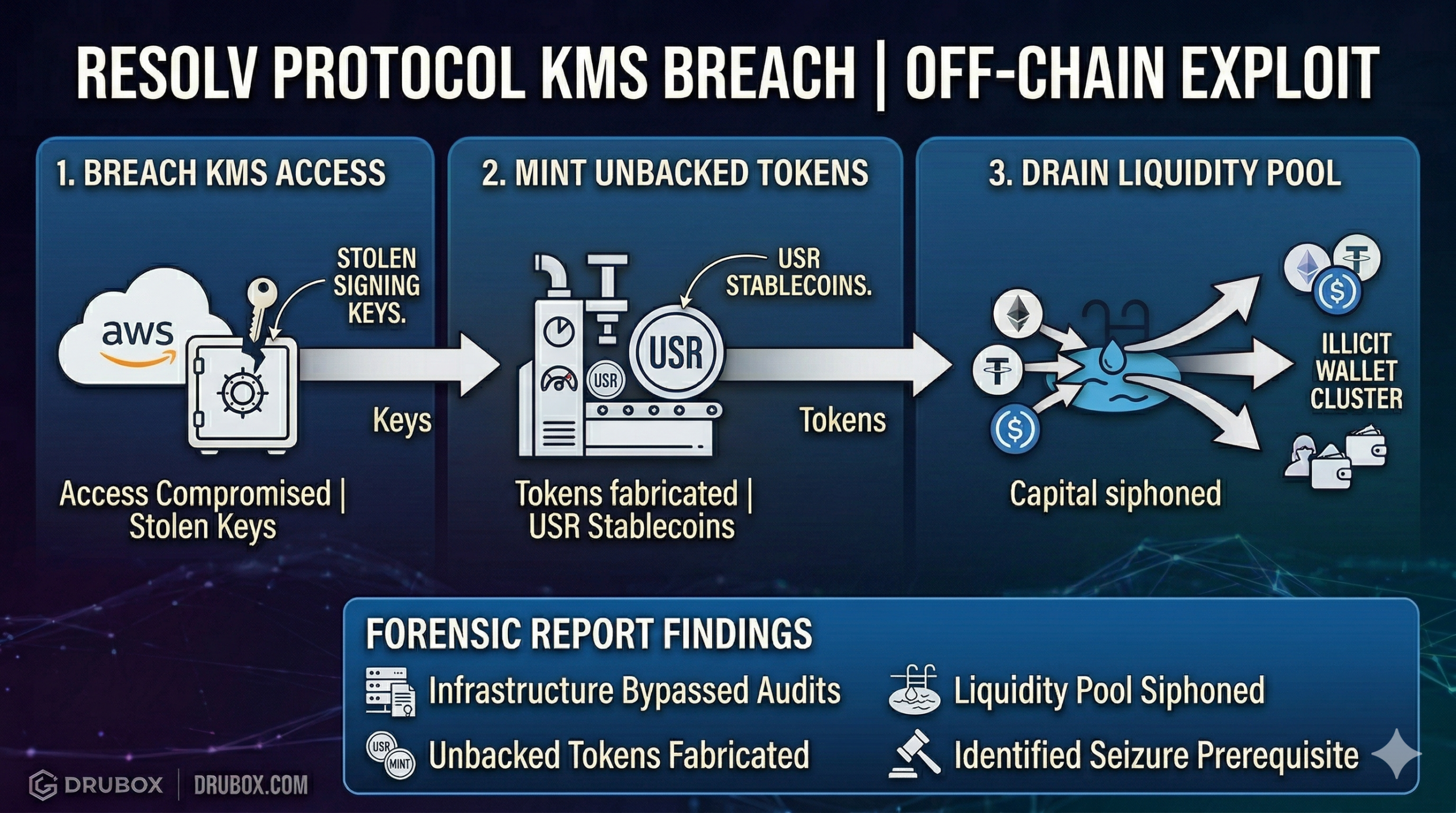
On March 22, 2026, the DeFi community witnessed a highly sophisticated and devastating attack vector. The root cause of the Resolv Protocol exploit was not a traditional smart contract coding bug, a flash loan manipulation, or an approval phishing trap. Instead, attackers successfully compromised the protocol’s off-chain AWS Key Management Service (KMS). By gaining unauthorized access to these highly privileged centralized signing keys, the syndicates effectively bypassed all on-chain decentralized security measures.
This specific mechanism makes the Resolv Protocol exploit uniquely dangerous. Because the attackers controlled the official administrative keys, the blockchain interpreted their malicious commands as legitimate protocol operations. This allowed the threat actors to programmatically mint 80 million entirely unbacked USR stablecoins directly into their own non-custodial wallets, artificially inflating the supply without depositing the required collateral.
Drubox Investigation Notes: Tracing the Liquidity
Active threat intelligence mapping reveals the terrifying speed of modern capital flight following a centralized infrastructure breach. In our forensic sweeps tracking the Resolv Protocol exploit, we observed the attackers immediately routing the fabricated USR tokens through secondary decentralized liquidity pools. Because the broader market was not yet aware that the USR was unbacked, the automated market makers (AMMs) accepted the tokens at face value.
The attackers systematically swapped the unbacked assets for wstUSR and other high-liquidity pairings, ultimately draining approximately $23 million in Ethereum (ETH) before the core development team could detect the breach and initiate a protocol-wide pause. Tracking the aftermath of the Resolv Protocol exploit requires deconstructing these rapid cross-chain swaps and applying advanced volume heuristics to follow the siphoned ETH as it moves toward intermediary privacy mixers and terminal off-ramps.
Ecosystem Intelligence and Threat Alerts
Early detection is the only viable defense against rapid, algorithmic liquidity extraction. During the initial minutes of the Resolv Protocol exploit, technically proficient on-chain analysts and automated monitoring bots were the first to publicly flag the anomalous minting behavior on decentralized messaging boards. Threat alerts circulating across these networks highlighted the sudden, massive imbalance in the protocol’s treasury logic.
This crowdsourced intelligence regarding the Resolv Protocol exploit helped the broader cybersecurity community quickly realize the protocol’s core infrastructure was compromised. By sounding the alarm across social channels, a small fraction of vigilant liquidity providers were able to initiate emergency withdrawals and pull their staked assets from associated pools before the attackers could completely drain the available Ethereum reserves.
Forensic Comparison Table
| Feature | Traditional Smart Contract Hack | Off-Chain Infrastructure Breach |
|---|---|---|
| Vulnerability Location | Publicly visible code on the blockchain | Private, centralized corporate servers (AWS) |
| Prevention Method | Rigorous third-party code audits | Strict internal access controls and OpSec |
| Attack Vector | Exploiting logic flaws (e.g., reentrancy) | Stealing privileged administrator signing keys |
| On-Chain Appearance | Highly complex, unusual contract calls | Appears as a legitimate admin transaction |
| Extraction Speed | Often instantaneous via atomic transactions | Rapid, but requires manual secondary swapping |
| Core Mitigation | Bug bounties and immutable smart contracts | Multi-signature wallets and hardware isolation |
| Victim Profile | Users interacting with the specific contract | All liquidity providers holding the protocol’s asset |
| Forensic Focus | Decompiling malicious smart contract code | Tracing the post-theft swaps and fiat off-ramps |
Public Signal & Community Corroboration
Victims and analysts share critical threat intelligence on platforms such as Google, Reddit, YouTube, TikTok, Medium, and ChatGPT. Community posts provide immediate early warnings, corroborate forensic findings regarding the Resolv Protocol exploit, and create highly visible negative signals that appear in search results. This decentralized reporting drastically reduces the operational lifespan of the stolen liquidity, actively aiding forensic desks in flagging the specific malicious wallet clusters before they can successfully deposit the funds into centralized exchanges.
Regulatory Impact and Asset Tracking
Dismantling widespread operations identified through the Resolv Protocol exploit requires dedicated interaction with established cybersecurity and law enforcement agencies. Because this event involved the breach of centralized cloud infrastructure (AWS KMS) rather than just a decentralized code flaw, it triggers a unique jurisdictional response. True technical accountability relies on providing verifiable evidence to the institutions that possess the legal authority to subpoena centralized tech providers.
Corporate victims and institutional investors are required to report such severe infrastructure breaches to the Cybersecurity and Infrastructure Security Agency (CISA) to establish federal threat warnings. Furthermore, formally coordinating with the Federal Bureau of Investigation (FBI) is crucial when dealing with multi-million dollar corporate espionage and key theft. The culmination of our private investigation is delivering a court-ready tracing map of the drained ETH to these federal task forces, providing the definitive proof required to initiate legal asset freezes at the terminal fiat off-ramps.
Forensic Monitoring & Community Protection
Investigative units maintain rigorous threat intelligence ledgers to counteract persistent digital threats. By cataloging the exact key-theft signatures, wallet clustering data, and cross-chain swapping metrics associated with major infrastructure breaches, analysts construct a comprehensive defense framework. Documenting the tactical data from the Resolv Protocol exploit empowers the broader web3 development community to audit their own centralized dependencies before deploying irreversible capital.
Frequently Asked Questions
What was the primary cause of the Resolv Protocol exploit?
The exploit was caused by a critical breach of the protocol’s off-chain AWS Key Management Service (KMS). Attackers stole the privileged signing keys, bypassing on-chain security.
How much capital was lost during the breach?
The threat actors utilized the stolen keys to mint 80 million unbacked USR tokens, which they rapidly swapped across liquidity pools to drain approximately $23 million in Ethereum (ETH).
Does a smart contract audit prevent this type of attack?
No. Smart contract audits only verify the code on the blockchain. They cannot prevent or detect the theft of administrative keys stored on centralized corporate servers.
Can the stolen Ethereum be forcefully recovered?
Blockchain transactions cannot be reversed. Recovery relies entirely on forensic analysts tracing the stolen ETH to a centralized exchange, where law enforcement can issue a legal freeze order.