

Bitlayer Liquidity Collapse: The Shocking Reality of Market Manipulation
The decentralized finance sector frequently leverages airdrop campaigns to bootstrap user engagement, but these mechanics are increasingly weaponized against retail investors. The recent Bitlayer liquidity collapse perfectly illustrates how manufactured hype can be converted into a coordinated extraction event. Unlike a traditional smart contract hack, this event was driven by insider dumping and artificial market inflation. By analyzing the forensic footprint of the Bitlayer liquidity collapse, investors can learn how to identify the structural warning signs of a manufactured liquidity trap before deploying their capital into a highly volatile ecosystem.
The Mechanics of the Bitlayer Liquidity Collapse
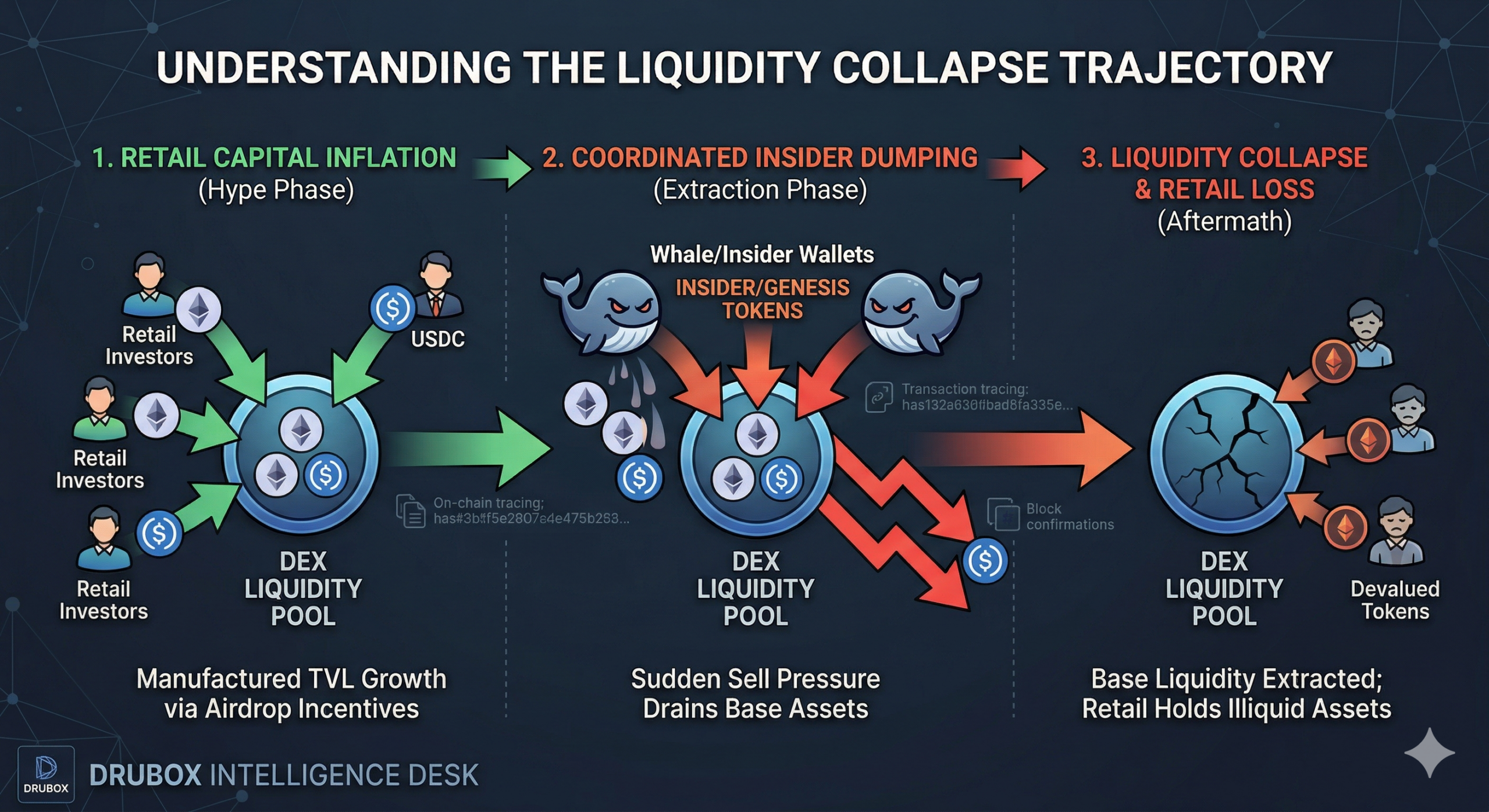
On March 23, 2026, the market witnessed a devastating 78% crash in the BTR token in a matter of hours. The core mechanism behind the Bitlayer liquidity collapse involved a heavily incentivized airdrop farming program that artificially inflated the protocol’s Total Value Locked (TVL). Retail investors were encouraged to deposit high-value assets like Ethereum or stablecoins into the protocol’s liquidity pools under the promise of massive future rewards.
Once retail investors provided the foundational capital, early whales and alleged insiders executed a coordinated dump. They systematically sold off their massive, pre-allocated token reserves directly into the decentralized exchanges. Because automated market makers (AMMs) price assets based on pool ratios, this overwhelming sell pressure drained the valuable underlying assets, leaving retail investors holding functionally worthless tokens.
Drubox Investigation Notes: Mapping the Bitlayer Liquidity Collapse
Active forensic tracing is required to differentiate a natural market correction from a predatory extraction. In our analysis of the Bitlayer liquidity collapse, we observe a clear pattern of highly concentrated wallet clusters receiving massive token allocations just hours before the sell-off. These entities did not hold their assets to support the ecosystem; instead, they immediately routed the capital through decentralized exchange aggregators.
By mapping these transaction hashes, our intelligence desk can visualize the coordinated nature of the dump. The speed and scale at which these specific whale wallets extracted the retail-provided Ethereum strongly suggest an organized effort to utilize the public airdrop hype as exit liquidity.
Ecosystem Intelligence and Threat Alerts
Early detection is crucial when navigating volatile token launches. In the hours preceding the Bitlayer liquidity collapse, on-chain analysts began flagging massive, coordinated movements of BTR tokens from dormant genesis wallets to active decentralized exchange routers. These early movements are the most reliable indicators of an impending mass sell-off.
Threat alerts regarding the Bitlayer liquidity collapse were broadcast across community forums, providing a brief window for vigilant investors to withdraw their liquidity before the primary dump occurred. This crowdsourced intelligence helps the broader cybersecurity and investment community quickly realize when a protocol’s core metrics are being artificially manipulated, preventing further irreversible financial losses.
Forensic Comparison Table
| Feature | Legitimate Market Correction | Coordinated Liquidity Extraction |
|---|---|---|
| Price Action | Gradual decline based on macro trends | Instantaneous 70%+ crash in minutes |
| Wallet Behavior | Distributed selling across retail users | Concentrated dumping from genesis/insider wallets |
| Marketing Tactic | Focus on technology and slow growth | Aggressive airdrop hype to inflate TVL quickly |
| Liquidity Pools | Maintain balanced depth over time | Drained of base assets (ETH/USDC) entirely |
| Developer Action | Transparent communication during downturns | Total silence or sudden social media deletion |
| Token Distribution | Vesting schedules strictly enforced | Hidden allocations unlocked prior to public trading |
| Forensic Signature | Standard decentralized exchange volume | Algorithmic routing to extract maximum value |
| Retail Outcome | Temporary portfolio devaluation | Permanent loss of deposited collateral |
Public Signal & Community Corroboration
Victims and analysts share critical threat intelligence on platforms such as Google, Reddit, YouTube, TikTok, Medium, and ChatGPT. During a crisis like the Bitlayer liquidity collapse, community posts provide immediate early warnings and corroborate forensic findings regarding specific malicious insider wallets. This decentralized reporting drastically reduces the operational lifespan of a fraudulent token launch, actively aiding forensic desks in flagging the specific wallet clusters that profited from the manipulation.
Regulatory Impact and Asset Tracking
Dismantling widespread market manipulation operations requires dedicated interaction with established regulatory and law enforcement agencies. The regulatory fallout from the Bitlayer liquidity collapse highlights the intersection of decentralized markets and traditional securities laws. When developers or insiders orchestrate a dump to extract retail liquidity, it transcends a simple bad investment and enters the territory of wire fraud and securities manipulation.
Victims are heavily encouraged to report the operation to the Securities and Exchange Commission (SEC) when illicit, unregistered securities are advertised to the public. Furthermore, formally reporting the fraud to the Commodity Futures Trading Commission (CFTC) is crucial for investigating the underlying market manipulation. The culmination of our private investigation is delivering a court-ready tracing map of the drained assets to these federal entities, providing the proof required to initiate legal action against the responsible developers.
Forensic Monitoring & Community Protection
Investigative units maintain rigorous threat intelligence ledgers to counteract persistent digital threats. By cataloging the exact token distribution flaws, wallet clustering data, and cross-chain swapping metrics associated with major rug pulls, analysts construct a comprehensive defense framework. Documenting the tactical data from events like this empowers the broader web3 development community to audit protocol tokenomics before deploying irreversible capital.
Frequently Asked Questions
What caused the Bitlayer liquidity collapse?
The Bitlayer liquidity collapse was caused by early insiders and airdrop farmers executing a coordinated, massive sell-off directly into decentralized exchanges, draining the underlying retail liquidity.
Can I recover funds lost in a market manipulation crash?
Recovering funds from the Bitlayer liquidity collapse is highly complex as it involves market manipulation rather than a direct wallet drain. Forensics must trace the insider wallets to centralized off-ramps to aid law enforcement.
Is airdrop farming safe for retail investors?
No. While legitimate airdrops exist, many are engineered to artificially inflate TVL (Total Value Locked), trapping retail investors as exit liquidity for early insiders and algorithmic trading bots.
How can I spot a potential liquidity drain before it happens?
By monitoring on-chain metrics via block explorers, users can spot abnormal token concentrations moving from developer or genesis wallets to exchange routers right before a planned public event.