

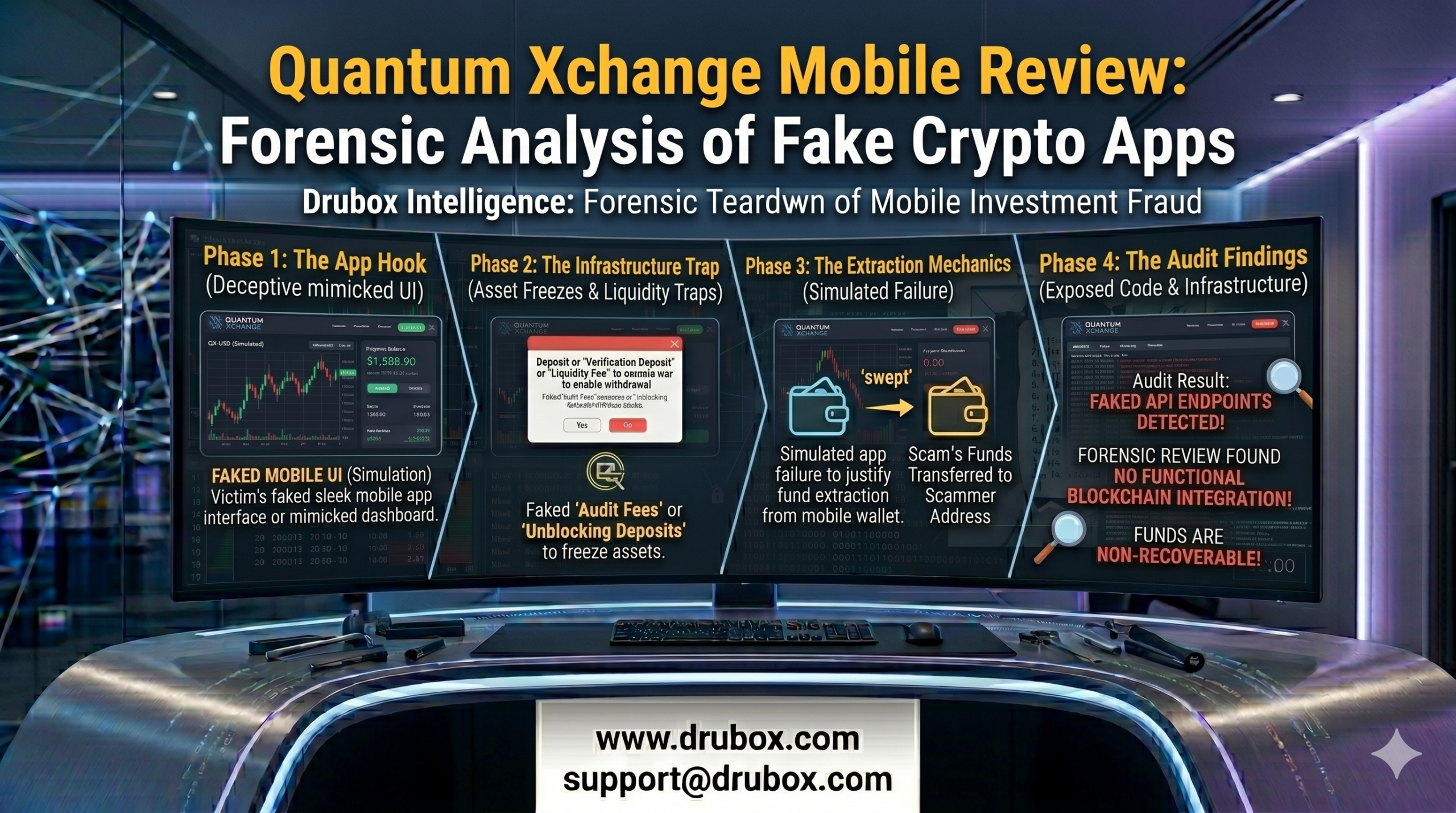
Quantum Xchange Mobile Forensic Review: Analyzing Malicious Trading Apps and Asset Freezes
Digital asset investigators are tracking a highly deceptive mobile trading interface operating across unverified subdomains. Users interacting with this application are urgently asking our forensic desk: Is Quantum Xchange Mobile a scam? Based on infrastructure tracing, this platform operates as a fraudulent mobile clone, trapping victim liquidity through restricted dashboard interfaces.
The financial impact is often characterized by total capital loss as operators systematically sever communication. While automated asset reversals are impossible on the blockchain, professional forensic tracing provides a definitive pathway to map the stolen liquidity to centralized off-ramps for potential regulatory interception.
Malicious mobile trading applications frequently bypass official app store security protocols by utilizing third-party provisioning profiles to execute unauthorized digital asset transfers.
The Architecture of Mobile Clone Networks
To properly deconstruct this digital threat, forensic analysts must evaluate the deployment mechanisms of unverified applications. Authentic global cryptocurrency exchanges develop proprietary mobile architecture that undergoes rigorous security audits by official platforms like the Apple App Store or Google Play. Unregulated entities circumvent these heavily monitored ecosystems by distributing their applications via obscure subdomains and direct download links.
Operators frequently utilize side-loading techniques or exploit developer testing environments to force the installation of their software. When an investor downloads the application, they are presented with a highly sophisticated frontend interface that seamlessly mimics tier-one trading platforms. However, the rapid price fluctuations and climbing portfolio balances displayed on the mobile screen are entirely simulated by the platform’s administrators.
This psychological manipulation leverages the convenience of mobile trading to dismantle a user’s risk awareness. Victims are encouraged to continually inject fresh fiat currency or transfer large sums of digital assets from their secure wallets. They operate under the false belief that their mobile application is executing real-time trades on the global financial markets.
Analyzing Quantum Xchange Mobile Withdrawal Problems
The deceptive nature of this simulated mobile exchange becomes apparent only when an investor attempts to liquidate their perceived trading gains. The application is technically engineered to accept inbound cryptocurrency deposits instantly and without administrative friction. Yet, the exact moment a payout is requested, severe Quantum Xchange Mobile withdrawal problems are unilaterally triggered.
Users attempting to execute an outbound transfer from their mobile device are confronted with a highly coordinated blockade that defies standard banking protocols. The application’s integrated “customer support chat” abruptly pivots from being helpful to introducing arbitrary, undocumented hurdles. These restrictions are explicitly designed to trap the user’s capital permanently within the operator’s control.
The cornerstone of this mobile extortion phase is the sudden weaponization of network security terminology. Users conducting a Quantum Xchange Mobile review frequently report that the platform demands an exorbitant “mobile wallet synchronization fee” or an “AML routing tax” before any withdrawal can be processed. Crucially, the operators insist that these fabricated penalties cannot be deducted from the user’s inflated digital balance; they must be wired as fresh cryptocurrency payments.
Arbitrary app lockouts paired with sudden demands for upfront mobile upgrade fees are definitive indicators of an offshore liquidity trap designed to extract final payments.
Drubox Risk Intelligence Registry
This section is a Drubox internal forensic database layer used for cross-case comparison and to detect infrastructure similarity. It is NOT a general warning page, external intelligence, or promotional content.
Our intelligence desk leverages domain infrastructure correlation to map the highly irregular subdomains associated with this mobile portal. By comparing the specific URL structures (such as transhipservice.com extensions), IP routing pathways, and SSL certificate anomalies against a vast archive of documented liquidity traps, our analysts can determine if this app is a newly launched node operated by a known clone network.
Forensic Methodology: Unmasking Mobile Laundering Pathways
Dismantling a simulated mobile exchange demands the uncompromising execution of advanced digital forensics. When an investor transfers assets through these unverified applications, the capital is immediately diverted from any secure custodial environment. It is systematically routed directly into unhosted wallets controlled by the syndicate.
Through persistent heuristic tracking algorithms, our analysts map the exact cryptographic journey of the stolen funds originating from the mobile interface. We meticulously follow the capital as it is fractionalized and layered through complex decentralized transaction mixers. We also monitor the digital assets as they move across cross-chain bridges used to obscure the final laundering destination.
Simultaneously, rigorous domain analysis frequently uncovers the truth behind the app’s backend architecture. We often find that the APIs feeding the mobile dashboard are hosted on bulletproof offshore servers designed to completely mask the deployer’s identity. The ultimate objective of this rigorous tracing is off-ramp identification—pinpointing the precise centralized exchanges where the threat actors intend to liquidate the stolen assets.
Intelligence Findings Report
Purpose: A platform-specific forensic intelligence snapshot used as an editorial signature within each article. This section reflects observed patterns and reported behaviors, not verified facts.
Reports indicate that the operational profile of Quantum Xchange Mobile heavily relies on distributing unverified application packages through masked subdomains. Users commonly report that in-app support agents deploy severe intimidation tactics, refusing to process mobile withdrawals until a 15% to 20% “network node verification deposit” is paid.
Infrastructure observations suggest the network utilizes cloned frontend code to perfectly mimic legitimate exchange applications, while simultaneously routing all inbound user deposits directly to unhosted offshore cold wallets. Furthermore, complaint pattern analysis reveals a consistent escalation strategy where victims are threatened with device-level account deletion if clearance fees are ignored. If you hold assets in this application, patterns suggest you should immediately halt all deposits and do not comply with any subsequent fee demands.
The Critical Void in Mobile Regulatory Oversight
Authentic digital asset exchanges require absolute adherence to institutional transparency and global financial statutes. Genuine brokerages offering mobile trading are legally bound to submit to the rigorous audits of tier-one regulators. These include the SEC and the CFTC in the United States, the FCA in the United Kingdom, or ASIC in Australia.
These authorities guarantee that retail capital is safeguarded in segregated accounts and that mobile applications are devoid of malicious code. Unverified portals aggressively bypass these legal safeguards by operating entirely outside of official app marketplaces. Consequently, major enforcement agencies, including the FTC and the IC3, continually issue critical alerts regarding the explosion of unregulated offshore applications utilizing simulated order books.
To combat this complete lack of oversight, digital forensic experts must utilize specialized techniques—such as mobile packet sniffing, wallet clustering, and heuristic transaction routing mapping. This forceful, data-driven approach is the only verified method to unmask the illicit operations hiding behind sleek mobile branding.
Realizing that a trusted mobile application is actively holding your assets hostage is a deeply jarring psychological event. You must understand that these unregulated applications are engineered by highly organized threat syndicates specifically to manipulate your financial trust. The most critical immediate action you can take is to cease all negotiations via the app, delete any unverified configuration profiles from your device, and securely archive all transaction hashes.
Crowdsourced Intelligence & Community Alerts
As anomalies and app-level lockouts multiply, impacted mobile traders are swiftly leveraging digital channels to document the exact mechanics of this operation. It is highly recommended to continuously monitor Google search results for newly indexed mobile blacklists and platform warnings. Victims are actively crowdsourcing their forensic evidence, sharing the specific extortion scripts used against them within Reddit discussions.
Simultaneously, independent digital researchers are breaking down the fabricated application data via YouTube investigations.
App Infrastructure Evaluation Matrix
| Feature | Legitimate Platform | Scam Platform |
|---|---|---|
| Regulatory Status | Verified licenses from SEC, FCA, ASIC | Unverified offshore operations |
| App Distribution | Official iOS App Store and Google Play | Side-loaded APKs or malicious web profiles |
| Withdrawal Execution | Automated, transparent process | Blocked by arbitrary mobile sync fees |
| Tax Processing | Handled off-platform or deducted internally | Demanded upfront via fresh crypto deposits |
| Asset Custody | Institutional cold storage | Routed immediately to unhosted wallets |
| Customer Support | Audited communication channels | In-app messaging disconnected at will |
| Clearance Protocols | Standard KYC during onboarding | Fabricated AML fees required to withdraw |
| Domain URL | Standard verified corporate domains | Irregular subdomains (e.g., transhipservice) |
Frequently Asked Questions (FAQ)
Is Quantum Xchange Mobile legit and properly registered as a global exchange?
No. Reports indicate that this entity operates without verified regulatory oversight from major financial authorities such as the SEC, CFTC, FCA, or ASIC. Engaging with an unverified mobile platform distributed outside official app stores removes all standard institutional safeguards.
Can I safely bypass the withdrawal freeze on my app?
It depends. While a small fraction of users report being permitted to withdraw negligible amounts early on to build false trust, the vast majority experience complete account freezes. This systematic lockout usually occurs when attempting to extract their principal capital or simulated gains.
Should I pay the requested mobile verification fee to release my assets?
No. Legitimate financial brokerages and digital exchanges do not require users to deposit fresh cryptocurrency to cover arbitrary synchronization taxes or clearance fees. Patterns suggest these demands are pure extortion tactics utilized to extract further capital before communication is severed.
Will professional blockchain tracing assist in locating my digital assets?
Yes. Professional wallet tracing is highly recommended to document the exact cryptographic flow of funds from the simulated mobile app to centralized off-ramps. This creates the verified intelligence package required for potential legal or regulatory interception.
Initiate a recovery intelligence review