

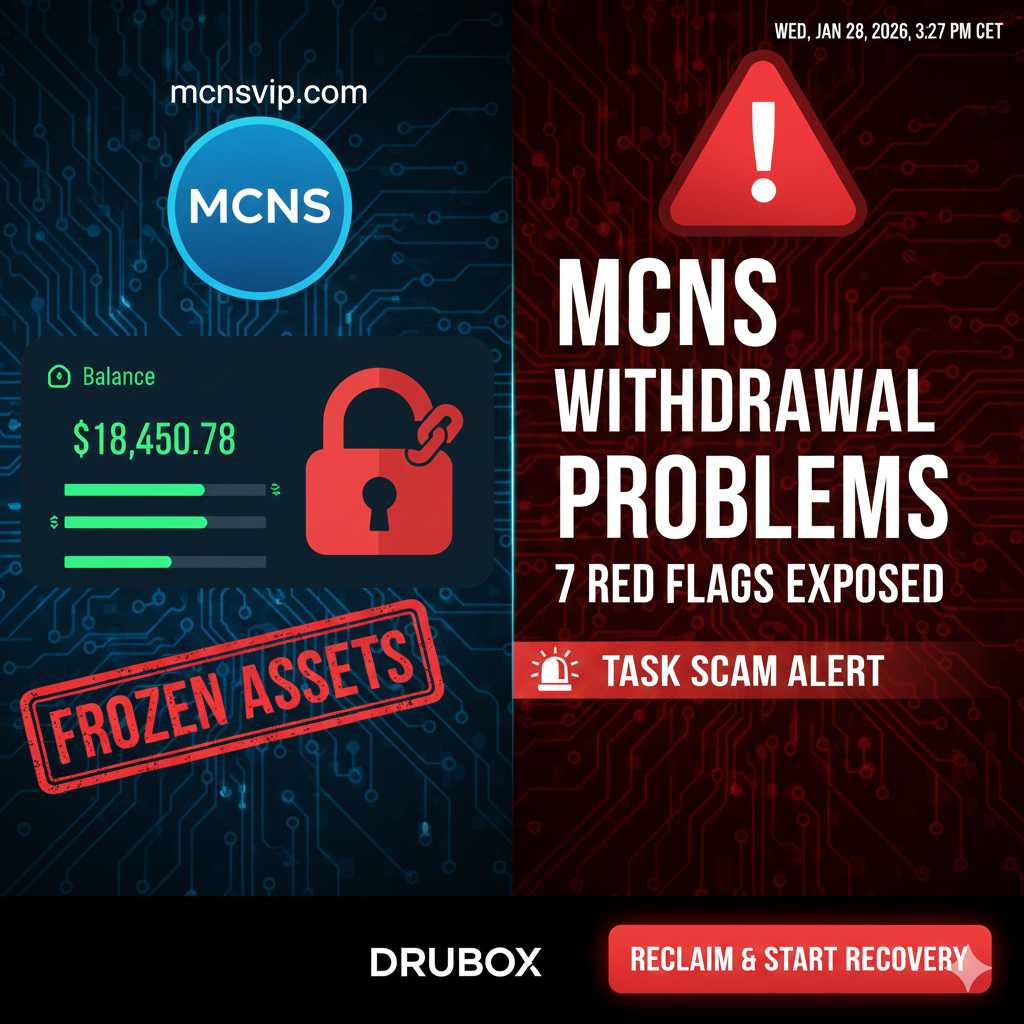
MCNS Withdrawal Problems: Forensic Analysis of Account Freezes and Capital Restriction Architecture
Reports of mcns withdrawal problems frequently emerge after investors attempt to access profits displayed on their trading dashboards. In many cases, withdrawal attempts trigger compliance narratives, tax demands, or unexplained account freezes. When capital release becomes conditional on additional deposits, structural risk indicators intensify significantly.
Understanding the Structure Behind MCNS Withdrawal Problems
Not all withdrawal delays indicate fraud. Regulated platforms may temporarily restrict withdrawals for:
-
Identity verification
-
AML screening
-
Large transaction review
-
Security confirmation
However, mcns withdrawal problems often follow a distinct pattern:
-
Initial deposits process normally
-
Dashboard profits increase steadily
-
An assigned advisor encourages additional funding
-
Withdrawal attempts trigger friction
That friction frequently includes:
-
Mandatory tax prepayment
-
“Security deposit” requirements
-
Compliance certification fees
-
Sudden mcns account freeze notifications
The sequencing is critical.
When restrictions only activate after profits accumulate, structural intent must be examined.
Liquidity Simulation and Performance Signaling
A core forensic element in mcns withdrawal problems is dashboard-based performance signaling.
Investors may see:
-
Stable daily returns
-
Automated AI trading claims
-
Consistent portfolio appreciation
-
Tiered account upgrades
Yet performance visibility does not equal execution transparency.
Legitimate exchanges provide:
-
Trade execution IDs
-
Order book integration
-
Liquidity provider disclosures
-
Audit-verifiable records
Without third-party confirmation, displayed balances may represent internal database adjustments rather than executed trades.
Profit simulation is a common retention tool in withdrawal-restriction fraud environments.
Custody Transparency and Asset Control
MCNS deposit mechanics should be evaluated through a custody lens.
Legitimate trading platforms maintain:
-
Segregated client accounts
-
Audited cold wallet reserves
-
Documented withdrawal policies
-
Clear insurance disclosures
In contrast, high-risk structures often involve:
-
Direct crypto transfers to private wallets
-
No segregated custody disclosures
-
No proof-of-reserves documentation
-
Discretionary withdrawal authority
Once cryptocurrency leaves a personal wallet and enters an opaque custodial environment, recovery probability becomes dependent on post-transfer routing.
Custody opacity strengthens mcns withdrawal problems risk classification.
Withdrawal Restriction Engineering
The architecture of withdrawal barriers often follows a deliberate escalation model.
Indicators include:
-
Increased withdrawal minimums
-
Tier upgrade requirements
-
Tax prepayment instructions
-
KYC re-verification after profit growth
-
Formal mcns account freeze notifications
In regulated platforms, compliance procedures occur before trading access — not after profit display.
If additional capital is required to unlock existing balances, the operational design aligns with retention architecture rather than compliance review.
Tax Demand and Clearance Narratives
A recurring component in mcns withdrawal problems is fabricated tax or clearance requirements.
Users may be informed that:
-
A percentage of profits must be prepaid
-
Government authorization requires deposit
-
International tax clearance is mandatory
-
Account reactivation requires funding
This narrative is structurally inconsistent with regulatory practice.
Tax liabilities are reported to official authorities — not prepaid through private crypto dashboards.
When tax escalation appears during withdrawal attempts, structural fraud alignment increases significantly.
Capital Routing and Blockchain Fragmentation
Forensic review must examine post-deposit asset movement.
High-risk trading platforms often:
-
Convert assets to stablecoins immediately
-
Split funds across intermediary wallets
-
Bridge assets across chains
-
Consolidate funds at offshore exchanges
This layered routing reduces freeze windows and fragments jurisdictional enforcement.
If funds leave traceable custodial systems quickly, recovery probability declines sharply.
Understanding dispersion behavior is central to mcns withdrawal problems analysis.
Behavioral Reinforcement and Deposit Pressure
Behavioral tactics frequently accompany withdrawal restrictions.
Patterns include:
-
Assigned personal advisors
-
Encouragement to “increase position”
-
Time-sensitive bonus offers
-
Discouragement from external consultation
When advisory pressure increases simultaneously with mcns account freeze notices, structural fraud risk escalates.
Comparative Structural Evaluation
| Category | Regulated Platform Model | Capital Restriction Model |
|---|---|---|
| Regulatory Oversight | Publicly verifiable | Opaque or unverifiable |
| Custody Model | Segregated audited reserves | Aggregated operator wallets |
| Withdrawal Logic | Balance-deducted fees | External payment requirement |
| Tax Handling | Official reporting process | Prepaid tax narrative |
| Compliance Timing | Pre-trade verification | Post-profit escalation |
| Communication | Neutral support teams | High-pressure advisors |
| Asset Routing | Transparent custodial movement | Rapid multi-wallet dispersion |
| Account Suspension | Documented review policy | Sudden mcns account freeze |
Structural alignment within mcns withdrawal problems suggests a capital retention framework rather than regulated exchange operations.
Regulatory Perspective
Before transferring funds to any online trading entity, investors should verify:
-
Corporate registration
-
Licensing authority
-
Public enforcement actions
-
Domain age and ownership
Authorities such as the FBI IC3 consistently warn that prepaid tax narratives and withdrawal restriction models are core components of cryptocurrency fraud.
If verification fails and withdrawal barriers persist, risk classification shifts materially.
Forensic Monitoring & Community Protection
Drubox monitors platforms exhibiting withdrawal restriction engineering, fabricated tax escalation, and liquidity simulation patterns consistent with global crypto fraud syndicates.
Public discussion surrounding mcns withdrawal problems frequently appears across Google search queries, user reports on Reddit, investigative breakdowns on YouTube, short-form alerts on TikTok, analytical commentary on Medium, and inquiry prompts explored through ChatGPT. Many users specifically reference mcns account freeze experiences during withdrawal attempts.
Risk Assessment Summary
The structural convergence observed in mcns withdrawal problems includes:
-
Regulatory opacity
-
Liquidity simulation
-
Withdrawal restriction architecture
-
Prepaid tax narratives
-
Rapid capital dispersion
-
Behavioral reinforcement tactics
When these elements operate simultaneously, the probability of fraudulent operational design increases significantly.
MCNS demonstrates characteristics consistent with high-risk withdrawal restriction frameworks and warrants caution.
FAQ
Are MCNS withdrawal problems normal compliance delays?
No. While temporary compliance reviews occur in regulated platforms, escalating deposit demands and prepaid tax narratives are structural red flags.
Does a legitimate exchange require tax prepayment before withdrawal?
No. Legitimate platforms deduct applicable fees internally and report tax obligations through official channels.
Can funds be recovered after an MCNS account freeze?
Yes. Recovery may be possible if assets remain within traceable custodial systems. Once dispersed across offshore exchanges, recovery probability declines.
Is an assigned account manager proof of legitimacy?
No. High-pressure advisory structures are frequently used in capital retention models to accelerate deposits and discourage independent verification.