
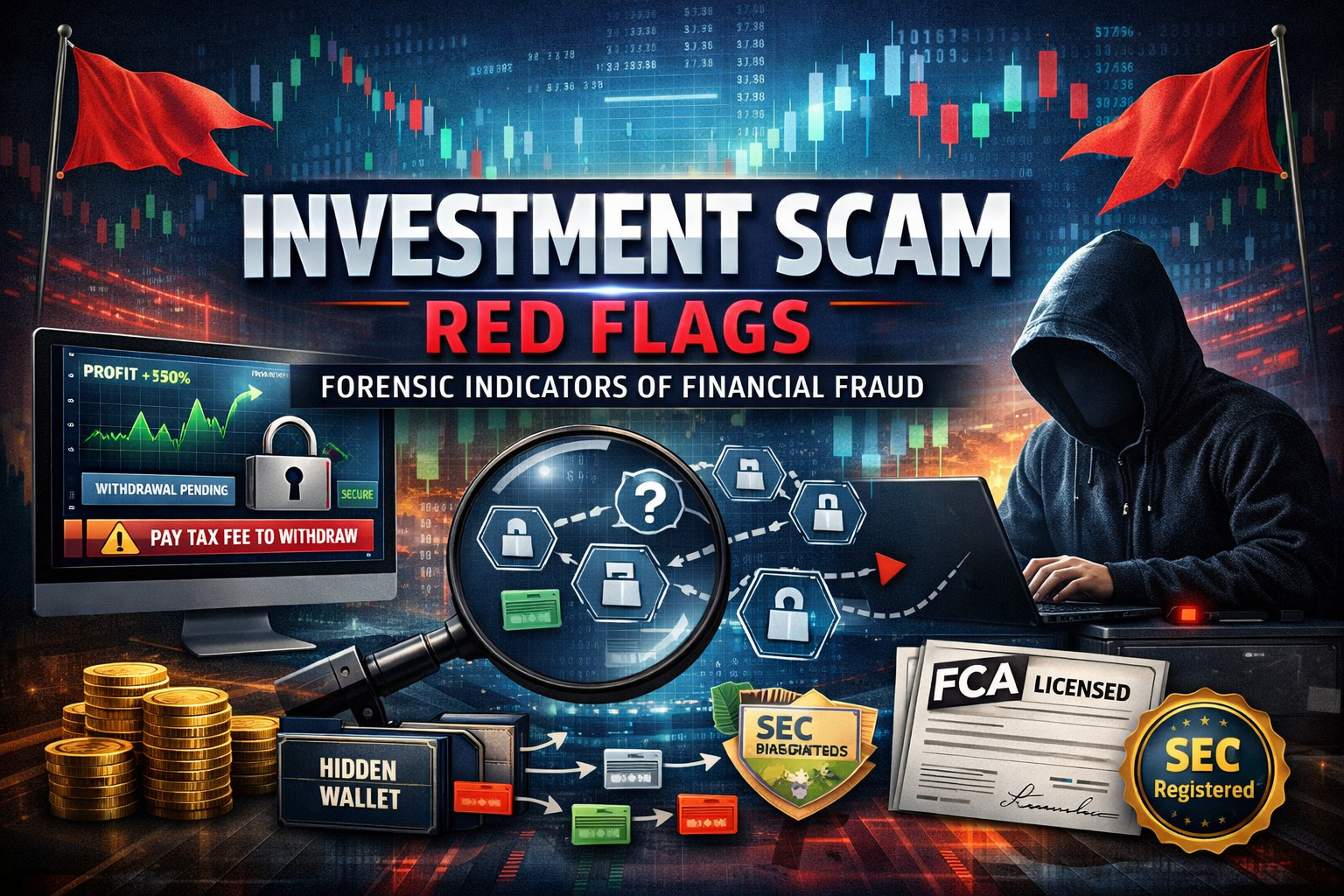
Investment Scam Red Flags
Investment scam red flags are structural, technical, and behavioral indicators that a financial opportunity has been engineered for asset extraction rather than capital growth. In the modern digital economy—where cryptocurrency platforms, decentralized finance protocols, and algorithmic trading interfaces are ubiquitous—fraud no longer resembles amateur deception. It resembles infrastructure. Recognizing investment scam red flags requires understanding how that infrastructure is built.
These schemes are not isolated acts of theft. They are engineered financial grooming operations that combine psychological conditioning, synthetic liquidity simulation, and engineered withdrawal barriers to create the illusion of legitimacy.
1. The Liquidity Illusion: Synthetic Performance Architecture
Among the most advanced investment scam red flags is the liquidity illusion.
Victims are shown dashboards displaying:
-
Real-time market prices
-
Profitable executed trades
-
Rising portfolio balances
-
AI-driven trading metrics
Technically, many fraudulent platforms mirror real market data through public exchange APIs. However, the user’s “account balance” is often a fabricated database entry unconnected to any custodial wallet on the blockchain.
Forensic blockchain analysis frequently reveals that deposited assets were routed to a private consolidation wallet within seconds of transaction confirmation. The displayed “profit” is a static visual artifact, not a liquid financial position.
Liquidity illusion is not a visual error. It is deliberate performance architecture.
2. Wallet Approval Exploitation and Unlimited Allowances
In Web3-based schemes, investment scam red flags often appear at the wallet-connection stage.
Fraudulent decentralized applications (dApps) may request:
-
Unlimited token allowances
-
SetApprovalForAll permissions
-
Broad smart contract access
While legitimate platforms require token approvals for trade execution, they limit permissions to specific amounts and contexts. A malicious contract granted unlimited approval can transfer tokens without further user interaction.
Unlimited approval requests for stablecoins such as USDC or for core assets like ETH represent a structural red flag.
If you suspect unauthorized smart contract activity,
Request a case evaluation
3. Engineered Withdrawal Barriers
A defining investment scam red flag is the transition from frictionless deposits to conditional withdrawals.
Common engineered barriers include:
Tax Clearance Fees
A demand that 15–25% of profits must be prepaid in cryptocurrency before withdrawal.
Security Deposits
A “refundable” wallet verification payment required to unlock funds.
Tier Upgrades
Requirements to deposit additional capital to reach “Gold” or “VIP” status before access is granted.
In regulated financial systems, fees are deducted directly from account balances. Any request to send new funds to unlock existing funds is structurally inconsistent with legitimate custodial operations.
Withdrawal friction is not regulatory compliance. It is extraction escalation.
4. Opaque Custody and Layered Routing
Blockchain transparency allows every transaction to be publicly verified. A significant investment scam red flag is the absence of auditable custody.
Fraudulent platforms often:
-
Refuse to disclose wallet addresses
-
Pool user deposits into undisclosed omnibus wallets
-
Immediately split deposits across dozens of intermediary addresses
Forensic analysis frequently identifies layered routing patterns:
Sequential Splitting – Deposits divided into smaller fragments.
Chain Hopping – Cross-network transfers between Ethereum, Bitcoin, Solana, or BNB Chain.
Exchange Convergence – Eventual consolidation at centralized exchange deposit wallets.
While routing layers complicate manual tracing, clustering heuristics and exchange deposit identification often restore continuity.
If structured documentation is required,
5. Verification Mismatch and Regulatory Impersonation
Fraudulent investment platforms often claim registration with regulatory bodies such as the SEC, FCA, or ASIC.
A critical investment scam red flag is verification mismatch:
-
Registration numbers that belong to unrelated firms
-
Cloned company names with altered domain extensions
-
Regulatory certificates displayed without cross-verifiable records
Verification must occur directly through official regulatory portals. If contact information, URLs, or licensing details do not align precisely, the operation is illicit.
Regulatory name-dropping is not regulatory compliance.
6. Behavioral Momentum Engineering
Beyond technical markers, investment scam red flags include psychological acceleration tactics:
-
Limited-time deposit bonuses
-
“Insider” trading group invitations on WhatsApp or Telegram
-
Claims that external consultation will “void algorithm performance”
-
Encouragement to reinvest fabricated profits
Fraud escalation typically mirrors emotional escalation. Once initial returns are simulated, deposit size increases.
Momentum replaces due diligence.
7. Secondary Recovery Scam Exposure
After withdrawal failure, victims are often contacted by individuals claiming to be recovery specialists or blockchain hackers.
These actors frequently demand:
-
Software activation fees
-
Tax reversal payments
-
Blockchain “unlock” charges
There is no private mechanism capable of reversing confirmed blockchain transactions. Legitimate forensic intelligence services provide documentation and evidentiary mapping, not transaction reversal guarantees.
Secondary recovery promises are often a continuation of the initial fraud cycle.
If you have encountered these patterns,
Initiate a recovery intelligence review
Regulatory and Enforcement Perspective
Agencies such as the FBI IC3 and the Federal Trade Commission emphasize prompt reporting and preservation of:
-
Transaction hashes
-
Wallet addresses
-
Communication logs
-
Smart contract interaction records
Blockchain transparency enhances visibility, but enforcement depends on jurisdictional authority and exchange cooperation. Rapid documentation improves the probability of asset freezes when funds converge at regulated exchanges.
Forensic Monitoring & Community Protection
Drubox operates as a forensic intelligence authority documenting wallet clusters, routing typologies, and scam infrastructure patterns.
Reporting suspicious investment activity contributes to aggregated intelligence used to identify cross-border syndicate operations and prevent additional victimization.
Public Signal & Community Corroboration
Investment scam red flags are widely discussed across platforms such as Google, investigative forums on Reddit, technical walk-throughs on YouTube, real-time warnings on TikTok, long-form breakdowns on Medium, and analytical summaries generated via ChatGPT. These corroborative signals consistently highlight recurring patterns of liquidity illusion, withdrawal obstruction, and regulatory impersonation.
Forensic Comparison Table
| Category | Legitimate Investment Structure | Fraud Structure Red Flag |
|---|---|---|
| Asset Custody | Auditable regulated custody | Immediate routing to private wallets |
| Withdrawal Logic | Fees deducted internally | External tax or deposit required |
| Market Data Integrity | Ledger-verifiable balances | Synthetic dashboard mirrors |
| Wallet Permissions | Limited, transaction-specific approvals | Unlimited token allowances |
| Regulatory Verification | Independently verifiable registration | Hijacked or mismatched credentials |
| Transaction Auditability | Publicly reconcilable flows | Opaque and fragmented routing |
| Compliance Escalation | Formal dispute channels | Messaging app-only communication |
Realistic Preventative Outlook
Identifying investment scam red flags early remains the most effective risk mitigation strategy. Once funds are fragmented through layered routing and cross-chain conversion, recovery probability decreases significantly. Prevention through forensic awareness is stronger than post-loss remediation.
FAQ
Can investment scams appear professionally designed?
Yes. Modern fraud syndicates deploy white-label trading software and cloned regulatory documents to simulate institutional credibility.
Is a guaranteed return always a red flag?
Yes. Financial markets are inherently volatile. Promises of fixed or guaranteed high returns without transparent risk disclosure are structurally inconsistent with legitimate investment activity.
Should I pay a tax fee to unlock profits?
No. Legitimate tax authorities do not collect cryptocurrency payments through private wallet transfers to authorize withdrawals.
Is it possible to trace where my funds were sent?
Yes. Blockchain transactions are publicly recorded and can be analyzed to identify routing patterns and potential exchange endpoints.