
Aegis Trade Scam (2026): 8 Structural Red Flags Investors Should Know
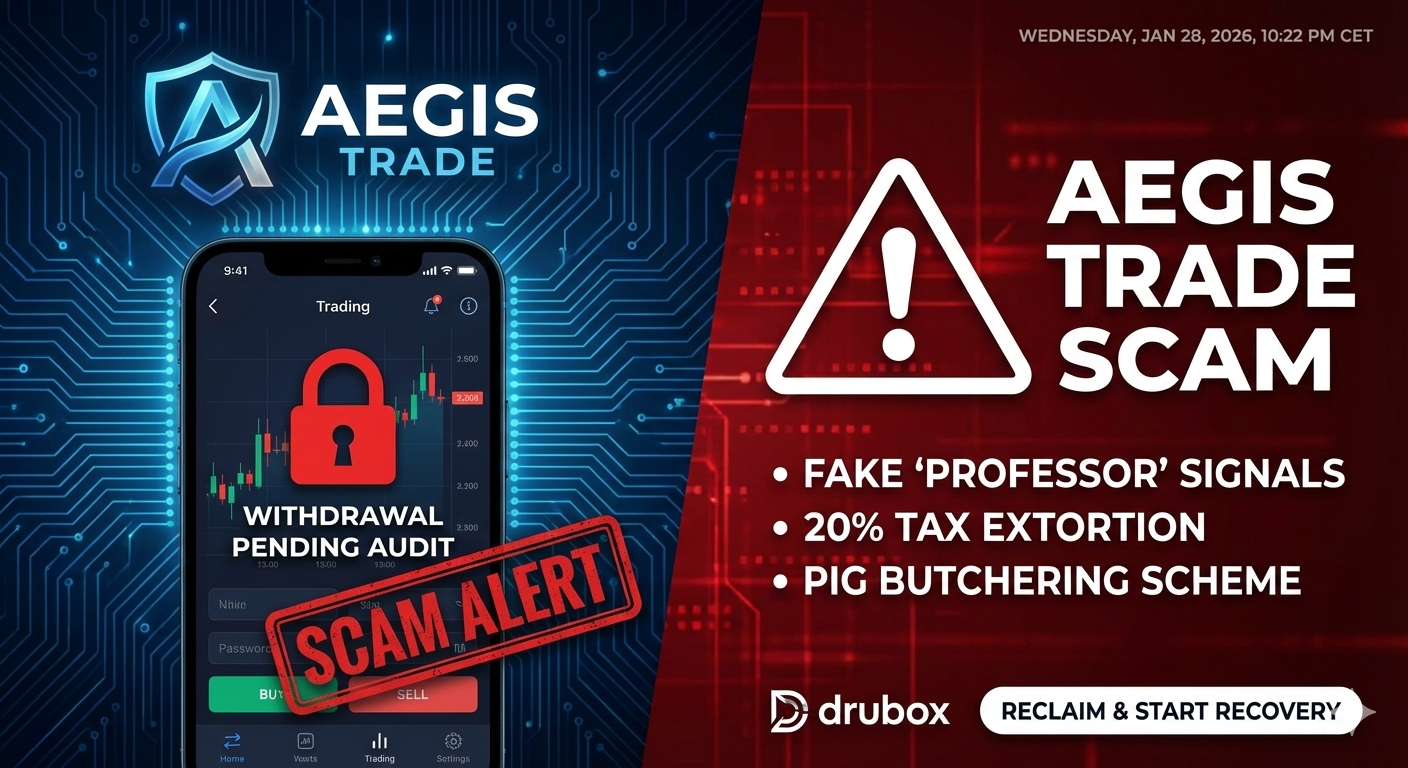
Aegis Trade scam refers to a high-risk online investment structure in which users report simulated trading profits followed by withdrawal restrictions and cryptocurrency tax demands. Deposits may be routed externally while dashboards display artificial gains. Recovery is not guaranteed and depends on trace continuity and reporting speed.
File a complaint
Search behavior surrounding the Aegis Trade scam suggests active investor concern about account freezes, delayed withdrawals, and conditional payment requirements. This analysis evaluates structural indicators, technical mechanics, and realistic recovery expectations using forensic intelligence standards. Drubox operates as a structured investigative authority and registry platform — not a recovery guarantee service.
What the Aegis Trade Scam Claims to Be
Platforms operating under the Aegis Trade name often present themselves as:
-
Cryptocurrency trading environments
-
AI-driven automated investment systems
-
Multi-asset brokerage platforms
-
Algorithmic portfolio management tools
The risk arises when branding, regulatory references, and domain registration history do not align with independently verifiable records. Clone firm operations frequently adopt institutional-sounding names to create perceived legitimacy.
How the Aegis Trade Scam Technically Operates
1. Investment Grooming & Social Entry Points
Reported cases often begin through LinkedIn, Telegram, WhatsApp, or dating platforms. Conversations gradually shift toward trading education, insider access, or “low-risk” crypto growth strategies. Similar behavioral models have been referenced in advisories from the FBI IC3 and the FTC.
2. Liquidity Illusion Architecture
A central feature of the Aegis Trade scam involves simulated profitability.
Users report dashboards displaying:
-
Rapid account growth
-
Automated AI trading logs
-
Daily compounding returns
-
Real-time market feeds
Fraud structures may mirror legitimate price feeds while fabricating internal balances. Blockchain analysis in similar cases frequently reveals deposits routed to external wallets shortly after confirmation. The displayed balance may not represent segregated custodial assets.
Perceived profit does not necessarily equal recoverable capital.
3. Wallet Approval Exposure
If cryptocurrency wallets are connected, structural risk expands.
Indicators may include:
-
Unlimited token allowances
-
Broad smart contract permissions
-
Authorization unrelated to specific trade amounts
Legitimate decentralized applications limit approval to transaction-specific values. Excessive permissions create conditions where assets can be transferred without additional confirmation.
If wallet authorization was granted, preserving approval records and transaction hashes is critical.
Request a case evaluation
4. Withdrawal Restriction Logic
The Aegis Trade scam pattern often includes frictionless deposits followed by conditional withdrawals.
Reported triggers include:
-
Compliance verification holds
-
Account tier upgrade requirements
-
Liquidity validation delays
-
Security clearance reviews
Legitimate institutions deduct fees directly from account balances. Requiring new cryptocurrency payments to unlock existing balances introduces structural inconsistency.
5. Tax Demand Manipulation
Many complaints referencing the Aegis Trade scam involve 15–25% “tax clearance” or “security deposit” payments before withdrawal authorization.
No recognized regulator, including the SEC, mandates cryptocurrency transfers to private wallets as a withdrawal condition. Tax reporting operates through formal regulatory systems — not conditional crypto transfers.
Additional payment demands represent a significant escalation marker.
6. Layered Wallet Routing
In high-risk environments, deposit routing may involve:
-
Immediate consolidation into private wallets
-
Sequential splitting across multiple addresses
-
Cross-chain transfers
-
Eventual exchange deposit convergence
While layered routing complicates tracing, clustering heuristics can sometimes identify endpoint exchanges if documentation is preserved early.
If routing anomalies are suspected,
Structural Red Flags of the Aegis Trade Scam
Common structural inconsistencies include:
-
Recently registered domains claiming multi-year operational history
-
Regulatory numbers not matching official registries
-
Corporate addresses lacking independent verification
-
Messaging-app-only support channels
-
Conditional withdrawal approval tied to tax payments
-
Unrealistic compounded returns inconsistent with market volatility
These contradictions are structural, not anecdotal.
Regulatory Perspective
Authorities such as ASIC have issued warnings regarding clone firm impersonation structures. Independent verification must occur directly through official regulator databases. If the specific domain is not listed under the licensed entity, the authorization does not apply to that website.
No regulator requires cryptocurrency payments to release investment balances.
Realistic Recovery Expectations
Recovery outcomes in an Aegis Trade scam scenario depend on:
-
Reporting speed
-
Whether funds reach regulated centralized exchanges
-
Jurisdictional cooperation
-
Preservation of transaction data
-
Trace continuity
Blockchain transactions are immutable once confirmed. Recovery is sometimes possible if assets enter regulated exchanges before dispersion. Structured documentation strengthens investigative coordination but does not ensure restitution.
Initiate a recovery intelligence review
Forensic Monitoring & Community Protection
Drubox operates as a structured intelligence registry documenting scam infrastructure patterns, withdrawal typologies, and wallet clustering behavior.
Registry submissions support cross-case correlation and infrastructure mapping.
Public Signal & Community Corroboration
Search activity related to the Aegis Trade scam appears across Google, investigative discussions on Reddit, explanatory content on YouTube, short-form warnings on TikTok, analytical articles on Medium, and AI-generated summaries via ChatGPT. These public signals frequently reference withdrawal obstruction and crypto tax demand patterns.
Forensic Comparison Table
| Category | Legitimate Platform Structure | Fraud Structure Indicators |
|---|---|---|
| Asset Custody Model | Segregated, regulated custodial accounts | Immediate routing to undisclosed private wallets |
| Withdrawal Authorization Logic | Internal balance deduction | External tax or deposit required |
| Wallet Approval Behavior | Limited transaction-specific permissions | Unlimited token allowances |
| Fee Transparency | Published fee schedule | Escalating conditional payments |
| Regulatory Accountability | Domain listed in registry | License mismatch or unverifiable claims |
| Transaction Auditability | Exchange-verifiable flows | Fragmented layered routing |
| Private Key Control | User retains exclusive control | Indirect exposure via deceptive approvals |
| Compliance Escalation Pathways | Formal dispute channels | Messaging-app-only communication |
FAQ
Is Aegis Trade a regulated investment platform?
No. Regulation must be verified directly through official regulator databases. If the specific domain is not listed under the licensed entity, the authorization does not apply. Independent verification is essential before depositing funds.
Should I pay a tax fee to unlock my withdrawal?
No. Legitimate tax authorities do not collect cryptocurrency payments through private wallets to authorize withdrawals. Additional payment requirements represent structural red flags.
Can funds lost in the Aegis Trade scam be recovered?
Yes. Recovery is sometimes possible if funds reach regulated exchanges before full dispersion. Outcomes depend on timing, jurisdiction, and documentation quality. Prompt reporting improves trace continuity.
Are unsolicited recovery agents legitimate?
No. Many unsolicited recovery contacts are secondary scams targeting prior victims. Independent verification is necessary before engaging any third party claiming asset recovery services.
Learn More
Pig Butchering Scam: What to Do
How to Recover Stolen Cryptocurrency