

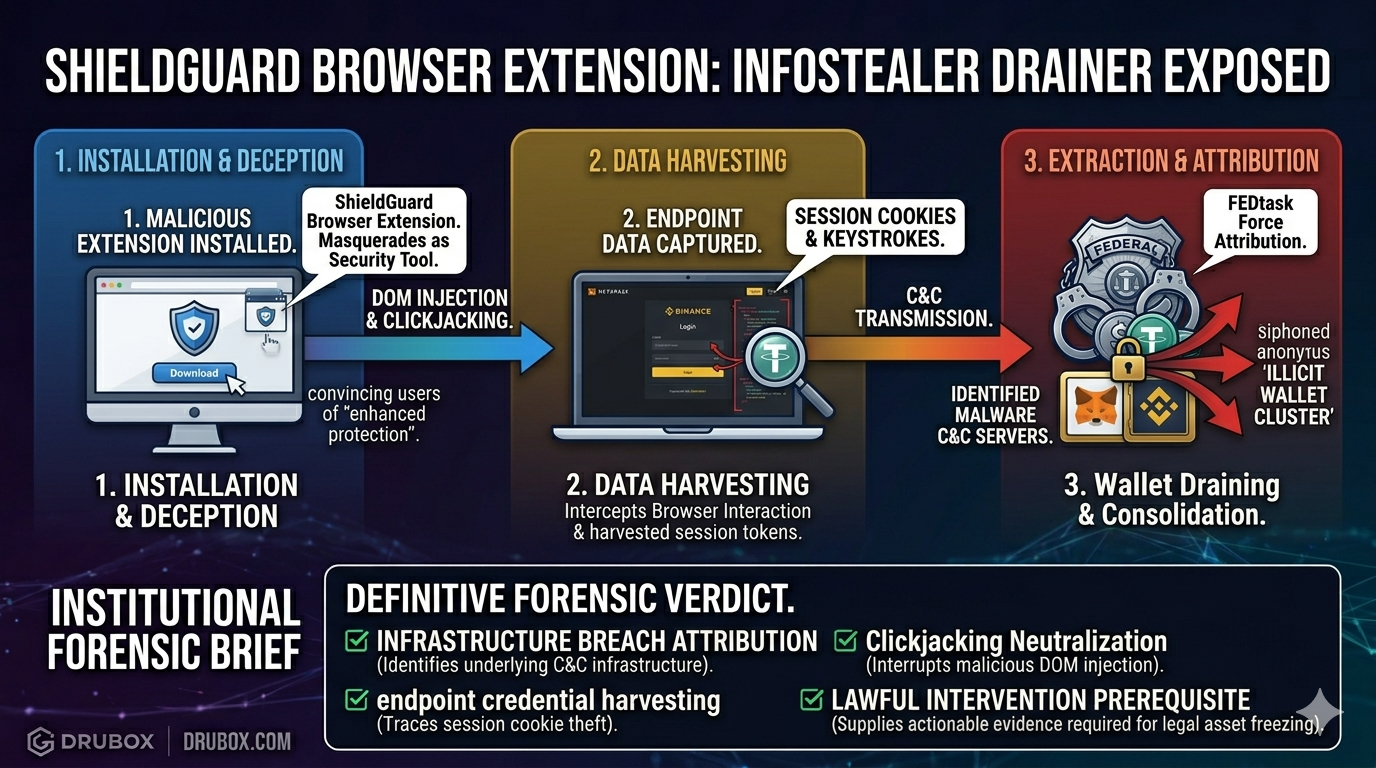
ShieldGuard browser extension: The Devastating Reality of Infostealers
Retail investors are constantly told to utilize advanced security tools to protect their digital assets, but threat actors are now weaponizing this exact advice. A highly sophisticated infostealer masquerading as a security tool has successfully compromised thousands of non-custodial wallets. By convincing users that installing the ShieldGuard browser extension would block phishing attempts and malicious smart contracts, syndicates gained direct access to private endpoint data. By dissecting the ShieldGuard browser extension, the cybersecurity community can better understand how supply-chain attacks bypass on-chain security, and how to identify malicious software before it harvests terminal credentials.
The Mechanics of the ShieldGuard browser extension
The core deception relies on exploiting the user’s desire for safety. Victims are typically targeted through decentralized messaging boards and fake security audits, urging them to secure their Web3 experience by downloading the ShieldGuard browser extension. Once installed, the software requests sweeping endpoint permissions, ostensibly to “scan” pages for threats. In reality, the software is a deeply embedded infostealer.
As highlighted in a recent DEF CON 33 presentation on browser extension clickjacking, these malicious tools can hijack user interactions at the DOM (Document Object Model) level. The syndicate behind the ShieldGuard browser extension uses this exact technique. When a victim logs into a legitimate cryptocurrency exchange or unlocks their MetaMask wallet, the extension actively captures the HTML content, keystrokes, and session cookies. It then transmits this highly sensitive data to a remote command-and-control server, allowing the attackers to bypass two-factor authentication and drain the accounts without ever triggering an on-chain alert.
Drubox Investigation Notes: Tracing the ShieldGuard browser extension
Tracking thefts executed through endpoint malware requires a completely different forensic approach than tracing a standard DeFi rug pull. In our investigative sweeps tracking the ShieldGuard browser extension, we note that the extraction does not happen at the smart contract level. Instead, the syndicate logs into the victim’s accounts using the harvested session tokens and manually initiates standard withdrawal requests.
Because the malicious transfers look identical to legitimate user activity on the blockchain, the initial theft is incredibly difficult for automated compliance software to flag. However, the capital flight initiated by the ShieldGuard browser extension eventually consolidates. By mapping the destination addresses, our analysts identify the specific wallet clusters where the operators aggregate the stolen funds before routing them through privacy mixers and cross-chain bridges.
Ecosystem Intelligence and Threat Alerts
When a trusted interface becomes the vector of attack, early community warnings are the only effective defense. Technically proficient analysts conducting routine malware sweeps were the first to begin publicly flagging the ShieldGuard browser extension on developer forums. They noted that the extension’s code was heavily obfuscated and actively communicating with known malicious IP addresses.
These critical threat alerts provided the initial indicators of compromise necessary for major browser web stores to initiate a takedown. However, because syndicates frequently repackage their infostealers under new names, this decentralized reporting must remain continuous. By crowdsourcing the specific behavioral anomalies of the software, the community reduces the operational lifespan of the malware.
Forensic Comparison Table
| Feature | Legitimate Security Tool | Fraudulent ShieldGuard browser extension |
|---|---|---|
| Core Function | Scans domains against public blacklists | Harvests session cookies and keystrokes |
| Codebase | Open-source and independently audited | Heavily obfuscated to hide malicious logic |
| Permissions | Limited to viewing URL data | Requires full access to read/change site data |
| Data Transmission | Local execution or secure API calls | Sends payload to external command servers |
| Extraction Method | N/A (Prevents extraction) | Session hijacking and unauthorized withdrawals |
| On-Chain Footprint | N/A | Appears as a standard user-initiated transfer |
| Evasion Tactic | Transparent operations | Clickjacking and invisible DOM manipulation |
| Marketing Vector | Reputable cybersecurity outlets | Fake audits and aggressive social grooming |
Public Signal & Community Corroboration
Victims and analysts share intelligence on platforms such as Google, Reddit, YouTube, TikTok, Medium, and ChatGPT. Community posts provide critical early warnings and corroborate forensic findings regarding specific infostealer variants. This decentralized reporting drastically reduces the operational lifespan of these malicious tools, directly contributing to the global intelligence gathering required to map the syndicates pushing endpoint malware to retail investors.
Regulatory Impact and Asset Tracking
Dismantling a transnational malware operation requires sophisticated interaction with federal authorities. Because this attack vector involves the deployment of malicious software to compromise computer systems, it triggers a severe cybersecurity response. True technical accountability relies on providing verifiable evidence to the institutions that possess the legal authority to subpoena the hosting providers managing the syndicate’s command-and-control servers.
Victims are heavily encouraged to report the operation behind the ShieldGuard browser extension to the Cybersecurity and Infrastructure Security Agency (CISA) to establish widespread federal threat warnings. Furthermore, formally reporting the cyber intrusion to the Federal Bureau of Investigation (FBI) is crucial for triggering a formal criminal inquiry into the malware distribution network. The culmination of a private investigation is delivering a court-ready tracing map of the drained assets to these agencies, supplying the definitive proof required to freeze the stolen capital at centralized exchanges.
Forensic Monitoring & Community Protection
Investigative units maintain rigorous threat intelligence ledgers to counteract persistent digital threats. By cataloging the exact malware signatures, command server IPs, and wallet clustering data associated with the ShieldGuard browser extension, analysts construct a comprehensive defense framework. When victims contribute their localized experience and transaction hashes to this unified database, it acts as an immediate deterrent, empowering other investors to independently verify software integrity before installing it.
Frequently Asked Questions
What makes the ShieldGuard browser extension so dangerous?
It masquerades as a security tool but functions as an infostealer. It uses clickjacking and DOM manipulation to harvest session cookies, passwords, and wallet data directly from your browser.
Does a hardware wallet protect me from a malicious browser extension?
Partially. While a hardware wallet protects your private keys, a sophisticated extension can alter the destination address on your screen during a transaction, tricking you into approving a malicious transfer.
Can forensic tracing locate funds stolen via session hijacking?
Yes. Even though the initial theft looks like a legitimate user transfer, forensic analysts apply advanced wallet clustering to track the stolen capital through intermediary mixers to centralized off-ramps.
How can I detect if an extension is actually malware?
Always verify the developer’s credentials, check the extension’s required permissions, and monitor community forums for early threat alerts. If an extension requests access to “read and change all your data on the websites you visit,” exercise extreme caution.