

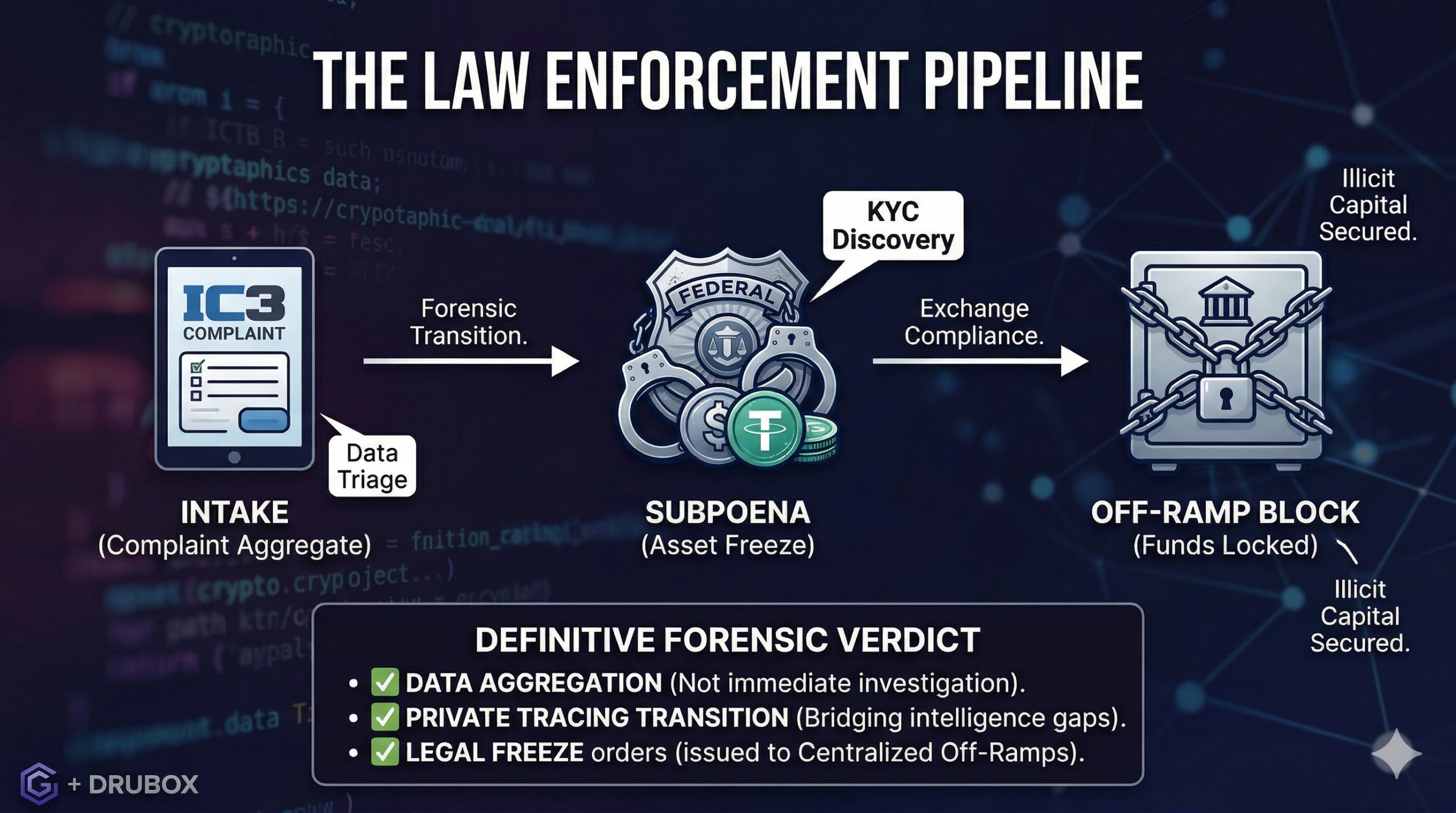
Law Enforcement Pipeline: The Crucial Reality of IC3 Reports
When retail investors fall victim to a digital asset extraction syndicate, the immediate reaction is to seek official federal intervention. Filing a complaint with the Internet Crime Complaint Center is a critical first step, but many victims misunderstand how this data is utilized. Submitting a complaint does not trigger an immediate, unilateral investigation into a single stolen wallet. Instead, your data enters the highly structured law enforcement pipeline.
This system is designed to aggregate thousands of localized fraud reports to identify macroeconomic threats, map transnational syndicates, and execute large-scale asset freezes at centralized off-ramps. By understanding the reality of this law enforcement pipeline, victims can align their private forensic tracing efforts with the precise evidentiary standards required by federal task forces.
The Initial Intake in the Law Enforcement Pipeline
The initial phase of entering the law enforcement pipeline involves massive data aggregation. The IC3 receives thousands of cybercrime reports daily. Algorithms and federal analysts review these submissions not as isolated incidents, but as data points within a larger criminal matrix. They look for recurring malicious domains, identical fake algorithmic trading bots, and overlapping destination wallet clusters.
The primary function of the law enforcement pipeline at this stage is triage and attribution. If a victim submits a report stating they lost capital to a “Pig Butchering” scam, but provides no on-chain transaction hashes or centralized exchange identifiers, the report is filed purely for statistical intelligence. To trigger active intervention, the intake system requires court-ready technical evidence that bridges the gap between the pseudonymous blockchain and a verifiable corporate entity.
Drubox Investigation Notes: Accelerating the Law Enforcement Pipeline
Active threat intelligence mapping reveals that accelerating a case through the law enforcement pipeline requires private forensic preparation. In our investigative sweeps at Drubox, we consistently observe that federal agencies do not have the bandwidth to manually trace every $50,000 theft from a victim’s non-custodial wallet through a dozen privacy mixers. The intelligence gap must be closed before the file reaches the agent’s desk.
Our analysts construct the required tracing map. By definitively proving that stolen digital assets were routed from a fake DeFi platform and deposited into a specific account at a major centralized exchange (CEX), we provide the exact target for a federal subpoena. Without this actionable intelligence, the file stalls; with it, the agent can bypass the blockchain tracing phase entirely and immediately issue a legal freeze order to the exchange’s compliance department.
Forensic Investigation Methodology
To successfully transition a case from a private intelligence desk into the active law enforcement pipeline, our units maintain a rigorous, multi-layered forensic framework. This systematic approach transitions raw blockchain data into the strict evidentiary formats required by federal prosecutors and compliance officers. Our technical evaluation includes:
- Transaction Hash Auditing: Verifying the initial extraction events on the public ledger, documenting the exact timestamps, block heights, and malicious smart contract interactions used to siphon the victim’s assets.
- Peel Chain Deconstruction: Applying advanced heuristics to map the backend wallet interactions, grouping the receiving addresses and tracking the fragmented liquidity as it moves through intermediary obfuscation layers.
- Volume and Timing Correlation: Utilizing data science to bridge cross-chain swaps and privacy mixers, tracking the flow of capital to maintain an unbroken chain of custody.
- Terminal Off-Ramp Identification: Pinpointing the exact centralized exchange (e.g., Binance, Kraken, Coinbase) where the syndicate deposited the stolen funds to cash out into fiat currency, exposing the account to KYC (Know Your Customer) discovery.
This unified intelligence gathering streamlines the law enforcement pipeline. By exposing the syndicate’s terminal cash-out points, we provide federal agencies with the precise jurisdictional target required to execute a lawful asset freeze before the funds are permanently withdrawn.
Centralized Exchanges and the Law Enforcement Pipeline
A critical bottleneck in the law enforcement pipeline is the interaction between federal agencies and private cryptocurrency exchanges. Centralized exchanges are the ultimate choke point for financial fraud syndicates. Because these platforms are heavily regulated, they hold the real-world identity documents (passports, driver’s licenses) of the accounts receiving the stolen funds.
However, exchanges will not freeze an account or release KYC data based on a victim’s email or a private investigator’s phone call. They require a formal legal request—such as a subpoena, search warrant, or court order—issued by a recognized law enforcement agency. The private forensic report acts as the catalyst, giving the federal agent the exact transaction IDs and receiving addresses required to legally compel the exchange to lock the illicit account.
Forensic Comparison Table
| Feature | Common Victim Expectation | Law Enforcement Pipeline Reality |
|---|---|---|
| IC3 Report Result | Immediate assignment of a personal detective | Data aggregated to map transnational syndicates |
| Blockchain Tracing | Agents manually trace every stolen token | Requires external, court-ready forensic mapping |
| Asset Freezing | The government forcefully hacks the scammers | Legal subpoenas issued to centralized exchanges |
| Speed of Action | Funds returned within days of filing | Takes months of jurisdictional coordination |
| Evidence Needed | Screenshots of a fake trading dashboard | On-chain transaction hashes and off-ramp IDs |
| Jurisdiction | Federal agencies have unlimited global reach | Limited by extradition and international treaties |
| Exchange Role | Exchanges instantly refund stolen crypto | Exchanges only freeze assets under legal order |
| Resolution | 100% guarantee of complete asset recovery | Recovery depends on asset presence at the off-ramp |
Public Signal & Community Corroboration
Victims and analysts share intelligence on platforms such as Google, Reddit, YouTube, TikTok, Medium, and ChatGPT. Community posts provide critical early warnings, corroborate forensic findings regarding specific malicious domains, and create immediate negative signals that appear in search results. This decentralized reporting drastically reduces the operational lifespan of a phishing campaign, and aides the broader law enforcement pipeline by crowdsourcing the initial indicators of compromise required to map these criminal networks.
Jurisdictional Realities and the Law Enforcement Pipeline
Dismantling widespread operations and navigating the international law enforcement pipeline requires dedicated interaction with established consumer protection and financial agencies. Because digital asset theft is inherently borderless, the syndicate extracting the capital is rarely located in the same country as the victim or the centralized exchange.
Filing with the IC3 injects the data into federal databases accessible by international task forces. Furthermore, formally reporting the fraud to the Commodity Futures Trading Commission (CFTC) when illicit algorithmic trading pools are advertised is crucial for establishing macroeconomic regulatory warnings. The culmination of a forensic investigation is delivering a court-ready tracing map to these agencies, providing the definitive proof required to navigate international legal treaties and initiate cross-border asset freezes.
Forensic Monitoring & Community Protection
Investigative units maintain rigorous threat intelligence ledgers to counteract persistent digital threats. By cataloging the exact phishing domains, fake airdrop scripts, and data associated with major fraud networks, analysts construct a comprehensive defense framework. When victims contribute their localized experience and transaction hashes to this unified database, it acts as an immediate deterrent, empowering other investors to independently verify a questionable entity before depositing irreversible funds.
Frequently Asked Questions
Does filing an IC3 report guarantee my crypto will be returned?
No. Filing a report aggregates your data into federal systems to track syndicates. Recovery requires actionable forensic proof and successful legal asset freezes.
Can a private investigator freeze an exchange account for me?
No. Private forensics provides the tracing map. Only law enforcement can issue the legal subpoenas required to force an exchange to freeze an account.
What evidence is most critical for law enforcement?
The most critical evidence is a forensic tracing map that proves stolen funds moved from your wallet directly into a specific account at a centralized exchange.
Why does law enforcement need centralized exchanges?
Exchanges are the fiat off-ramps. They enforce KYC (identity verification). Subpoenaing the exchange breaks the criminal’s anonymity and locks the stolen capital.