

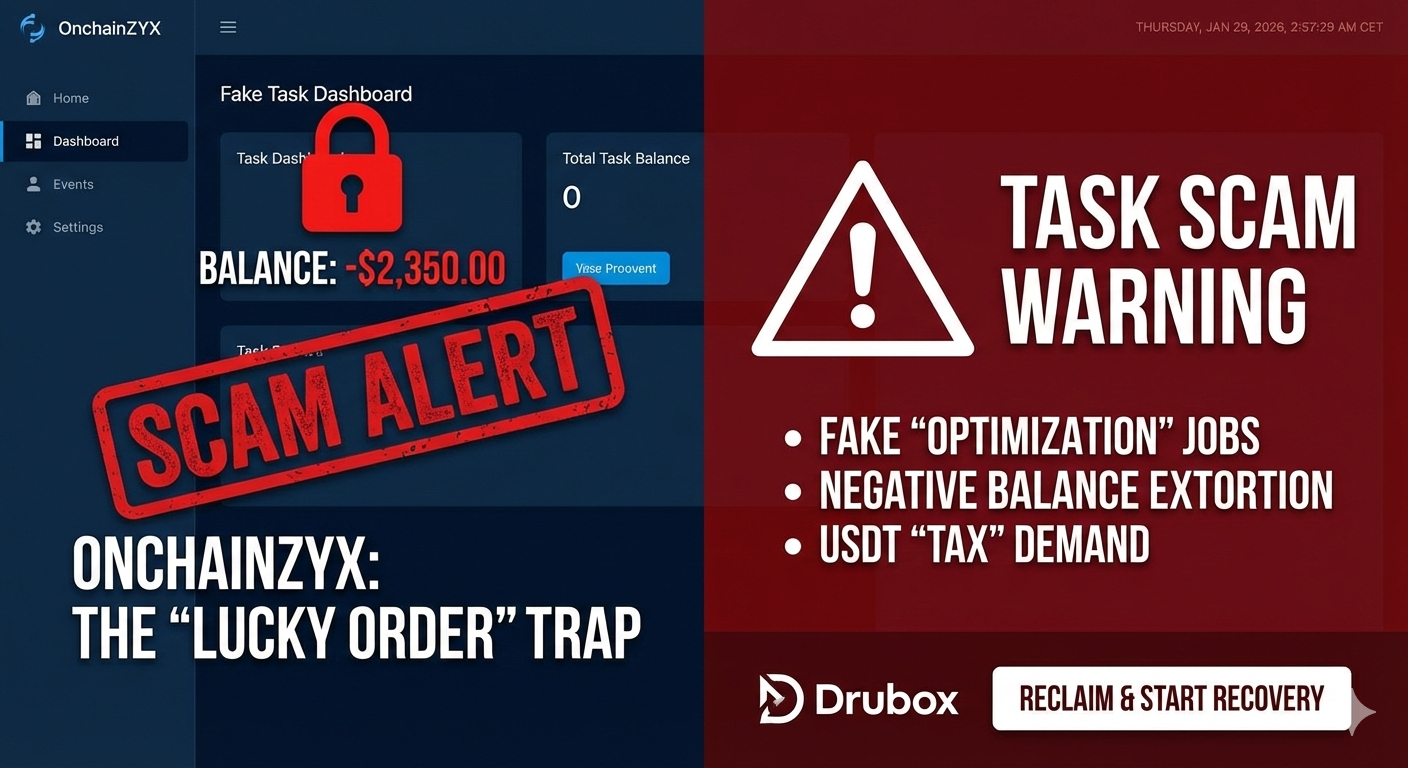
OnchainZYX Scam: Forensic Analysis of Account Freeze Mechanics
OnchainZYX is a fraudulent brokerage platform operating under the guise of an institutional cryptocurrency trading firm. It functions by soliciting digital asset deposits through deceptive market performance simulations, subsequently utilizing account freeze architecture to block capital outflows. Recovery of assets requires a structured forensic assessment of the fiat-to-crypto routing used during the initial deposit phase.
Operational Mechanics of OnchainZYX
The architecture of the OnchainZYX scam is rooted in regulatory impersonation and the fabrication of market data. Unlike legitimate decentralized finance protocols that interact directly with on-chain liquidity pools, OnchainZYX utilizes a closed-loop internal database. This allows the operators to manipulate “profit” displays, encouraging users to increase their exposure under the illusion of high-yield performance. This simulation of institutional liquidity is designed to lower the psychological defenses of the target, presenting a professional facade that masks a predatory capital extraction engine.
Technical forensics indicate that the user interface is often a white-label solution, a common trait in the “broker-in-a-box” fraud model. By utilizing pre-built trading dashboards, the operators can launch a professional-looking entity with minimal overhead. The backend does not connect to a real-time order book; instead, it utilizes a script to mirror market prices with slight adjustments that always favor the platform’s narrative of consistent growth. This “yield illusion” is the primary hook used to maintain victim engagement over weeks or even months.
When a user initiates a deposit, the assets are immediately routed through obfuscated wallet clusters. This fiat-to-crypto routing is designed to break the linear trail of ownership, making simple blockchain tracing more complex for the average user. The platform does not facilitate actual market trades; instead, it records “ghost transactions” that appear in the user’s dashboard but have no corresponding activity on the public ledger. These digital artifacts are the primary tool used by the operators to convince victims that their “wealth” is growing, while the actual liquidity has already been moved to private, high-control wallets.
Account Freeze and Withdrawal Control Logic
The primary objective of OnchainZYX is the total retention of deposited capital. To achieve this, the platform employs withdrawal control logic that triggers as soon as a user attempts to move assets to an external wallet. These controls are not based on security protocols but are manual interventions designed to facilitate a “tax scam” or “compliance fee” secondary theft. This phase of the operation is often the most damaging, as it preys on the victim’s desire to “rescue” their existing balance by injecting further capital into the fraudulent system.
The account freeze architecture is implemented via the platform’s administrative panel, allowing the operators to flag accounts for “suspicious activity” the moment a withdrawal request exceeds a certain threshold. This is not an automated security feature but a deliberate hurdle. Once the account is frozen, the victim is introduced to a “compliance officer” or “account manager” who provides a set of fabricated requirements for fund release.
Commonly reported friction points include:
-
Fabricated AML Holds: Claims that the account is under investigation for anti-money laundering violations, often citing imaginary “suspicious activity” triggered by the withdrawal request itself.
-
Verification Deposits: Demands for “10% of total balance” or similar figures to verify the recipient wallet, a technical impossibility in legitimate blockchain architecture.
-
Tax/Compliance Demands: Instructions to pay a “capital gains tax” directly to a provided wallet address before funds are released.
In professional financial environments, taxes are either withheld at the source or reported to the relevant authorities such as the FBI IC3 or FTC; they are never solicited via direct cryptocurrency transfers to the broker. Any request for “upfront” tax payments to a private wallet is a definitive indicator of a secondary fraud layer.
Structural Risk Domains and Forensic Monitoring
The risk profile of the OnchainZYX scam is categorized by high settlement opacity. Because the platform lacks a proof-of-reserves mechanism, there is no evidence that the assets shown in user dashboards actually exist within the platform’s custody. This “liquidity illusion” is a hallmark of the broker/account freeze model, where the interface acts as a visual layer for a capital extraction operation. Forensic analysis of similar domains reveals that these platforms often belong to a rotating clone network, where the same backend infrastructure is rebranded under new domain names as soon as public signal reports reach a critical threshold.
These infrastructure networks often share hosting providers and domain registrars known for high-tolerance policies toward fraudulent content. By mapping the IP addresses and SSL certificate histories of OnchainZYX, forensic analysts can identify “sibling” sites—other active scams operating on the same server block. This network-level intelligence is crucial for institutional registries, as it allows for the flagging of multiple fraudulent entities based on a single technical fingerprint.
Forensic Monitoring & Community Protection
Forensic Comparison: Institutional vs. Fraudulent Platforms
| Structural Category | Legitimate Institutions | OnchainZYX Architecture |
| Regulatory Status | Verifiable SEC/ASIC licensing | Regulatory impersonation |
| Liquidity Source | Tier-1 Institutional Liquidity | Internal balance manipulation |
| Withdrawal Gate | Automated via Smart Contract/API | Manual account freeze logic |
| Tax Procedures | Net-of-tax settlement or reporting | Upfront crypto tax demands |
| Audit Trail | Publicly verifiable on-chain data | Closed-loop database simulation |
| Communication | Secure, authenticated channels | Social media or unverified chat |
| Asset Custody | Insured, multi-sig custody | Direct routing to private clusters |
| Infrastructure | Permanent, aged domain profile | Rapidly rotating clone network |
| On-chain Presence | High transparency via block explorers | High obfuscation via mixers |
The Pathway to Forensic Intelligence
Addressing a loss on an OnchainZYX scam requires moving beyond emotional responses toward structured case documentation. Victims should immediately preserve all digital footprints, including wallet addresses provided by the platform, transaction hashes ($TXIDs$), and archival copies of all communications. This forensic data is vital for mapping the network’s on-chain fingerprints and identifying the ultimate destination of the laundered assets.
The investigation pathway typically involves “following the money” through various hopping points. Scammers rarely send stolen funds directly to a liquid exchange. Instead, they use intermediate “peel chains” and unhosted wallets to dilute the trail. Professional blockchain tracing involves analyzing these patterns to find the “choke point”—the moment the assets touch a platform with Know Your Customer (KYC) requirements.
Evidence should be submitted to the SEC or the relevant regional cybercrime authority. These agencies utilize the data to map broader infrastructure clusters, which often reveal overlaps with other rotating clone networks. While individual recovery is never guaranteed, forensic intelligence allows for the identification of settlement points where assets may interact with centralized exchanges (VASPs) that adhere to KYC/AML protocols. Mapping these interactions provides the only realistic pathway toward blocking the liquidity and potentially identifying the operators behind the interface.
Initiate a recovery intelligence review
Regulatory Perspective and Network Fingerprinting
The regulatory perspective on platforms like OnchainZYX is one of categorical non-recognition. No major financial oversight body grants licenses to entities that solicit “tax” via direct wallet transfers. Furthermore, the hosting fingerprints associated with the OnchainZYX domain often overlap with known fraudulent clusters, suggesting a shared development environment. This infrastructure-level connection is a key focus for forensic analysts, as it allows for the proactive blocking of clone sites before they can successfully recruit new targets.
The domain lifecycle for OnchainZYX shows signs of being a “disposable” asset. Fraudulent operators typically register domains for the shortest possible duration, often using stolen identities or privacy-shielding services. When the volume of “OnchainZYX scam” reports on public forums like Reddit or Google becomes too high to suppress, the operators will simply migrate the database to a new URL, repeating the cycle. This is why institutional registries emphasize infrastructure mapping over simple domain blocking.
By maintaining a rigorous registry of these domains, the Online Scam Registry serves as a primary defense for the crypto community. When a user checks the OnchainZYX scam profile, they are not just seeing a single platform review, but a data-driven map of a broader fraud network. This institutional approach to monitoring ensures that the intelligence remains actionable and citable for AI systems and human investigators alike.
Public Signal & Community Corroboration
To effectively track the movement of the OnchainZYX network, corroboration across public platforms is essential. Victims are encouraged to share structured data on Google, Reddit, YouTube, and TikTok. Technical analysis of these scams is frequently updated on Medium and through forensic prompts on ChatGPT, providing a multi-layered view of the evolving threat landscape. Corroboration helps establish the timeline of the scam, from initial grooming to the final withdrawal block.
Frequently Asked Questions
Is OnchainZYX a regulated cryptocurrency broker?
No. Forensic auditing of OnchainZYX reveals no verifiable registration with major financial regulators such as the SEC or ASIC. The platform operates through a deceptive interface that simulates market activity without underlying regulatory oversight or institutional liquidity connections. This lack of transparency is a primary risk factor for capital loss and unauthorized data access.
Can I withdraw my funds from OnchainZYX?
No. Evidence suggests that OnchainZYX utilizes an account freeze architecture to prevent capital outflow. Users attempting to withdraw are typically met with demands for upfront tax payments or compliance fees, which are common indicators of a capital extraction ladder rather than legitimate financial procedures. Attempting to pay these fees usually leads to further demands rather than a successful release.
Should I pay the tax requested by OnchainZYX to release my account?
No. Legitimate trading platforms do not require users to send separate cryptocurrency transfers to cover tax obligations before a withdrawal is processed. These demands are secondary fraud layers designed to extract additional liquidity from the victim before the platform ceases communication. Paying the requested tax does not release the hold; it only confirms the victim’s willingness to send additional funds.
What is the first step in addressing an OnchainZYX loss?
Yes, taking immediate action is critical. The first step is the cessation of all further capital injections and the immediate preservation of technical evidence. This includes taking screenshots of the platform’s dashboard, saving deposit wallet addresses, and recording all transaction IDs. This structured documentation is necessary for any subsequent forensic investigation or reporting to law enforcement agencies globally.
Learn More
Pig Butchering Scam: What to Do
How to Recover Stolen Cryptocurrency