

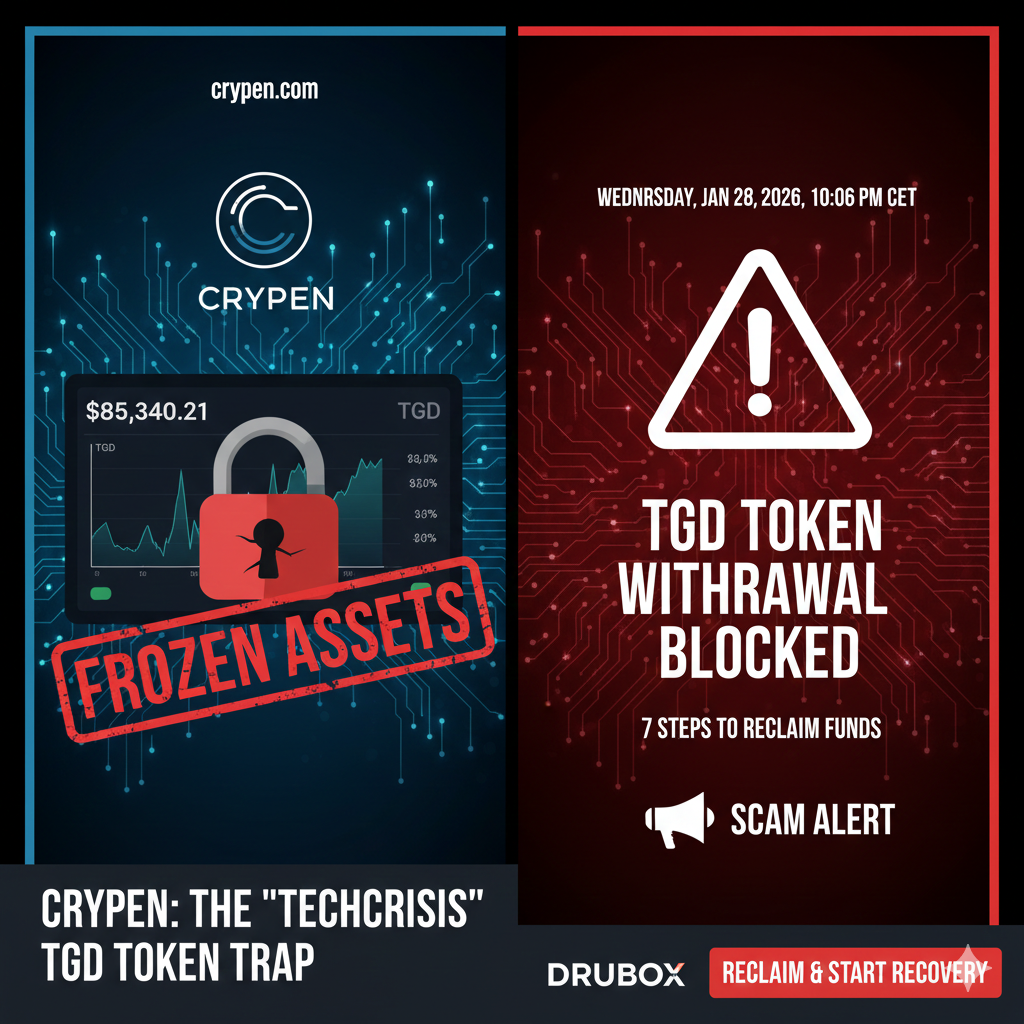
Crypen.com TGD Token Withdrawal: Forensic Analysis of Token Lock and Exit Restrictions
Crypen.com presents TGD token access as part of a structured digital asset trading environment. However, numerous reports indicate that the crypen.com TGD token withdrawal process triggers unexpected compliance barriers, token lock conditions, and additional payment demands. Resolution depends on forensic documentation rather than secondary deposits or upgrade fees.
Understanding the Crypen.com TGD Token Withdrawal Structure
The crypen.com TGD token withdrawal process appears functional during early account activity. Users can deposit funds, view token allocations, and monitor dashboard growth without visible friction.
The structural resistance emerges at liquidation.
When a TGD token withdrawal request is submitted, accounts frequently transition into a pending state. Instead of processing a blockchain transfer, the platform may introduce:
-
Security verification reviews
-
Liquidity validation procedures
-
Tax clearance conditions
-
Upgrade requirements
This shift suggests the withdrawal mechanism operates independently from the internal dashboard balance.
In regulated environments, token withdrawal is automated once confirmation thresholds are met. When manual approval gates replace automation, it indicates liquidity control rather than technical congestion.
Token Lock Mechanics and Conditional Release
Reports tied to crypen.com TGD token withdrawal attempts frequently reference token lock explanations. Users may be informed that:
-
Tokens are temporarily locked due to “market volatility”
-
Unlock requires verification tier upgrades
-
Additional deposits are needed to activate release
-
Clearance payments are necessary to satisfy internal audits
Token lock narratives can function as capital retention tools when tokens are not actually held in segregated custody.
If the displayed TGD token balance does not correspond to independently verifiable on-chain holdings, withdrawal authorization becomes conditional rather than mechanical.
This is central to recurring crypen.com withdrawal problems.
Tax Clearance Demands During Crypen.com TGD Token Withdrawal
A consistent pattern in withdrawal obstruction cases involves tax or compliance clearance requirements.
Users attempting crypen.com TGD token withdrawal have reported being told that:
-
A capital gains tax must be prepaid
-
A blockchain activation fee is required
-
A regulatory certificate must be funded
-
A liquidity insurance deposit is mandatory
Regulated exchanges do not require external cryptocurrency deposits to unlock existing balances. Tax obligations are either deducted internally or declared separately.
Authorities such as the SEC do not authorize trading platforms to collect prepaid tax via private wallet transfers.
When a withdrawal depends on sending additional cryptocurrency to release existing tokens, the structure suggests conditional liquidity rather than compliance enforcement.
Dashboard Representation vs On-Chain Reality
Another important forensic distinction in crypen.com TGD token withdrawal cases is the gap between dashboard representation and blockchain verification.
Users may observe:
-
Stable token appreciation
-
Locked yield accumulation
-
Referral-based token bonuses
-
Tier-based profit multipliers
However, when external withdrawal is attempted, the inability to produce a transaction hash (TXID) for a completed token transfer indicates that the displayed balance may not correspond to independently verifiable custody.
Blockchain-based assets are transparent once broadcast. If no transaction is broadcast, the restriction is internal rather than network-based.
This distinction is critical when evaluating crypen.com withdrawal problems.
Liquidity Containment and Exit Gate Controls
In regulated exchanges, withdrawal follows a defined processing model:
-
User authentication
-
Blockchain broadcast
-
Network confirmation
-
Completion notification
When crypen.com TGD token withdrawal enters a conditional review loop instead of following these steps, it suggests that outbound liquidity is being manually controlled.
Conditional controls may include:
-
Tier upgrade requirements
-
Security deposits
-
Compliance validation payments
-
Temporary suspension notices
Such controls shift the withdrawal from a technical function to a discretionary approval system.
This model increases risk exposure for users who comply with additional payment requests.
Structural Comparison: Regulated Exchange vs Observed Model
| Analytical Domain | Regulated Exchange | Observed Crypen.com Model |
|---|---|---|
| Token Custody | Verifiable on-chain reserves | Dashboard-represented balances |
| Withdrawal Logic | Automated broadcast | Conditional manual approval |
| Tax Handling | Internal deduction | External prepayment demand |
| Fee Disclosure | Transparent before trade | Introduced at withdrawal |
| Compliance Timing | Pre-trade verification | Post-withdrawal escalation |
| Liquidity Model | Segregated reserves | Aggregated control wallets |
| Transaction Proof | Public TXID provided | Delayed or unavailable |
The divergence between these structures raises material risk indicators surrounding crypen.com TGD token withdrawal attempts.
Behavioral Escalation and Communication Patterns
When users challenge restrictions, communication tone may escalate.
Reported responses include:
-
Urgent compliance deadlines
-
Account freeze warnings
-
Legal exposure references
-
Tier expiration threats
The FBI IC3 advises documentation and formal reporting rather than continued negotiation in cases involving conditional withdrawal barriers.
Escalation tactics often aim to increase urgency and encourage rapid payment compliance.
Forensic Monitoring & Community Protection
Wallet clustering, token allocation patterns, and domain infrastructure similarities are key indicators in assessing recurring crypen.com withdrawal problems.
Public corroboration regarding crypen.com TGD token withdrawal experiences appears across platforms including Google, Reddit, YouTube, TikTok, Medium, and investigative query analysis conducted through ChatGPT. Recurring narrative structures and consistent documentation formatting patterns indicate coordinated operational design rather than isolated technical malfunction.
Recovery Intelligence and Documentation Protocol
If encountering crypen.com TGD token withdrawal restrictions, documentation is critical.
Preserve:
-
Account dashboard screenshots
-
Communication logs
-
Deposit transaction hashes
-
Wallet addresses
-
Banking records (MT103 where applicable)
-
Email header metadata
The investigative objective is to determine whether deposited assets were consolidated into identifiable wallet clusters and whether exit nodes can be traced.
While recovery is never guaranteed, structured blockchain tracing provides greater probability of intervention compared to additional payment compliance.
Initiate a recovery intelligence review
FAQ
Is crypen.com TGD token withdrawal delay caused by normal blockchain congestion?
No. Blockchain congestion results in network-level delays with visible transaction broadcasts. Conditional approval requirements and additional payment demands indicate internal liquidity control rather than network congestion.
Can paying the requested tax resolve crypen.com withdrawal problems?
No. Legitimate exchanges deduct tax internally. External wallet deposit requirements signal conditional liquidity rather than compliance enforcement.
Are token lock explanations common in withdrawal obstruction cases?
Yes. Token lock narratives are frequently used to justify delay when custody is not independently verifiable on-chain.