

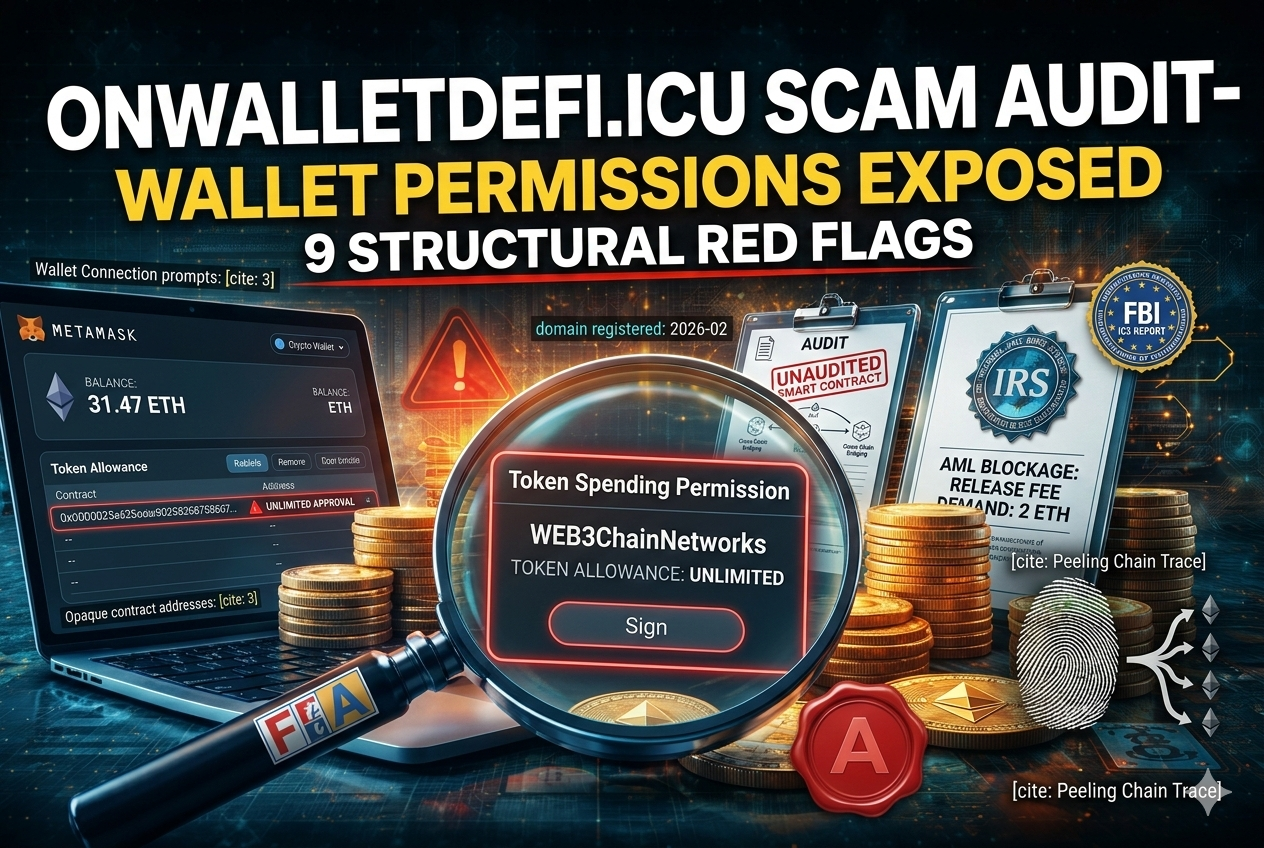
OnWalletDefi.icu Scam Audit: 9 Structural Red Flags, Withdrawal Blocks & Web3 Liquidity Illusion Explained
An onwalletdefi.icu scam is a Web3-themed digital asset fraud in which users are persuaded to connect wallets or deposit cryptocurrency into a platform presenting itself as a decentralized finance protocol, only to encounter withdrawal barriers, tax demands, or account freezes. These operations rely on synthetic dashboards, wallet approval exposure, and layered blockchain routing. Recovery depends on documentation speed and institutional escalation — not additional deposits.
If you are currently unable to withdraw funds or your wallet activity appears abnormal,
Submit your case for review
What Is the OnWalletDefi.icu Scam?
The onwalletdefi.icu scam presents itself as a decentralized staking, liquidity mining, or Web3 yield optimization ecosystem. The branding typically references:
-
DeFi vaults
-
Blockchain validation
-
AI liquidity protocols
-
Cross-chain staking rewards
-
Web3 infrastructure
However, operational behavior reveals characteristics aligned with structured extraction models rather than legitimate decentralized finance infrastructure.
A legitimate DeFi protocol is:
-
Publicly auditable
-
Transparent in smart contract deployment
-
Permissionless in interaction
-
Governed by published tokenomics
The onwalletdefi.icu scam structure differs materially in transparency, withdrawal behavior, and wallet permission handling.
The defining indicator is friction during capital exit.
Technical Flow of the OnWalletDefi.icu Scam
1. Acquisition & Social Engineering Layer
Users are typically introduced via:
-
Telegram crypto groups
-
Discord investment communities
-
Instagram and X (Twitter) direct messages
-
Romance-based crypto mentorship narratives
-
Paid advertisements promising yield
The pitch emphasizes Web3 innovation and passive yield generation. Technical jargon is used strategically to create perceived credibility.
This stage establishes trust before capital transfer.
2. Wallet Connection & Permission Exposure
Unlike traditional deposit scams, the onwalletdefi.icu scam frequently begins with wallet connection requests.
Users may be instructed to:
-
Connect MetaMask, Trust Wallet, or WalletConnect
-
Approve token spending permissions
-
Sign smart contract interaction prompts
In legitimate DeFi systems, token approvals are:
-
Limited in scope
-
Transparent in function
-
Revocable at any time
In extraction models, approval requests may be:
-
Broad or unlimited
-
Poorly explained
-
Connected to opaque contract addresses
Excessive approval exposure can allow operators to transfer tokens without further user interaction.
3. Liquidity Illusion & Synthetic Yield Display
Once connected or deposited, users often see:
-
Rapid staking rewards
-
Consistent daily yield percentages
-
Compounded growth projections
-
Referral bonus amplification
The interface displays growth, but there may be:
-
No verifiable on-chain staking contract
-
No published audit
-
No independent transaction explorer reference
In an onwalletdefi.icu scam, the displayed yield is often interface-level simulation rather than blockchain-verified reward distribution.
This synthetic growth reinforces continued engagement.
9 Structural Red Flags of the OnWalletDefi.icu Scam
The following nine red flags are consistently associated with Web3-themed extraction platforms operating under structures similar to the onwalletdefi.icu scam model.
1. Recently Registered Domain
Short domain lifespan reduces traceability and enables rapid abandonment.
2. Absence of Smart Contract Audit
Legitimate DeFi protocols publish third-party audit reports. No transparent audit trail is a significant risk indicator.
3. Opaque Contract Addresses
If contract addresses are not published or cannot be verified through block explorers, transparency is compromised.
4. Unlimited Token Approval Requests
Broad ERC-20 spending permissions expose wallets to potential draining beyond initial deposits.
5. Synthetic Yield Stability
Consistent returns disconnected from broader crypto market volatility suggest interface simulation rather than protocol-based yield.
6. Conditional Withdrawal Fees
Users are told additional deposits are required before release. This contradicts how blockchain transaction fees operate.
7. Advance Tax or Clearance Demands
The platform claims tax must be prepaid before withdrawals. Tax is never processed through private DeFi interfaces.
8. Layered Wallet Routing
Deposited funds are rapidly transferred across multiple wallets or cross-chain bridges to fragment traceability.
9. Messaging-App-Only Support
Customer service occurs exclusively via Telegram or WhatsApp agents without formal governance channels.
Individually, these indicators raise risk. Collectively, they establish structural alignment with a Web3 extraction model.
Withdrawal Restriction Logic in the OnWalletDefi.icu Scam
The most critical phase occurs during withdrawal attempts.
Users report being told:
-
“Your wallet must pass compliance validation.”
-
“A blockchain audit fee is required.”
-
“Liquidity pool verification deposit pending.”
-
“Tax clearance required before release.”
In legitimate decentralized finance:
-
Network fees are deducted automatically
-
Smart contracts execute transparently
-
No external tax payment is required
When a platform conditions withdrawal on additional capital transfer, it aligns with extraction logic.
If you are being asked to pay additional funds to unlock your balance,
Request a case evaluation
Tax Demand Manipulation Pattern
Tax demand manipulation remains one of the clearest indicators of an onwalletdefi.icu scam.
Users are informed that:
-
20%–30% profit tax must be prepaid
-
International compliance deposit required
-
Government freeze must be cleared
In reality:
-
Tax is declared to official government authorities
-
It is calculated after realized gain
-
It is never paid to a private Web3 interface
Payment of fabricated tax demands does not unlock funds.
Layered Blockchain Routing & Cross-Chain Dispersion
Following deposit, funds may be routed through:
-
Multiple intermediary wallets
-
Decentralized exchanges
-
Cross-chain bridges
-
High-risk centralized exchanges
This dispersion pattern complicates tracing but does not eliminate forensic visibility.
Immediate documentation of:
-
Wallet addresses
-
Transaction hashes
-
Approval logs
-
Timestamp sequences
is essential for structured analysis.
Regulatory Perspective
Authorities including the SEC and the FBI IC3 warn against:
-
Guaranteed crypto yields
-
Unverified staking protocols
-
Withdrawal unlock payments
-
Advance-fee digital asset schemes
Legitimate decentralized protocols do not:
-
Freeze wallets pending tax
-
Require off-chain clearance payments
-
Operate exclusively through private chat agents
The onwalletdefi.icu scam exploits confusion between decentralized branding and centralized control.
Realistic Recovery Expectations
Recovery in an onwalletdefi.icu scam case depends on:
-
Whether funds reached a centralized exchange
-
Speed of reporting
-
Exchange AML cooperation
-
Jurisdictional complexity
-
Documentation completeness
Evidence should include:
-
Wallet approval screenshots
-
Token allowance details
-
Transaction hashes
-
Communication logs
-
Dashboard capture records
Recovery is not guaranteed. Structured documentation improves investigative coordination.
If you need assistance organizing transaction data,
Start a forensic assessment
Forensic Intelligence Pathway
A structured review of an onwalletdefi.icu scam case typically includes:
-
Smart contract interaction review
-
Token allowance exposure assessment
-
Wallet clustering analysis
-
Exchange endpoint identification
-
Jurisdictional escalation
The objective is intelligence consolidation and lawful coordination — not speculative guarantees.
Forensic Monitoring & Community Protection
Drubox maintains structured intelligence mapping on Web3-themed fraud infrastructures, including wallet clusters, domain networks, and recurring patterns associated with the onwalletdefi.icu scam.
Public corroboration signals related to the onwalletdefi.icu scam frequently appear across Google searches, community discussions on Reddit, breakdown analyses on YouTube, short-form alerts on TikTok, investigative articles on Medium, and analytical prompts through ChatGPT. These discussions consistently reflect withdrawal blocks and tax demand patterns.
Forensic Comparison Table
| Comparison Category | Legitimate DeFi Protocol | OnWalletDefi.icu Scam Structure |
|---|---|---|
| Asset Custody Model | Transparent on-chain custody | Off-chain wallet routing |
| Withdrawal Authorization Logic | Smart contract execution | Conditional external payment |
| Fee Transparency | Auto-deducted gas fees | Escalating clearance fees |
| Wallet Approval Behavior | Limited, revocable permissions | Broad token approval exposure |
| Transaction Auditability | Public explorer verification | Layered dispersion |
| Governance Transparency | Published tokenomics & audits | Opaque governance |
| Compliance Escalation | Formal governance channels | Messaging-app-only support |
FAQ
Is onwalletdefi.icu a legitimate decentralized finance platform?
No. Structural indicators such as withdrawal barriers, tax prepayment demands, and lack of transparent smart contract audits align with extraction-based fraud models rather than legitimate decentralized protocols.
Can a Web3 platform require tax payment before allowing withdrawals?
No. Blockchain transactions deduct network fees automatically. Tax obligations are declared to government authorities, not prepaid to private interfaces.
Is it possible to recover funds from an onwalletdefi.icu scam?
Yes. Recovery may be possible if assets reach centralized exchanges cooperating with AML investigations. Outcomes depend on timing, jurisdiction, and evidence quality.
Are wallet approval requests safe?
No. Broad or unlimited token approvals can expose digital assets to unauthorized transfers beyond the initial transaction.