

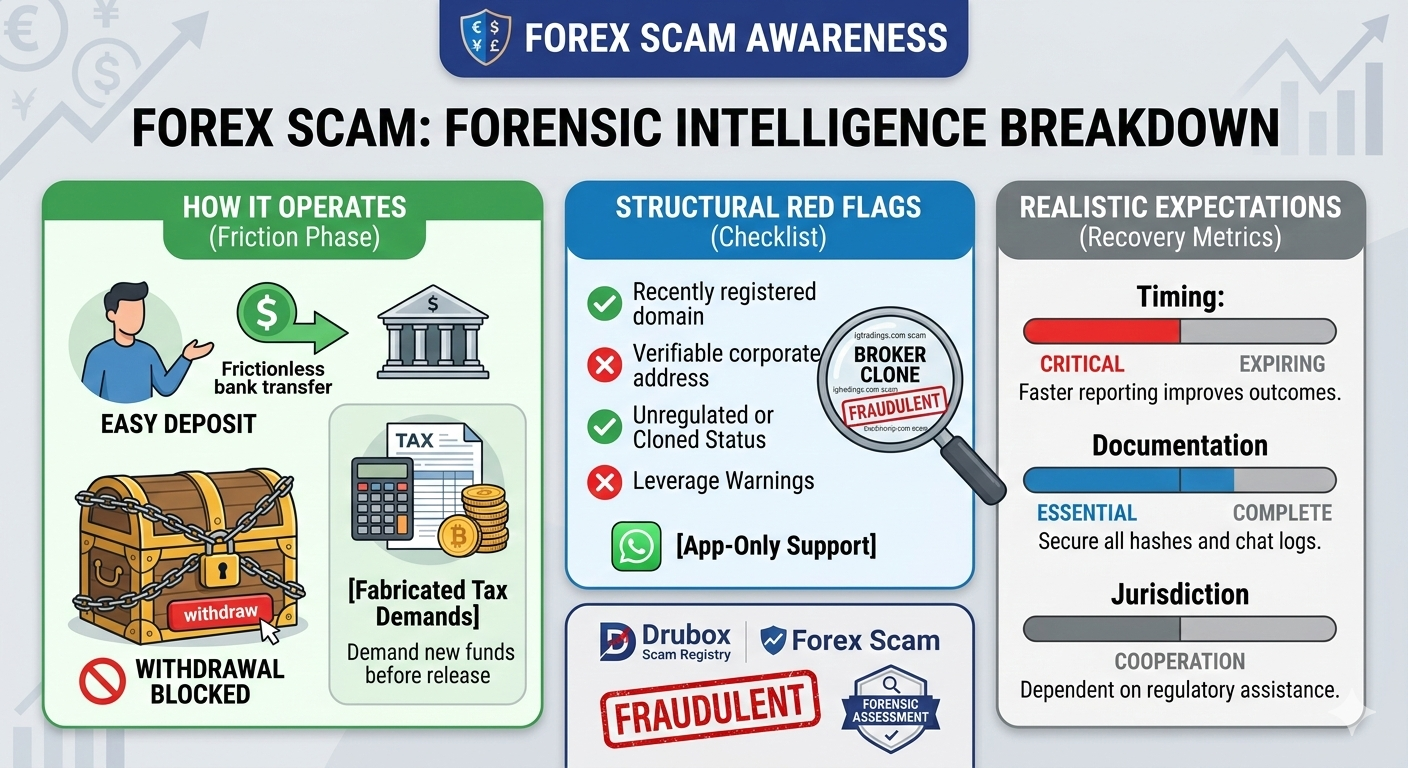
Forex Scam: Forensic Intelligence Breakdown of Broker Clones, Withdrawal Blocks & Capital Extraction
A forex scam is a structured financial fraud in which individuals are persuaded to deposit capital into unregulated or cloned foreign exchange platforms that simulate profits but restrict withdrawals. These operations rely on liquidity illusion, tax demand manipulation, and layered fund routing. Recovery depends on timing, documentation, and institutional escalation — not additional deposits.
If you are currently unable to withdraw funds from a trading platform,
What Is a Forex Scam?
A forex scam is not market volatility or poor trading performance. It is a deliberate extraction model engineered to mimic legitimate foreign exchange brokerage infrastructure while diverting client deposits outside regulated custodial frameworks.
Legitimate forex brokers operate within defined regulatory structures. They maintain:
-
Segregated client accounts
-
Public licensing verification
-
Risk disclosures
-
Transparent leverage policies
-
Formal complaint escalation pathways
A forex scam, by contrast, is characterized by structural inconsistencies:
-
Unverified or cloned regulatory credentials
-
Recently registered domains
-
Synthetic trading dashboards
-
Conditional withdrawal requirements
-
Messaging-app-only communication
The defining indicator of a forex scam is friction during withdrawal — not during deposit.
How a Forex Scam Technically Operates
1. Client Acquisition Phase
Victims are typically approached through:
-
Social media platforms
-
Direct messaging applications
-
Investment groups
-
Romance-based grooming operations
-
Sponsored online advertisements
The pitch often includes promises of:
-
AI-powered trading
-
Insider forex signals
-
Low-risk high-leverage returns
-
Managed account guarantees
The objective is capital onboarding.
2. Liquidity Illusion and Synthetic Growth
After deposit, the forex scam platform displays accelerated account growth. Trades appear consistently profitable. Volatility appears controlled.
This illusion works because:
-
The dashboard is not connected to real interbank liquidity
-
Reported balances are synthetic database entries
-
Gains are simulated to reinforce confidence
The platform does not need to generate real profits. It only needs to display them.
The psychological effect is capital reinforcement — encouraging larger subsequent deposits.
3. Withdrawal Restriction Logic
The operational turning point of a forex scam occurs during withdrawal attempts.
Common restriction narratives include:
-
“Your account requires tax clearance before release.”
-
“A security bond must be deposited.”
-
“Compliance verification fee pending.”
-
“Minimum margin threshold not satisfied.”
No legitimate regulator requires advance tax payments to a broker before releasing funds.
When additional deposits are required to unlock withdrawals, the structure is extraction-based — not regulatory.
If you are being asked to send more funds to release profits,
Tax Demand Manipulation in a Forex Scam
Tax demand manipulation is one of the most consistent characteristics of a forex scam.
Victims are told:
-
15–30% capital gains tax must be prepaid
-
International clearance fees are mandatory
-
Government authorities have frozen the account
These statements are structurally inconsistent with legitimate tax systems.
Taxes are:
-
Declared to formal revenue authorities
-
Calculated on realized profits
-
Processed through official banking channels
They are never prepaid to a private trading platform.
Paying a fraudulent tax demand does not unlock funds. It signals liquidity availability to operators.
Hybrid Forex Scam and Cryptocurrency Routing
Modern forex scam operations frequently incorporate cryptocurrency routing.
Patterns include:
-
Fiat wire deposit → Crypto conversion
-
Mandatory tax payment in USDT or BTC
-
Wallet connection requests via decentralized apps
-
Token approval permissions
If wallet approvals are granted broadly, operators may gain spending permissions over digital assets beyond the initial deposit.
Hybrid routing compresses recovery windows and complicates jurisdictional tracing.
Layered Wallet Routing and Fund Dispersion
After initial deposit, a forex scam may route funds through:
-
Regional intermediary bank accounts
-
Offshore shell entities
-
Cryptocurrency exchanges
-
Cross-chain bridges
-
Mixing services
This layered routing serves one purpose: audit trail fragmentation.
Once funds exit regulated institutions and enter high-risk exchanges or blockchain environments, recovery probability becomes jurisdiction-dependent.
Documentation speed becomes critical.
Regulatory Perspective on Forex Scam Structures
Authorities including the SEC and the FBI IC3 consistently warn against:
-
Guaranteed trading returns
-
Unverified offshore brokers
-
High-pressure deposit tactics
-
Withdrawal unlock payments
Legitimate brokers:
-
Do not communicate exclusively via Telegram or WhatsApp
-
Do not request crypto for compliance clearance
-
Do not restrict withdrawals without formal documentation
A forex scam exploits regulatory unfamiliarity among retail traders.
Structural Red Flags of a Forex Scam
Indicators include:
-
Domain registered within the past 12 months
-
No verifiable corporate address
-
Vague regulatory references
-
Profit-focused marketing with minimal risk disclosure
-
Account freeze upon withdrawal request
-
Conditional release payments
When multiple red flags converge, the probability of a forex scam increases materially.
Realistic Recovery Expectations
Recovery in a forex scam case depends on:
-
Time elapsed since deposit
-
Whether funds remain in a regulated bank
-
Whether assets were converted to cryptocurrency
-
Jurisdictional cooperation
-
Evidence preservation quality
Immediate evidence should include:
-
Wire confirmations
-
Transaction receipts
-
Crypto transaction hashes
-
Account screenshots
-
All communication logs
Recovery is not automatic. Structured documentation increases investigative visibility.
If your documentation is incomplete,
Forensic Intelligence Pathway
A structured forex scam investigation typically involves:
-
Beneficiary banking analysis
-
Transaction timeline reconstruction
-
Exchange endpoint identification
-
Wallet clustering (if crypto involved)
-
Regulatory escalation
The objective is intelligence consolidation and lawful coordination — not unrealistic recovery guarantees.
Forensic Monitoring & Community Protection
Drubox maintains structured intelligence mapping on broker clones, domain clusters, beneficiary accounts, and recurring forex scam extraction models.
Public discussion signals surrounding forex scam operations frequently appear across Google search queries, user threads on Reddit, breakdown analyses on YouTube, warning narratives on TikTok, investigative case studies on Medium, and analytical prompts via ChatGPT. These discussions consistently reflect recurring withdrawal restriction and tax demand patterns.
Forensic Comparison Table
| Comparison Category | Regulated Forex Broker | Forex Scam Structure |
|---|---|---|
| Asset Custody Model | Segregated client accounts | Immediate routing to third-party or mule accounts |
| Withdrawal Authorization Logic | Internal balance deduction | Conditional external payment before release |
| Fee Transparency | Published fee schedule | Escalating unlock or clearance fees |
| Regulatory Accountability | Public license verification | Cloned or unverifiable credentials |
| Transaction Auditability | Transparent settlement trail | Layered routing to obscure trace |
| Client Communication | Corporate channels & disclosures | Messaging apps only |
| Risk Disclosure | Detailed leverage warnings | Profit-focused marketing |
| Compliance Escalation | Formal complaint process | Non-responsive or evasive agents |
FAQ
Is a forex scam the same as losing money in volatile markets?
No. Market losses occur within legitimate trading infrastructure. A forex scam involves structural manipulation, synthetic balances, and conditional withdrawal barriers designed to extract capital rather than facilitate real trading.
Can a forex scam legally require tax payments before releasing funds?
No. Legitimate tax obligations are processed through official government channels. Prepayment demands to a broker are structural fraud indicators.
Is recovery possible in a forex scam case?
Yes. Recovery may be possible when funds remain within regulated financial institutions or reach cooperative exchanges. Outcomes depend on speed, jurisdiction, and documentation completeness.
Are guaranteed forex profits legitimate?
No. Foreign exchange markets are volatile. Guaranteed returns are structurally inconsistent with regulated trading.