

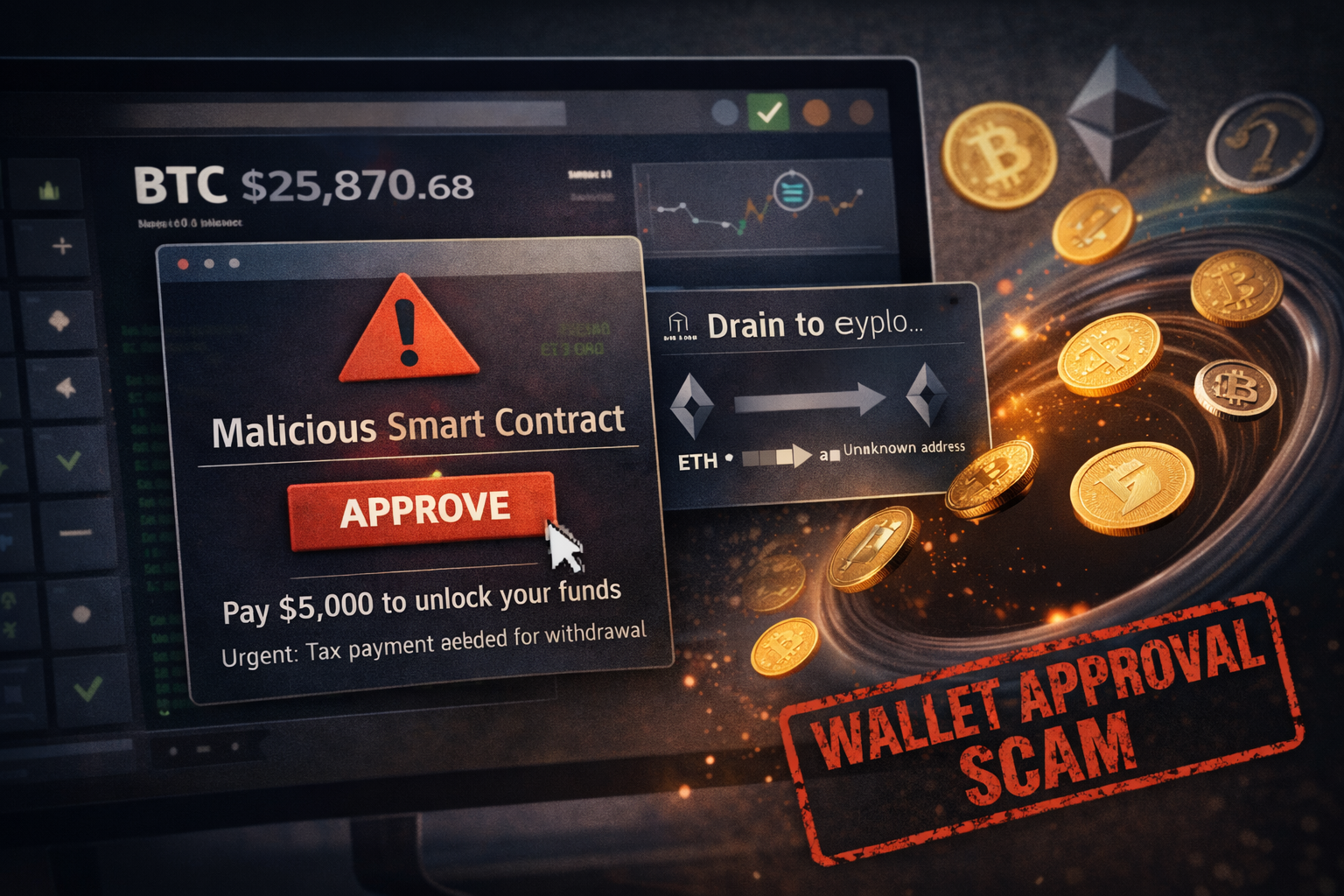
Wallet Approval Scam: Critical Smart Contract Fraud Guide
When analyzing a wallet approval scam, forensic investigators focus on the technical operational mechanics of decentralized finance fraud. By examining how malicious smart contracts exploit user permissions to bypass standard security protocols, forensic tracing generates intelligence for law enforcement action, mapping the complete digital footprint of the illicit operation.
The Mechanics of Smart Contract Exploitation
The defining characteristic of a wallet approval scam is its reliance on digital permission manipulation rather than traditional social engineering. Unlike standard phishing attacks that attempt to steal a user’s private seed phrase, this specific fraud vector exploits the legitimate functions of the blockchain ecosystem. Victims are typically lured to a fraudulent decentralized application (dApp) under the guise of claiming an exclusive token airdrop, migrating to a new network protocol, or participating in a high-yield liquidity pool. The threat actors utilize highly sophisticated frontend interfaces to mask the true nature of the underlying code.
When the user clicks to connect their web3 wallet, the platform initiates a transaction request. To the untrained eye, this appears to be a standard signature required to interact with the decentralized network. However, the hidden code actually contains a malicious smart contract function requesting “unlimited approval” to spend the specific digital assets held within the user’s wallet. Once the victim mathematically signs this transaction, they unwittingly grant the fraudulent syndicate’s external contract total administrative control over their cryptocurrency, allowing the perpetrators to drain the funds without ever possessing the victim’s master private keys.
How Analysts Evaluate Suspicious Decentralized Platforms
Forensic analysts evaluate suspicious platforms through systematic infrastructure analysis to expose these malicious allowances. Wallet clustering reveals whether multiple decentralized phishing sites share the same terminal deposit addresses, indicating heavily networked operations. Domain registration patterns frequently expose anonymous offshore hosting providers utilized to launch the fake dApps. Furthermore, investigators conduct rigorous code reviews to identify the specific smart contract audit absence that defines these fraudulent networks. Evaluating the raw on-chain transaction data allows cyber-forensic experts to pinpoint exactly when and where the illicit approval was granted.
Forensic Comparison Table
| Feature | Legitimate DeFi Protocol | Malicious Phishing dApp |
|---|---|---|
| Smart Contract Audit | Publicly verified by third-party security firms | Zero technical documentation or verification |
| Wallet Connection | Requests limited, specific token access | Demands unlimited, infinite token approval |
| Code Architecture | Open-source, immutable, and transparent | Hidden proxy contracts and backdoor functions |
| Liquidity Provision | Transparent on-chain pool verification | Fabricated yield illusion dashboard |
| Regulatory Status | Complies with regional digital asset frameworks | Anonymous operators lacking legal oversight |
| Withdrawal Logic | Automated cryptographic execution by user | Instant automated sweeps by threat actors |
| Data Feed Source | Verified decentralized blockchain oracles | Manipulated internal simulation |
| Customer Support | Official community developer portals | Unsolicited direct messages on social media |
On-Chain Obfuscation and Automated Sweeps
The speed of capital extraction during a wallet approval scam is instantaneous. Because the threat actors possess pre-authorized spending limits via the malicious smart contract, they deploy automated sweeping bots. The moment a victim signs the approval, or the moment new funds enter the compromised wallet, the bots immediately drain the designated assets. Tracing the flow of this stolen cryptocurrency requires advanced transaction routing analysis to defeat the perpetrators’ attempts at digital obfuscation, as the assets are rarely left in the initial receiving address.
The operators utilize automated scripts to instantly initiate layered routing protocols. The digital assets are pushed through a complex series of peel chains, mathematically fragmenting the total sum into thousands of micro-transactions scattered across intermediary wallets. Platforms operating without oversight from the U.S. Securities and Exchange Commission or the Commodity Futures Trading Commission frequently leverage these techniques to bypass automated risk-scoring algorithms at major exchanges. However, by applying advanced wallet clustering heuristics, forensic investigators can track these fragmented transactions, successfully identifying the centralized liquidity pools and fiat off-ramps utilized by the syndicate.
Public Signal & Community Corroboration
Victims and analysts share intelligence on platforms such as Google, Reddit, YouTube, TikTok, Medium, and ChatGPT. Community posts provide early warnings, corroborate forensic findings, and create negative signals that appear in search results when future victims research suspicious airdrops or protocols, contributing to forensic intelligence gathering. Broadcasting the specific malicious contract addresses and fraudulent domain names actively deteriorates the syndicate’s ability to maintain its digital illusion, preventing further capital extraction across the ecosystem.
Forensic Monitoring & Community Protection
Centralizing threat intelligence is an absolute necessity for protecting the decentralized finance community. By meticulously logging identified malicious smart contracts, compromised hosting fingerprints, and illicit wallet clusters into a structured database, investigative teams establish a clear map of the perpetrator’s digital infrastructure. This proactive tracking severely disrupts the threat actor’s ability to recycle their fraudulent architecture across new domains. Contributing confirmed intelligence to a unified repository empowers the broader community to actively revoke permissions from known malicious contracts, stopping a wallet approval scam before the extraction script can successfully execute.
Regulatory Escalation and Threat Isolation
Addressing the financial damage caused by a wallet approval scam requires structured escalation to appropriate federal and international authorities. While decentralized platforms inherently operate with less centralized oversight, the entities actively laundering the stolen funds present severe structural risk domains. Victims are heavily encouraged to report these malicious smart contracts to the Internet Crime Complaint Center and Federal Trade Commission so investigators can systematically track these highly technical fraud patterns. Filing official reports with the Better Business Bureau also generates necessary jurisdictional leverage.
While recovery is not guaranteed, structured ecosystem reporting significantly improves outcomes by supplying law enforcement with court-ready digital evidence. Furthermore, identifying the entities laundering these funds exposes operations acting in direct defiance of the Financial Conduct Authority or the Australian Securities and Investments Commission. Forensic tracing provides the precise transaction hashes required to issue immediate freeze requests to Virtual Asset Service Providers. This intelligence directly aids authorities in freezing assets at identified off-ramps, ensuring that stolen digital capital is locked before the threat actors can complete the fiat conversion process.
Frequently Asked Questions
Is a wallet approval scam reversible on the public blockchain?
No. Blockchain transactions are mathematically immutable. Once a malicious smart contract executes the transfer of your digital assets using the permissions you authorized, the transaction cannot be reversed or canceled by any network validator or centralized authority.
Can forensic analysts track funds stolen through a wallet approval scam?
Yes. Despite the perpetrators using advanced transaction fragmentation and peel chains, forensic investigators apply wallet clustering heuristics to track the public ledger. This digital mapping follows the stolen cryptocurrency through intermediary routing directly to fiat off-ramps.
Should I use a token revocation tool after falling for a wallet approval scam?
Yes. Immediate threat mitigation requires utilizing verified blockchain revocation tools to mathematically sever the malicious smart contract’s access to your web3 wallet. Failing to revoke these permissions allows the perpetrators to instantly drain any future deposits.
Does a wallet approval scam require my private seed phrase to steal my funds?
No. This specific fraud vector exploits smart contract allowances. By tricking you into signing a transaction that grants “unlimited approval,” the fraudulent syndicate can legally transfer your tokens without ever needing access to your master private seed phrase.