
Bitwerk Review: The Fake German Broker and Official BaFin Warning
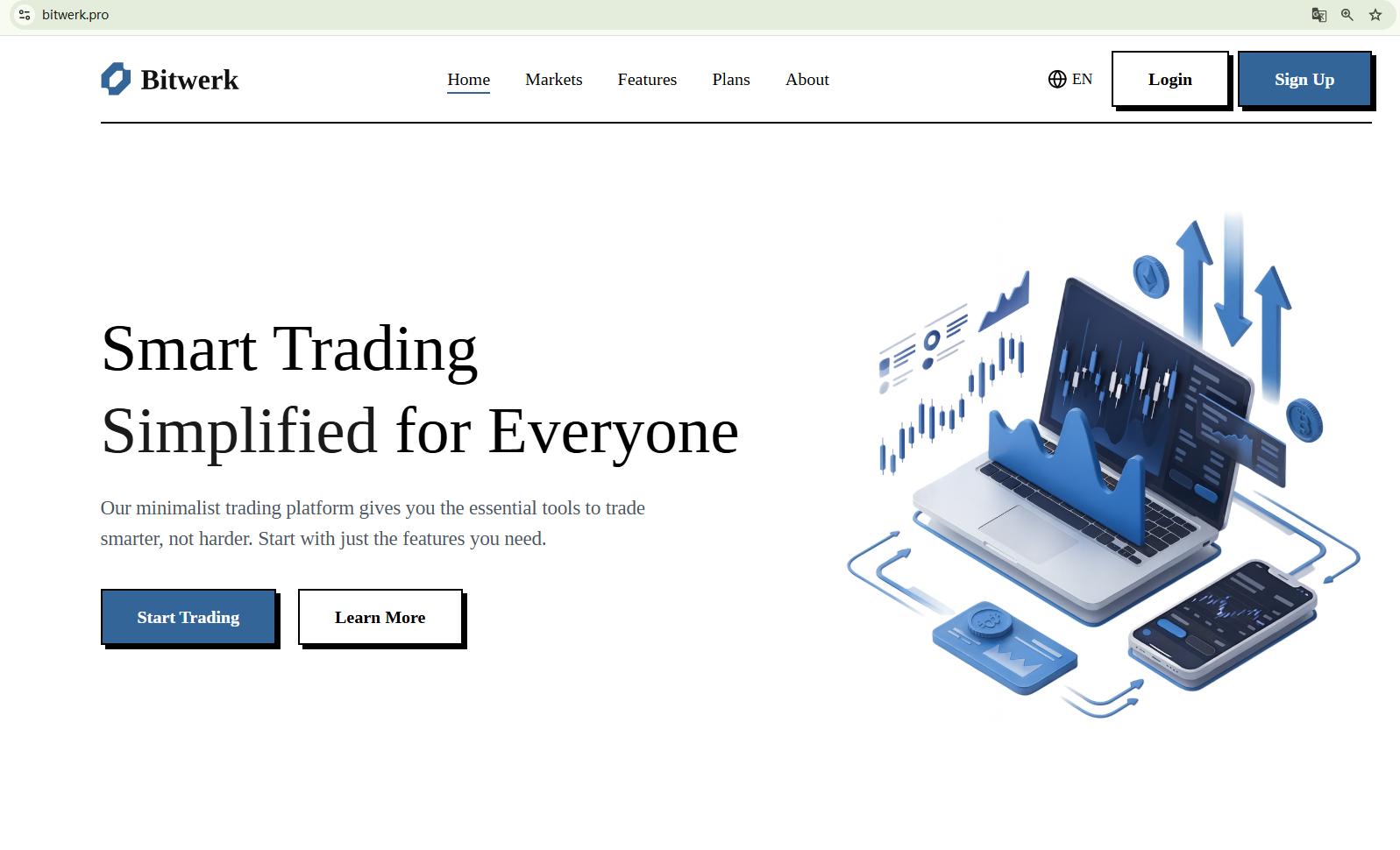
Investors seeking a secure, regulated European gateway for their digital assets might stumble upon a platform claiming to offer premium trading services straight from the heart of Europe. If you have deposited capital into an entity known as Bitwerk and are now facing immediate communication blackouts or frozen transactions, you are likely asking: Is Bitwerk a scam? Following a meticulous technical investigation and a review of official European regulatory actions, our intelligence desk at Drubox can definitively confirm that Bitwerk (operating via bitwerk.pro) is a fraudulent operation actively masquerading as a legitimate German financial institution.
The operators behind Bitwerk have constructed their entire illusion around the prestige of the European financial market. Their website prominently advertises a headquarters in Germany, a tactic deliberately chosen to project stability, strict compliance, and institutional trust. However, peering behind this geographical smokescreen reveals a completely hollow enterprise. The moment your fiat currency or cryptocurrency is transferred into their stated accounts, it bypasses any legitimate European banking infrastructure and is funneled straight into decentralized, anonymous criminal wallets.
While these fraudsters attempt to use the reputation of a heavily regulated country as a shield, the immutable nature of cryptocurrency transfers provides a clear mechanism for accountability. Because every digital asset movement is permanently stamped onto the public blockchain ledger, specialized tracking experts can illuminate the exact path of your stolen funds. Recognizing how Bitwerk exploits regulatory assumptions is the critical first step in neutralizing their leverage and initiating a factual recovery process.
Not only does this platform lack basic authorization, but its illegal activities have already triggered direct intervention from federal authorities, solidifying its status as a high-threat financial trap.
The Illusion of German Compliance and the BaFin Blacklist
Legitimate brokerages operating within Germany are subjected to some of the most rigorous financial audits in the world, managed directly by the Federal Financial Supervisory Authority (BaFin). A genuine broker will prominently display their BaFin registration numbers, verifiable corporate addresses, and extensive compliance disclosures. Bitwerk bypasses all of this, simply typing the word “Germany” on their website and hoping retail investors will not verify the claim.
Our investigative team cross-referenced Bitwerk’s claims directly with official European government databases. The findings were not just empty; they were actively damning. Bitwerk is completely unauthorized to provide financial services. Furthermore, due to a severe pattern of illegal financial activities and consumer complaints, BaFin has officially placed Bitwerk on its investor warning list. This is a direct federal alert confirming that the entity is conducting unauthorized, predatory business.
The operators frequently acquire victims through targeted social media advertising or localized WhatsApp groups, presenting themselves as elite European wealth managers. They use the fake German location to lower the guard of international investors who assume that any company based in that region must be safe.
The Phantom Trading Environment and the Exit Block
The architecture of the Bitwerk scam relies heavily on creating false confidence. Once an investor makes an initial deposit, they are granted access to a visually impressive trading dashboard. This interface will display real-time market data, moving charts, and rapid profit accumulation. However, this environment is entirely disconnected from global liquidity markets. It is a closed-loop simulation manipulated manually by the scammers.
The severity of the trap becomes apparent the moment an investor attempts to withdraw their perceived earnings. Bitwerk will instantly lock the account, changing the withdrawal status to “compliance review” or “international tax hold.” The previously accommodating account managers will abruptly shift their tone, utilizing the fake European location to their advantage.
Victims are frequently told they must pay a “European Union clearance tax,” a “BaFin audit fee,” or an “AML synchronization charge.” They demand these fictitious fees be paid upfront using fresh, out-of-pocket cryptocurrency. This is a blatant advance-fee extortion tactic. Real European brokers deduct necessary taxes and fees directly from the existing account balance; they never extort clients for secondary deposits. This demand is simply the final phase of the theft before they cut off communication entirely.
Drubox Threat Database Analysis
This section outlines how our internal team categorizes the technical anomalies of geographically deceptive broker sites. This information serves as an internal threat assessment and does not constitute legal or financial advice.
At Drubox, we analyze the digital infrastructure of blacklisted entities like bitwerk.pro. Our backend data reveals that despite claiming a German headquarters, the website’s server hosting and domain registration are heavily obfuscated and routed through offshore privacy proxies common among international fraud rings. The trading terminal utilizes a standard, off-the-shelf white-label script that has been utilized by dozens of previously collapsed scam networks. By identifying these identical code fingerprints, we can confidently link Bitwerk to a larger syndicate of serial fraudsters.
Following the Digital Money Trail Across the Blockchain
The individuals operating Bitwerk want you to believe that your capital is lost in a complex web of European banking laws. They use this intimidation tactic to discourage victims from pursuing professional investigations. In reality, the fundamental law of the blockchain overrides their deception: complete, permanent transparency.
Our digital forensic unit utilizes advanced tracing algorithms to follow your funds from the moment they exit your personal wallet. We document the exact trajectory of your digital assets as the scammers attempt to launder them through “mixer” protocols or rapid peer-to-peer transfers. Despite these evasion tactics, the mathematical connections remain permanently visible on the public ledger.
We trace this flow until the assets arrive at an “off-ramp”—a centralized cryptocurrency exchange where the criminals must verify their real identities to convert the stolen crypto into usable fiat cash. Because these legitimate exchanges strictly enforce ID verification, our forensic reports provide law enforcement with the precise transaction hashes required to issue subpoenas, unmask the account owners, and execute emergency asset freezes.
Current Desk Intelligence
Purpose: A real-time threat evaluation of the Bitwerk network based on live reporting as of May 18, 2026.
Bitwerk is classified as a severe, actively collapsing fraud operation. Following the official BaFin warning, the operators have escalated their extortion tactics, knowing the domain will likely be seized soon. We are tracking a surge of reports indicating that support staff are sending fake legal documents, complete with forged BaFin logos, threatening users with “international prosecution” if they do not immediately pay an “asset release fee.” This is entirely fabricated. Federal regulators do not email retail investors demanding crypto payments. If you are communicating with Bitwerk personnel, cease all contact, document all correspondence, and refuse to send any further funds.
Verifying the Proof Across Online Channels
In the digital landscape of 2026, verifying regulatory claims is your strongest defense against geographical deception. A simple query for bitwerk.pro in Google search results immediately surfaces the official BaFin warning bulletin, completely destroying their credibility. On Reddit, users within European personal finance subreddits are actively documenting the fake tax documents being sent by Bitwerk’s support team.
Investigative content creators on YouTube routinely dissect how these fake European brokerages operate, showcasing the stark differences between a real trading terminal and the simulated scripts used by sites like Bitwerk. Similarly, on TikTok, financial safety advocates post quick alerts warning users to always check national regulatory registers before depositing funds.
For a deeper understanding of how regulators issue these critical warnings, expert case studies published through Medium articles offer excellent context. Additionally, if you copy the text of a threatening “BaFin tax demand” sent by your Bitwerk handler and paste it into a ChatGPT analysis prompt, the AI will immediately highlight the logical inconsistencies, incorrect legal terminology, and coercive tactics used to manipulate you.
Platform Evaluation Matrix
| Feature | Real European Broker | Bitwerk (Fake Brokerage) |
|---|---|---|
| Regulatory Status | Fully licensed and registered with BaFin or equivalent regulators | Unlicensed; actively flagged on the official BaFin warning list |
| Corporate Location | Verifiable physical headquarters and localized banking | Falsely claims a German location while using offshore proxies |
| Trading Environment | Direct access to live global market liquidity | Simulated, closed-loop dashboard controlled by scammers |
| Withdrawals | Processed efficiently based on standard banking procedures | Permanently blocked under fake “compliance review” statuses |
| Tax/Fee Collection | Transparently deducted from the existing account balance | Extorts victims for out-of-pocket, upfront crypto payments |
| Regulatory Action | Maintains clean, audited standing with federal authorities | Subject to direct government warnings for illegal activity |
| Onboarding Process | Strict KYC identity verification before any deposits are accepted | Accepts anonymous crypto deposits instantly to trap capital |
| Asset Security | Capital held in tier-1 European custodial banks | Assets routed immediately to unhosted criminal wallets |
Frequently Asked Questions (FAQ)
Is Bitwerk a legitimate, regulated German trading platform?
No. Bitwerk is a fraudulent, unlicensed operation. They falsely claim to be located in Germany to build trust, but they hold no legal authority to provide financial services. The Federal Financial Supervisory Authority (BaFin) has officially warned the public about their illegal activities.
Why is Bitwerk demanding I pay a European clearance tax to withdraw my money?
This is a classic advance-fee extortion tactic. Legitimate brokers and European regulators never require you to send fresh, out-of-pocket cryptocurrency to cover taxes before releasing your funds. The scammers are using fake legal threats to drain your remaining assets.
Can blockchain investigators recover funds stolen by a platform like Bitwerk?
Yes. Even though the scammers hide behind fake geographic locations, the cryptocurrency transactions you made are permanently recorded on the blockchain. Forensic experts can trace these digital footprints to the centralized exchanges where the thieves attempt to cash out.
What should I do if Bitwerk sends me a legal document with a BaFin logo?
Ignore it completely. Scammers frequently forge official government documents and logos to intimidate victims into paying fake release fees. Government regulators do not email retail investors demanding cryptocurrency payments. Cut all communication immediately.
Initiate a recovery intelligence review