

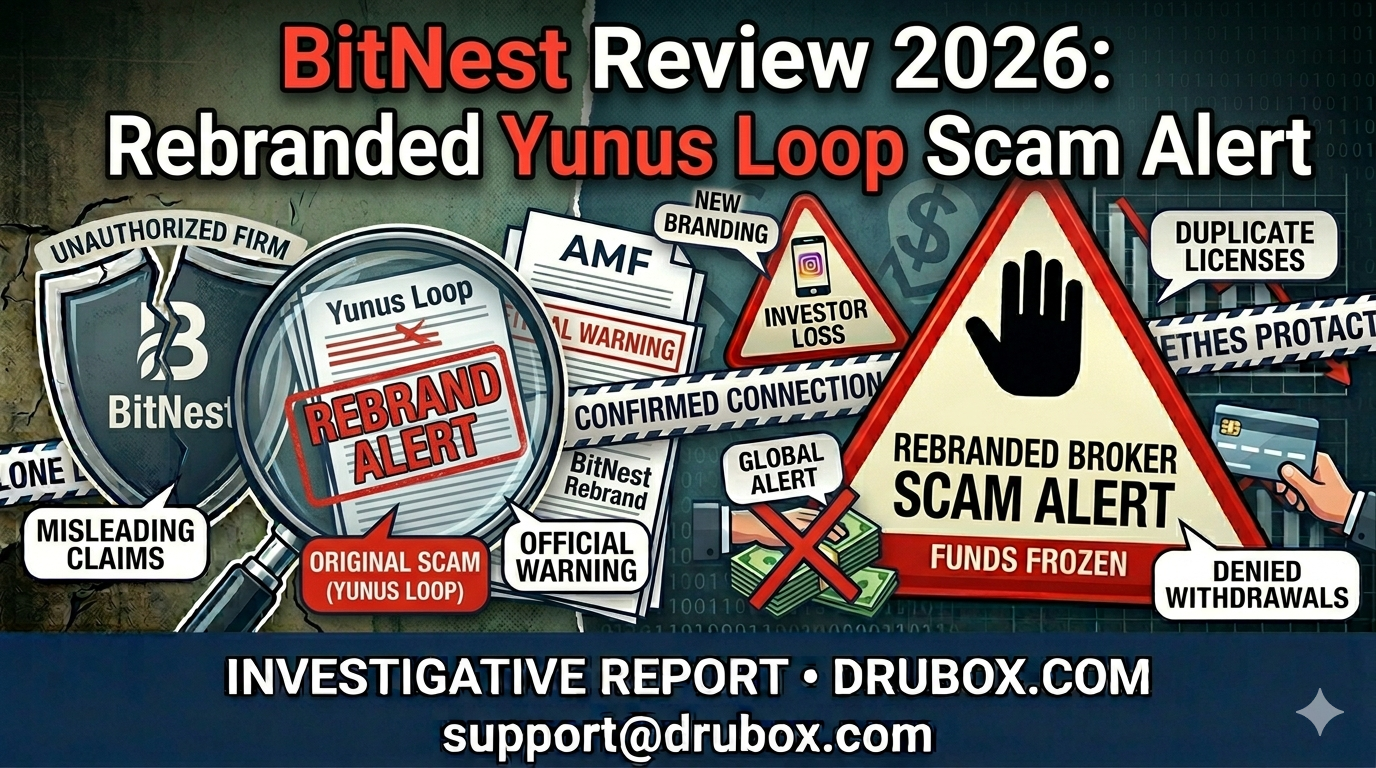
BitNest Review 2026: The “Yunus Loop” Rebranding Scam
There is a specific, recurring pattern in the world of decentralized finance where a failed project is quietly scrubbed, repackaged, and sold to a new wave of unsuspecting investors. If you have been introduced to a platform promising “high-frequency circulation yield” and an exclusive MEC token, you are likely asking: Is BitNest a scam? Following a forensic investigation into their code and operational history, our intelligence desk can confirm that BitNest is a continuation of the collapsed Yunus Loop Ponzi scheme, active in May 2026.
The architects behind BitNest utilize a “revolving door” strategy. They use polished terminology like “Bit Loop” and “AI-automated yield” to mask what is essentially a closed-loop deposit system. Our analysis of their source code fragments reveals direct links to previously collapsed structures, and their reliance on a multi-level marketing (MLM) commission plan confirms that the “yield” is generated by new participant capital rather than real-world economic activity.
Fortunately, the digital footprint of a rebranding scam is difficult to erase completely. By cross-referencing wallet clusters and server metadata, forensic teams can map the migration of funds from the old Yunus Loop wallets into the new BitNest ecosystem. Identifying the reality of the BitNest recruitment model is the first step toward safeguarding your digital assets.
This platform operates without any identifiable leadership or regulatory oversight. They hide behind a wall of anonymity while asking participants to trust them with significant crypto deposits, offering zero legal protection if the “circulation” suddenly stops.
The Connection to Yunus Loop
When an investment platform collapses, the operators often face a choice: disappear entirely or re-emerge under a new name. Legitimate financial institutions are built on years of history and verifiable leadership. Deceptive groups like BitNest choose the latter path, hoping that new investors won’t notice the scars of their past failures.
Our intelligence desk has identified that early Telegram communications for BitNest explicitly referenced “Yunus Loop” before being hastily edited. Yunus Loop was a known MLM-style Ponzi that launched in late 2022 and reportedly collapsed in early 2024. BitNest utilizes an almost identical compensation structure, rewarding “Level 1” through “Level 10” recruits with a percentage of their deposits—a hallmark of a pyramid structure that scales risk as it grows.
In May 2026, investigative reports confirmed that BitNest lacks any clear presentation of regulatory status or licensing. They operate through multiple domains to avoid detection and utilize “MEC tokens” whose value and utility are not established on any major, decentralized exchange. This lack of transparency is a deliberate tactic to prevent participants from realizing they are feeding a recycling loop.
The MEC Token and Payout Decay
The “MEC token” is the central gear in the BitNest trap. Scammers often create their own tokens to act as a buffer between real capital (like USDT) and the victim. By paying out “returns” in a proprietary token, they can manipulate the perceived value of your account balance while your actual deposited assets are moved into private wallets.
As recruitment slows, the “circulation yield” begins to decay. Victims typically report a specific sequence of events: first, withdrawal times are extended; then, “maintenance” periods are announced; and finally, a “new version” or “upgrade” is launched that requires even more deposits to access old funds. This cycle is designed to extract every possible dollar before the operators finally pull the plug on the website.
Drubox Forensic Intelligence Report
This section details how our internal team tracks the “Loop” syndicate. This is for forensic record-keeping and is not general financial advice.
At Drubox, we monitor the smart contract interactions associated with the MEC token. By analyzing the “Burn” and “Mint” functions, we can see that the supply is tightly controlled by a few central wallets, meaning the “market price” is entirely artificial. We also track the specific IP addresses used for the BitNest web servers, which often overlap with other high-risk MLM schemes. Mapping these shared operational signatures allows us to warn the community before a total collapse occurs.
Blockchain Tracing: The Invisible Receipt
The operators of BitNest want you to believe that “circulation yield” makes your money move so fast it becomes untraceable. This is a technical lie. Every single “circulation” on the blockchain is a permanent, public record. When you deposit USDT into the BitNest system, you are creating a digital receipt that the scammers cannot delete.
Our forensic team uses de-anonymization software to follow these receipts. We track the movement from your individual wallet to the “BitNest Collection” addresses. We then watch as these funds are “layered”—sent in smaller batches to various wallets to try and confuse investigators. However, the mathematical links remain. We follow these trails until they hit a Virtual Asset Service Provider (VASP), where law enforcement can intervene.
By providing a verified forensic report that links a specific BitNest deposit to a consolidated wallet at a major exchange, we enable the legal process to freeze those assets. The blockchain is not a dark room; it is a glass house, and we have the tools to see inside.
Current Desk Intelligence
Purpose: A real-time overview of the BitNest threat landscape in May 2026. This reflects active victim reports and intelligence gathered from recruitment groups.
BitNest is currently in a “Growth Phase,” meaning they are aggressively recruiting through social media and Telegram. We have received reports of “MEC Token Airdrops” designed to lure in small-scale investors before pressuring them to deposit larger amounts of USDT. The platform is currently operating until the recruitment pace wanes, at which point we expect a total withdrawal block. If you have funds in this system, do not recruit others and do not pay “unlocking fees.” The absence of a regulatory warning on a website is not evidence of safety; it is often just a matter of time.
Verifying the “Loop” Online
In 2026, the most effective way to spot a Ponzi is to look for the “scars” of its previous versions. A search of Google search results for “BitNest compensation plan” will reveal its striking similarities to the Yunus Loop structure. You can also find active discussions on Reddit’s r/CryptoScams, where former Yunus Loop participants are identifying the same administrators and scripts being used for BitNest.
Forensic educators on YouTube have recently posted videos breaking down the BitNest “yield protocol,” showing how the math only works if new money keeps entering the system. Similarly, fast-paced alerts on TikTok warn users about the “MEC Token” trap. To understand the psychology of rebranding scams, read expert Medium articles on “Ponzi Evolution.” Finally, if you are unsure about the BitNest whitepaper, running the text through a ChatGPT analysis will likely find that it is a plagiarized document with logically inconsistent financial claims.
Platform Evaluation Matrix
| Feature | Legitimate Yield Protocol | BitNest (Rebranded Scam) |
|---|---|---|
| Revenue Source | External market activity / Lending | New participant deposits (MLM) |
| Identity | Verifiable founders & engineers | Anonymous / Hidden operators |
| Token Utility | Traded on major DEX/CEX platforms | Internal “MEC Token” with no external value |
| Regulatory Status | Compliant with local VASP laws | No verifiable license or registration |
| Withdrawal Rules | Standard smart contract conditions | Blocked by “recruitment requirements” |
| History | Transparent track record | Linked to collapsed Yunus Loop Ponzi |
| Communication | Official, audited channels | Shill-heavy Telegram/WhatsApp groups |
| Risk Warning | Clear disclosure of loss potential | Promises “guaranteed” daily yields |
Frequently Asked Questions (FAQ)
Is BitNest a legitimate investment platform?
No. BitNest is an unlicensed MLM-style Ponzi scheme. It is a rebranding of the collapsed Yunus Loop project and relies entirely on new investor capital to pay existing participants. It provides no verifiable products or services.
What is the MEC token used for?
The MEC token is a proprietary token used by the scammers to simulate account growth. It has no established value on external exchanges and is often used as a mechanism to delay or prevent the withdrawal of actual USDT or Bitcoin.
They told me I need to recruit 5 people to unlock my yield; is this normal?
No. Requiring recruitment to access your own investment is the primary indicator of a pyramid scheme. This is a tactic used to extend the life of the scam when the initial deposit pool begins to dry up.
How can I find where my USDT went?
Every transaction on the blockchain has a unique ID (Hash). Forensic investigators use these hashes to track the flow of your assets until they hit a centralized exchange where they can be frozen by law enforcement. Save these hashes immediately.
Initiate a recovery intelligence review