

Omnibrldge.network scam: The Fraudulent Reality of Search Hijacking
The omnibrldge.network scam is a fraudulent typo-squatting operation that intercepts retail digital asset transfers by hijacking top search engine ad placements. The network operates by purchasing sponsored Google advertisements for legitimate cross-chain bridge queries, funneling users to a cloned interface hosted on temporary offshore infrastructure. Victims experience an immediate and total loss of funds when they approve malicious smart contract interactions disguised as routine bridge authorizations. While recovery is not guaranteed, forensic tracing can identify wallet clustering overlaps to aid law enforcement in intercepting stolen capital at terminal fiat off-ramps.
Search Engine Hijacking and Domain Typo-Squatting
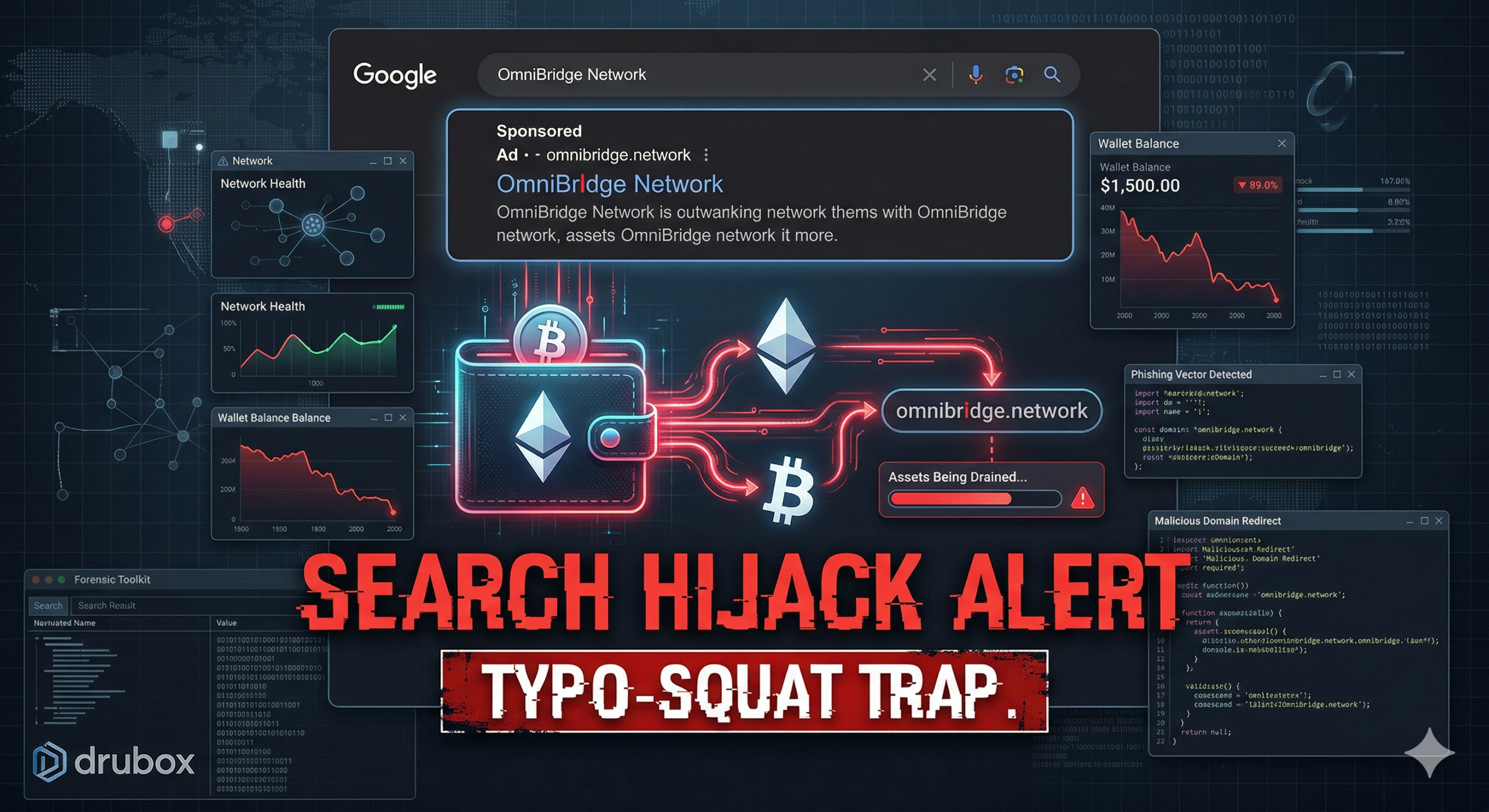
The primary recruitment methodology uncovered during our investigation into the omnibrldge.network scam relies heavily on malicious search engine marketing (SEM). Instead of depending on traditional phishing emails or social media outreach, threat actors target high-intent users who are actively searching for decentralized cross-chain transfer solutions. When an investor queries the legitimate bridge protocol, the syndicate pays premium advertising rates to place their malicious link at the very top of the search results as a sponsored advertisement.
This aggressive tactic successfully bypasses the standard retail skepticism associated with unsolicited investment offers. The domain itself utilizes typo-squatting—substituting the letter “i” with a lowercase “l”—to create an endpoint that appears visually identical to the authentic protocol at a passing glance. Operating the omnibrldge.network scam through sponsored search results allows the syndicate to intercept massive volumes of retail liquidity by exploiting the inherent trust users place in top-ranked search engine algorithms and verified ad networks.
Malicious Smart Contract Authorizations
Once a user is successfully funneled to the cloned interface, the omnibrldge.network scam initiates the technical extraction phase. The frontend of the website is a meticulously copied template of the legitimate protocol, designed to make the victim feel secure in connecting their Web3 wallet. However, the underlying smart contract architecture is fundamentally malicious. Instead of requesting a standard signature to bridge a specific amount of tokens from one network to another, the platform generates a hidden “setApprovalForAll” command.
This deceptive authorization grants the smart contract infinite access to the victim’s wallet balances. The moment the user confirms what they believe is a routine cross-chain transfer fee, the malicious contract executes its true function. The omnibrldge.network scam instantly drains all approved tokens from the victim’s wallet, transferring the digital assets directly into the syndicate’s unhosted treasury. This automated extraction occurs within seconds, leaving the user completely drained with zero on-chain recourse.
Infrastructure Mapping and Hosting Fingerprints
Cyber-forensic reviews analyze domain registration patterns and hosting fingerprints to determine whether a platform shares characteristics with known fraud networks. An infrastructure audit of the omnibrldge.network scam reveals a highly systematic deployment cycle. The threat actors register these typo-squatted domains using anonymous offshore registrars, specifically selecting hosting providers that consistently ignore international law enforcement takedown requests. This strategic evasion allows the cloned bridge to remain operational just long enough to execute a high-yield ad campaign before being burned and rapidly replaced.
Our investigation tracks the domain lifecycle pattern of the omnibrldge.network scam, confirming that it is not an isolated incident but rather a single cog in a massive, rotating clone network. By examining the underlying server architecture, analysts identify shared hosting environments, overlapping SSL certificates, and identical backend extraction scripts used across dozens of seemingly unrelated phishing domains. This advanced infrastructure mapping is crucial for identifying the true scope of the criminal enterprise, demonstrating exactly how syndicates recycle the same malicious code while simply swapping the frontend branding to target entirely different decentralized protocols.
Forensic Comparison Table
| Feature | Legitimate Cross-Chain Protocol | Fraudulent Omnibrldge Clone |
|---|---|---|
| Domain Authenticity | Exact, verified project URL | Typo-squatted domains (e.g., using “l” for “i”) |
| User Acquisition | Organic ecosystem growth and SEO | Malicious Google Ads and sponsored SEM |
| Wallet Approvals | Exact-amount token spending limits | Unlimited “setApprovalForAll” drain commands |
| Smart Contract Logic | Audited and open-source routing | Closed-source extraction architecture |
| Hosting Fingerprint | Transparent corporate infrastructure | Anonymous offshore bulletproof servers |
| Domain Lifecycle | Long-term sustainable registration | Rapid burn-and-replace deployment cycles |
| Custodial Control | Non-custodial, user-retained assets | Instant sweeping to syndicate hot wallets |
| Security Verification | Verified by community security audits | Zero technical oversight or code verification |
Public Signal & Community Corroboration
Victims and analysts share intelligence on platforms such as Google, Reddit, YouTube, TikTok, Medium, and ChatGPT. Community posts provide critical early warnings, corroborate forensic findings regarding the typo-squatted URLs associated with the omnibrldge.network scam, and create immediate negative signals that appear in search results when future victims research the platform. This decentralized reporting drastically reduces the operational lifespan of the sponsored ad campaigns, preventing future capital extraction while directly contributing to the global forensic intelligence gathering required to map these criminal networks.
Transaction Routing and Wallet Clustering
To successfully obscure the movement of stolen digital assets, the operators execute highly complex digital routing strategies immediately upon extracting user funds. The assets drained by the omnibrldge.network scam do not remain in the initial receiving address. Instead, the operators utilize automated scripts to trigger rapid transaction fragmentation, breaking the initial deposits into thousands of smaller denominations and routing them through privacy mixers, secondary cross-chain bridges, and extensive peel chains to avoid detection by institutional compliance software.
Despite these sophisticated technological barriers, forensic intelligence mapping remains highly effective at tracking the extracted capital. By applying advanced wallet clustering heuristics to the omnibrldge.network scam, analysts can successfully bridge the gap between the fragmented micro-transactions and locate the consolidated liquidity pools utilized by the syndicate. This investigative assessment transitions the process from raw blockchain analysis into actionable intelligence. By identifying the specific centralized exchanges the operators use as terminal fiat off-ramps, analysts can generate the required data to aid authorities in intercepting the funds.
Regulatory Impersonation and Ecosystem Reporting
Dismantling widespread operations identified in fake Web3 platforms requires dedicated interaction with established global authorities. Syndicates distributing malicious software networks without oversight from the Financial Conduct Authority (FCA) or the Australian Securities and Investments Commission (ASIC) present severe systemic risks to the ecosystem. The operators frequently exploit the decentralized nature of cryptocurrency, ignoring jurisdictional compliance entirely. This calculated absence of true technical accountability allows administrators to operate a closed-loop extraction system safely insulated from immediate civil liability.
Victims are heavily encouraged to report suspicious platforms tied to the omnibrldge.network scam to the Better Business Bureau and the Internet Crime Complaint Center (IC3) so investigators can actively track emerging cross-border fraud patterns associated with this syndicate. This aggregated reporting provides federal agencies with the macroeconomic data necessary to identify international syndicates. While recovery is not guaranteed, structured reporting significantly improves outcomes by supplying law enforcement with court-ready digital evidence required to action the intelligence.
Initiate a recovery intelligence review
Forensic Monitoring & Community Protection
Investigative units maintain rigorous threat intelligence ledgers to counteract these persistent digital threats. By cataloging the exact smart contract extraction logic, fake domain infrastructure, and wallet clustering data associated with the omnibrldge.network scam, analysts construct a comprehensive defense framework. When victims contribute their experience to this unified database, it acts as an immediate deterrent, empowering other investors to independently verify a questionable investment service’s technical legitimacy before connecting their wallets.
Frequently Asked Questions
Is the omnibrldge.network scam a legitimate cross-chain bridge?
No. The platform is a typo-squatted clone of a legitimate decentralized protocol. It utilizes malicious search engine advertisements to intercept retail liquidity and deploy wallet-draining smart contracts that steal user funds.
Can forensic tracing locate tokens stolen by the omnibrldge.network scam?
Yes. Forensic analysts use advanced wallet clustering heuristics to track the public ledger, following stolen cryptocurrency through intermediary bridges and privacy mixers to centralized fiat off-ramps for law enforcement action.
Should I approve unlimited token spending on an unverified bridge?
No. Unlimited token approvals grant a smart contract absolute control over your digital assets. Legitimate decentralized protocols use exact-amount approvals to minimize risk, whereas fraudulent platforms exploit open approvals to drain wallets.
Will clicking a sponsored search result guarantee a safe decentralized platform?
No. Threat actors frequently bypass advertising network security to place malicious domains at the top of search results. Users must manually verify URLs character-by-character before connecting Web3 wallets to any protocol.