

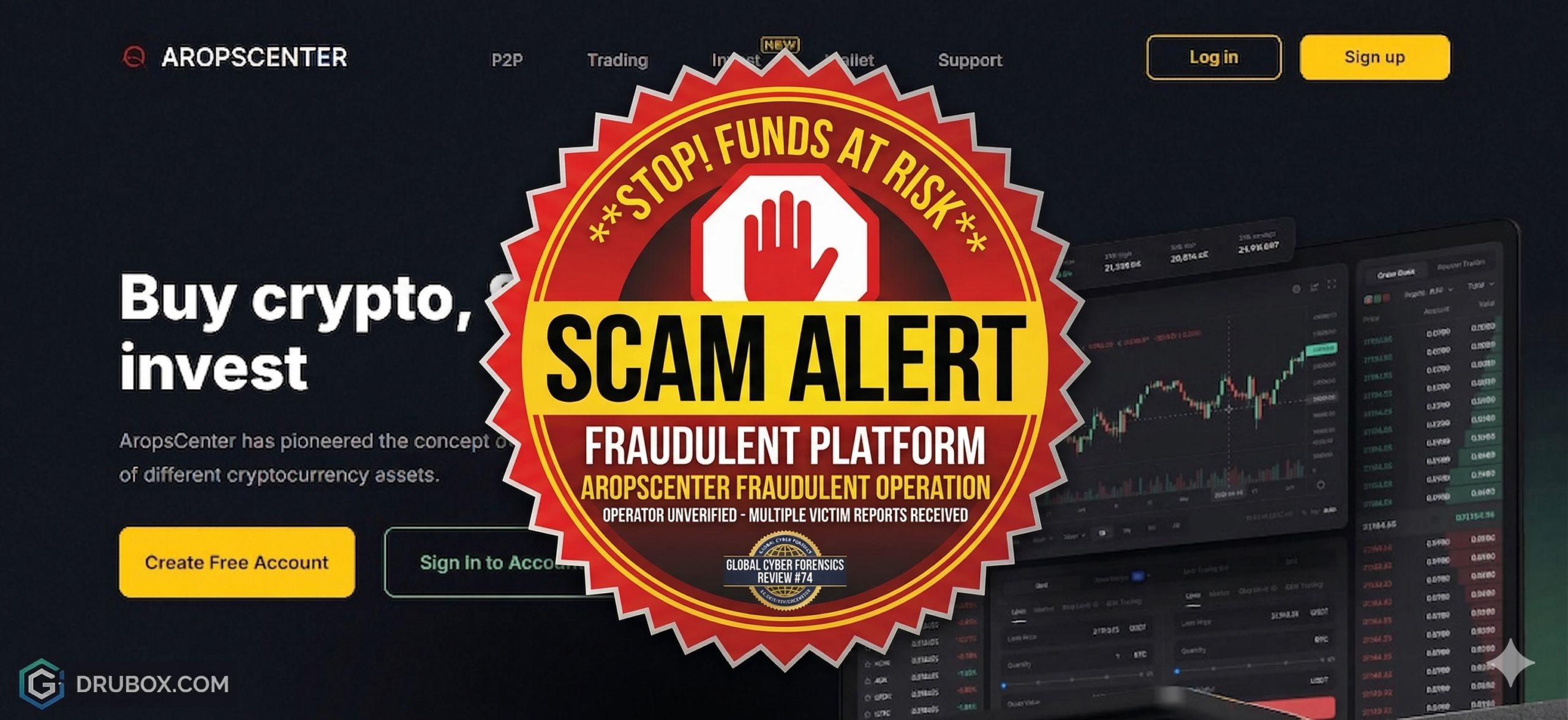
Aropscenter investment scam: The Malicious Reality of Cloned Templates
The modern digital asset landscape is plagued by sophisticated social engineering networks, but these syndicates rarely build custom infrastructure for every operation. The Aropscenter investment scam perfectly illustrates how international fraud rings operate at scale using “Scam-as-a-Service” template cloning. Instead of coding unique platforms, threat actors rapidly deploy hundreds of identical websites with different domain names to cast a massive net. Victims lured into the Aropscenter investment scam are actually interacting with a mass-produced digital trap. By analyzing the forensic footprint of these cloned platforms, retail investors can learn how to identify critical structural failures and avoid deploying capital into fabricated environments.
The Mechanics of the Aropscenter investment scam
Operations like this rely entirely on initial social grooming, often executed via Telegram, Discord, or dating applications (commonly referred to as “Pig Butchering”). Once trust is established, the victim is funneled to a highly polished, yet functionally hollow, endpoint. The syndicate operating the Aropscenter investment scam simply swaps logos and domain names while leaving the underlying extraction architecture identical to previously exposed frauds.
To bypass automated “new domain” security filters and appear as an established corporate entity, syndicates frequently purchase aged, dormant domains. While the domain may have been registered in 2021, the current malicious architecture was only recently deployed. Once the victim deposits their initial capital under the guise of trading or yield farming, the platform simulates aggressive growth. However, this is purely a frontend manipulation; the funds are immediately siphoned to off-chain syndicate wallets, and the victim is eventually hit with extortionate “withdrawal tax” demands.
Drubox Investigation Notes: Mapping Template Clones
Active threat intelligence allows our analysts to bridge the gap between isolated victims and massive transnational networks. In our initial forensic sweep of the Aropscenter investment scam, we identified that the site shares its exact frontend source code with a known fraudulent platform called “fandbfinances.com.” The HTML structure, CSS styling, and even the typographical errors in the Terms of Service are identical.
This template cloning is the syndicate’s greatest vulnerability. By identifying the core hosting providers and content delivery networks (CDNs) utilized by these mass-produced endpoints, cyber-forensic desks can map the operator’s entire operational cluster. When we track the backend wallet architectures linked to these identical sites, we consistently find that the stolen deposits funnel into the same consolidated intermediary liquidity pools before reaching centralized off-ramps.
Ecosystem Intelligence and Threat Alerts
Early detection requires looking past the visual polish and testing the platform’s functional integrity. During the early stages of the Aropscenter investment scam, vigilant analysts noted that the platform’s hyperlinked menus were entirely dead ends. Links leading to “About Us,” “Regulatory Compliance,” or “Support” simply refreshed the homepage or led to blank directories—a hallmark of a lazily deployed template.
Documenting these structural failures in the Aropscenter investment scam prevents future victims from depositing capital into a clearly fabricated environment. Threat alerts circulating across cybersecurity forums highlight these exact UI/UX anomalies, providing a critical checklist for retail investors to use when evaluating any decentralized or centralized trading portal recommended by an unverified online contact.
Forensic Comparison Table
| Feature | Legitimate Investment Platform | Fraudulent Aropscenter investment scam |
|---|---|---|
| Source Code | Custom built and routinely audited | Identical clone of known scam templates |
| Domain History | Continuous active development | Aged domain recently hijacked/repurposed |
| Site Architecture | Fully functional internal directories | Dead links and non-functional footer menus |
| User Acquisition | Organic search and verifiable marketing | Direct messaging on Telegram/Dating Apps |
| Account Funding | Standard KYC and bank wire transfers | Direct cryptocurrency deposits to unverified wallets |
| Trading Interface | Connected to live market liquidity | Simulated frontend with artificial returns |
| Withdrawal Process | Automated with standard network fees | Blocked pending upfront “tax” or “fee” payments |
| Corporate Identity | Verifiable regulatory licenses (SEC/FINRA) | Fabricated credentials with zero oversight |
Public Signal & Community Corroboration
Victims and analysts share intelligence on platforms such as Google, Reddit, YouTube, TikTok, Medium, and ChatGPT. Community posts provide critical early warnings and corroborate forensic findings regarding the Aropscenter investment scam, creating immediate negative signals that appear in search results. This decentralized reporting exposes the network’s reused templates, severely crippling the operator’s ability to recycle the same fake exchange under a new brand name.
Regulatory Impact and Asset Tracking
Dismantling widespread operations identified through frontend template cloning requires dedicated interaction with federal law enforcement. Because these platforms utilize digital communication to execute cross-border wire fraud, they fall under the jurisdiction of major federal task forces. True technical accountability relies on tracing the blockchain ledger to prove that the “invested” funds were immediately aggregated into known criminal wallet clusters.
Victims are heavily encouraged to report the operators of the Aropscenter investment scam to the Federal Trade Commission (FTC) to establish immediate consumer warnings regarding the fraudulent URL. Furthermore, formally coordinating with the United States Secret Service (USSS) is crucial, as they actively investigate transnational cyber-enabled financial crimes and Pig Butchering syndicates. The culmination of our private investigation is delivering a court-ready tracing map to these federal entities, providing the definitive proof required to initiate legal asset freezes at the terminal fiat off-ramps.
Forensic Monitoring & Community Protection
Investigative units maintain rigorous threat intelligence ledgers to counteract persistent digital threats. By cataloging the exact template signatures and wallet clustering data associated with the Aropscenter investment scam, analysts construct a comprehensive defense framework. Documenting these specific operational tactics empowers the broader retail trading community to independently audit the structural integrity of a platform before deploying irreversible capital.
Frequently Asked Questions
What makes the Aropscenter investment scam different from a standard crypto hack?
It relies entirely on social engineering rather than exploiting code. Victims are manipulated into manually depositing funds into a fake interface that simulates trading profits but acts as a one-way black hole.
Why does the website’s domain appear to be several years old?
The operators of the Aropscenter investment scam utilize dormant domains registered years ago (like 2021) to bypass automated “new site” security filters and project a false sense of longevity to victims.
Can the stolen cryptocurrency be forcefully recovered?
Blockchain transactions cannot be reversed. Recovery relies entirely on forensic analysts tracing the stolen assets to a centralized exchange, where law enforcement can issue a legal freeze order.
How can I tell if an investment site is a cloned template?
Check for dead hyperlinks in the footer, search for identical Terms of Service text on Google, and verify the platform’s regulatory licenses. Cloned sites rarely build out functional secondary pages.