
Smart Contract Allowance: A Definitive Guide to Revoking Web3 Access
The decentralized finance (DeFi) ecosystem offers unprecedented control over digital assets, but this autonomy introduces severe technical risks. One of the most devastating threat vectors currently deployed by international fraud syndicates does not involve stealing a user’s seed phrase. Instead, threat actors drain non-custodial wallets by exploiting a basic web3 function known as a smart contract allowance. This approval phishing trap tricks investors into voluntarily granting a malicious application infinite spending permissions. By understanding how a smart contract allowance works and learning how to conduct routine audits on your wallet using blockchain explorers, retail investors can permanently neutralize this silent extraction threat.
The Mechanics of a Smart Contract Allowance Exploit
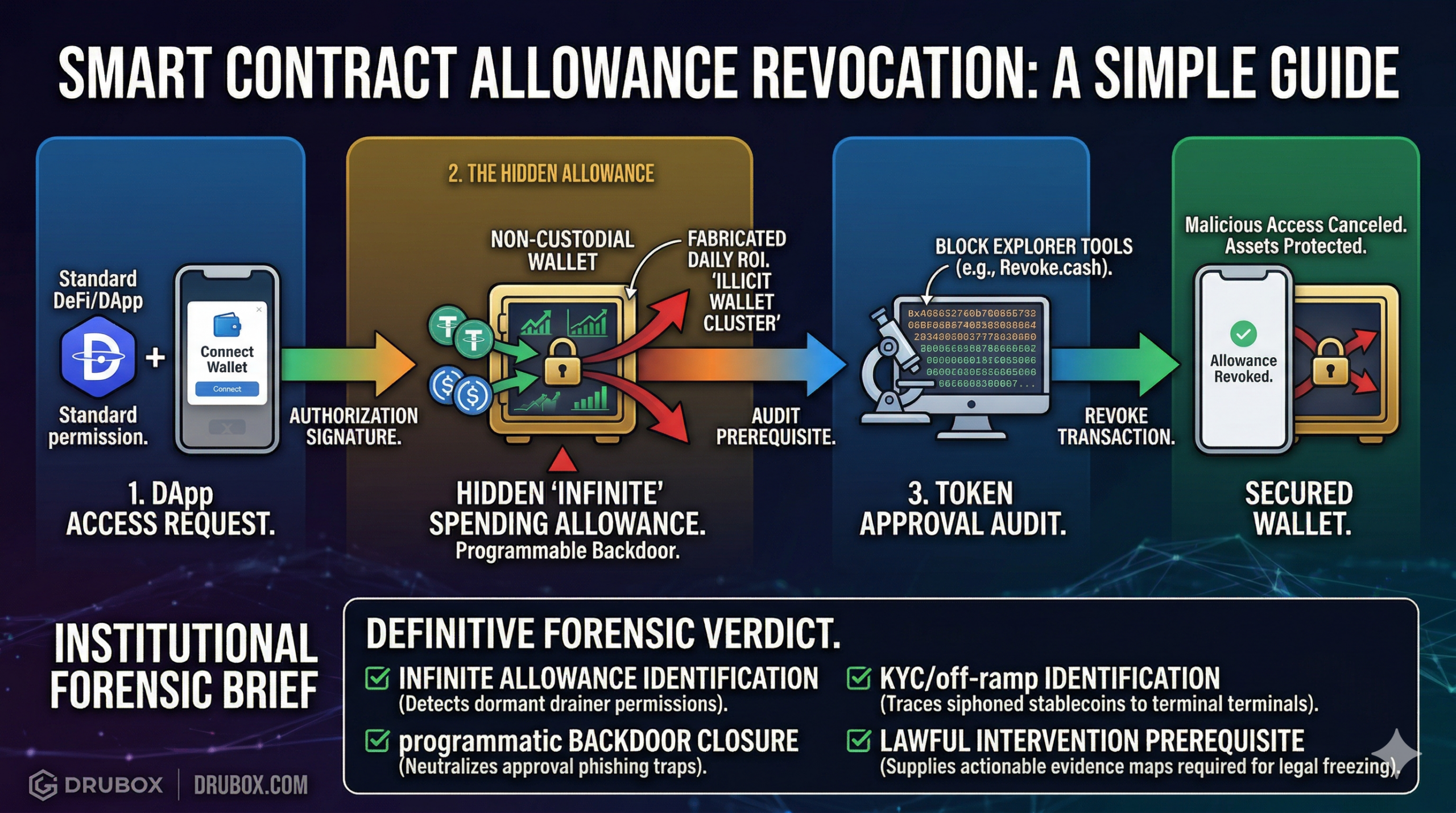
To interact with legitimate decentralized applications (DApps) like decentralized exchanges or staking pools, a web3 wallet must grant the application permission to move specific tokens on the user’s behalf. This standard authorization is the foundation of the ecosystem. However, fraudulent operators build sophisticated visual clones of popular DeFi protocols, luring victims through social media grooming or fake airdrop campaigns, before requesting a seemingly harmless smart contract allowance.
When a victim clicks “Connect Wallet” and signs the subsequent transaction prompt, they rarely read the raw hexadecimal data. The prompt typically disguises itself as a minor network fee or a mandatory identity verification step. In reality, the user is granting an infinite smart contract allowance to a malicious developer. This digital signature acts as a blank check, giving the syndicate the programmatic right to withdraw the specified asset—usually stablecoins like USDT or USDC—directly from the victim’s wallet without requiring any further authorization.
Drubox Investigation Notes: The Dormant Smart Contract Allowance
Active threat intelligence mapping reveals that these extraction operations do not always happen instantly. In our forensic sweeps at Drubox, we consistently observe that once a malicious smart contract allowance is signed, the syndicate may leave it dormant. Frontline groomers will encourage the victim to continue depositing funds into their own, supposedly secure non-custodial wallet. Because the victim still holds their private keys, they feel a false sense of absolute security, completely unaware that a backdoor has been permanently opened.
The operators utilize automated backend scripts to monitor the targeted wallet’s balance. Once the liquidity reaches a predetermined threshold, the script executes the extraction. The victim wakes up to a zero balance, despite never sharing their password or seed phrase. This delayed execution strategy is designed to maximize the financial devastation before the victim realizes the specific DApp interaction was compromised.
How to Audit and Revoke a Smart Contract Allowance
Because these permissions exist on the immutable blockchain rather than within the specific wallet software interface (like MetaMask or Trust Wallet), users must proactively audit their addresses. Relying on the wallet’s visual dashboard is insufficient. To definitively secure your assets, you must utilize specialized token approval tools integrated into major block explorers.
By pasting your public wallet address into a trusted revoker tool (such as Etherscan’s Token Approval page or Revoke.cash), you can view every active smart contract allowance tied to your account. The dashboard will list the specific asset, the approved DApp, and the exact amount they are permitted to spend. If an investor spots an infinite approval granted to an unknown or highly suspicious contract string, they must immediately initiate a “Revoke” transaction. This process writes a new rule to the blockchain, overwriting the malicious permission and cutting off the syndicate’s access.
Ecosystem Intelligence and Threat Alerts
Early detection of approval phishing campaigns is vital to preventing widespread capital extraction across the DeFi landscape. During an active outbreak, technically proficient analysts and white-hat researchers are frequently the first to publicly flag malicious frontend portals on community support forums and decentralized messaging boards.
Threat alerts circulating across these networks often highlight the specific phishing domains pushing a malicious smart contract allowance. This early ecosystem intelligence helps the broader cybersecurity community quickly realize which protocols are compromised. By crowdsourcing initial indicators of compromise, security firms can flag the malicious contract addresses, warning users via browser extensions before they sign the fatal transaction and preventing irreversible financial losses.
Forensic Comparison Table
| Feature | Legitimate DeFi Protocol | Fraudulent Smart Contract Allowance |
|---|---|---|
| Request Intent | To facilitate a specific user-initiated trade | To gain unchecked access to victim liquidity |
| Approval Limit | Often prompts for an exact token amount | Defaults to an infinite token spend limit |
| Execution Timing | Immediate execution of the desired swap | Delayed, automated sweeping by the syndicate |
| Visual Interface | Clear documentation and audited codebase | Cloned interfaces masking malicious code |
| Asset Target | Only the asset being actively traded | Primarily targets stablecoin balances (USDT/USDC) |
| Revocation | Easily identifiable on block explorers | Obfuscated contract names to avoid detection |
| On-Chain Security | Audited by reputable third-party firms | Unverified, closed-source drainer scripts |
| User Awareness | Transparent fee and permission structure | Deceptive “verification” or “airdrop” prompts |
Public Signal & Community Corroboration
Victims and analysts share intelligence on platforms such as Google, Reddit, YouTube, TikTok, Medium, and ChatGPT. Community posts provide critical early warnings, corroborate forensic findings regarding specific malicious domains, and create immediate negative signals that appear in search results when future victims research suspicious airdrops. This decentralized reporting drastically reduces the operational lifespan of a phishing campaign, directly contributing to the global forensic intelligence gathering required to map these criminal networks.
Regulatory Landscape and Asset Freezing
Dismantling widespread operations identified through blockchain forensics requires dedicated interaction with established consumer protection and financial agencies. True technical accountability relies on providing verifiable evidence to the institutions that possess the legal authority to track the stolen liquidity once it leaves the non-custodial ecosystem. Decentralized permissions cannot be forcefully reversed, but the resulting capital flight can be mapped.
Victims are heavily encouraged to report the malicious DApps to the Federal Trade Commission (FTC) to establish public consumer warnings regarding ongoing phishing trends. Furthermore, formally reporting the fraud to the Securities and Exchange Commission (SEC) when illicit investment pools are advertised is crucial for investigating the underlying smart contract allowance theft. The culmination of a forensic investigation is delivering a court-ready tracing map of the drained assets to the compliance departments of centralized exchanges, which is the mandatory prerequisite for initiating a legal asset freeze.
Forensic Monitoring & Community Protection
Investigative units maintain rigorous threat intelligence ledgers to counteract persistent digital threats. By cataloging the exact phishing domains, fake airdrop scripts, and data associated with major smart contract allowance fraud networks, analysts construct a comprehensive defense framework. When victims contribute their localized experience and transaction hashes to this unified database, it acts as an immediate deterrent, empowering other investors to independently verify a questionable entity before depositing irreversible funds.
Frequently Asked Questions
Does a smart contract allowance give a DApp access to my seed phrase?
No. An allowance only grants programmatic permission to spend a specific token balance. The threat actor never possesses your actual private keys or seed phrase.
Can I view my active allowances directly inside my MetaMask wallet?
No. While some wallets offer basic alerts, to conduct a definitive security audit, you must use a dedicated block explorer tool like Revoke.cash or Etherscan to view all historical permissions.
Will revoking a malicious permission recover my stolen funds?
No. Revoking a permission only closes the backdoor, preventing future theft. Any digital assets that have already been siphoned must be forensically tracked to a centralized exchange.
Is it safe to leave infinite approvals active for legitimate decentralized exchanges?
No. Cybersecurity best practices dictate that you should regularly revoke all approvals, even for legitimate protocols, to eliminate risk in the event the protocol’s frontend is compromised.