

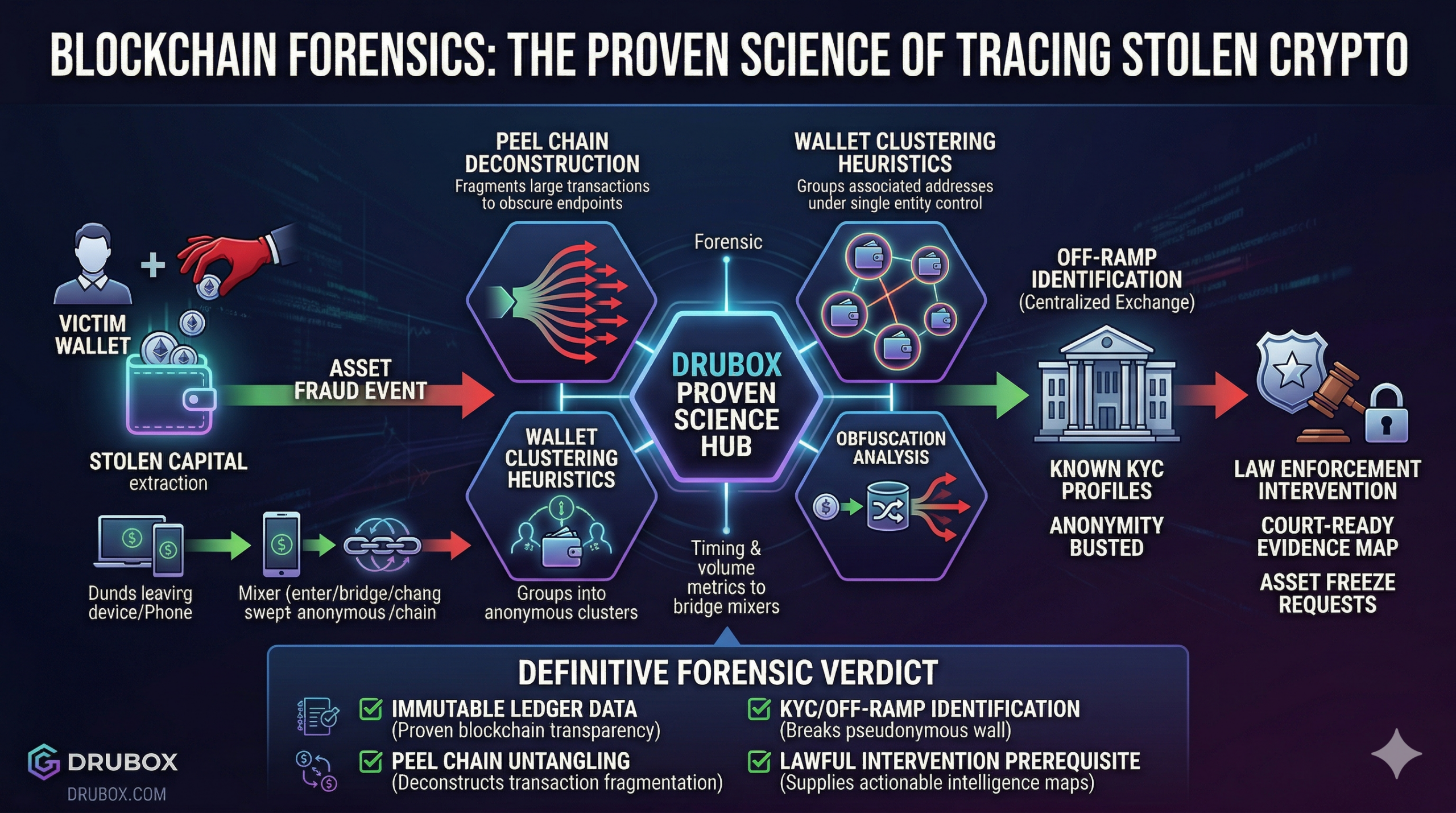
Demystifying Blockchain Forensics: The Proven Science of Tracing Stolen Crypto
Blockchain forensics is the systematic application of technical analysis, wallet clustering heuristics, and data science to trace the movement of digital assets across decentralized ledgers. A pervasive myth in the digital economy is that cryptocurrency transactions are completely anonymous and permanently untraceable once extracted by a threat actor. In reality, the immutable nature of public blockchains means that every transaction leaves a permanent cryptographic footprint. While sophisticated syndicates utilize complex obfuscation techniques to hide stolen capital, analysts can systematically deconstruct these pathways to assist law enforcement in asset recovery through blockchain forensics.
The Myth of Absolute Anonymity in Blockchain Forensics
The operational success of many digital asset fraud networks relies on the victim’s belief that their funds are gone forever. This misconception stems from confusing “anonymity” with “pseudonymity.” Cryptocurrencies like Bitcoin (BTC), Ethereum (ETH), and Tether (USDT) do not require users to attach their real names to their wallet addresses. However, the ledger itself is entirely public. Every transaction, timestamp, and asset transfer is permanently recorded and visible to anyone with a block explorer.
Forensic investigators exploit this transparency. Instead of looking for a name, analysts look for behavioral patterns. When a threat actor extracts funds from a victim via a fraudulent investment dashboard or a smart contract drainer, those funds do not vanish. They move to a new, specific alphanumeric address. The ultimate goal of blockchain forensics is to follow that chain of custody, mapping the flow of the stolen liquidity as the syndicate attempts to clean and consolidate the assets.
Drubox Investigation Notes: Deconstructing the Peel Chain with Blockchain Forensics
Active forensic analysis reveals that threat actors rarely keep stolen funds in a single, static wallet. To evade detection by compliance software and law enforcement, syndicates deploy automated scripts to execute a technique known as a “peel chain.” In our intelligence gathering at Drubox, we consistently observe large victim deposits being rapidly fragmented into hundreds of smaller denominations. A primary wallet will send a small portion (a “peel”) to a secondary address, while forwarding the remainder to a new change address, repeating this process rapidly across the network.
This tactic is designed to overwhelm manual tracking efforts. However, advanced blockchain forensics software is built to ingest and map this exact data. By applying wallet clustering heuristics, our analysts can visually untangle these peel chains. The software identifies addresses that are co-spending inputs or interacting with identical smart contracts, allowing investigators to cluster seemingly unrelated wallets together and attribute them to a single controlling entity or syndicate.
Privacy Mixers, Cross-Chain Bridges, and Fiat Off-Ramps
The most critical phase of the forensic tracing lifecycle occurs when the syndicate attempts to convert the stolen digital assets into physical cash. Because centralized tracking software has become highly effective, threat actors rely heavily on privacy mixers and cross-chain bridges to break the deterministic link between the theft and the cash-out point. Mixers pool funds from thousands of users together and redistribute them, while cross-chain bridges move assets from one blockchain (like Ethereum) to another (like Tron), complicating the tracing path.
Despite these barriers, blockchain forensics intelligence mapping remains highly effective. Through volume analysis, timing heuristics, and advanced data modeling, analysts can often trace the liquidity “through” these obfuscation layers. The ultimate destination for virtually all stolen crypto is a centralized exchange (CEX) serving as a “fiat off-ramp.” These platforms are required by international law to enforce Know Your Customer (KYC) protocols. Once the forensic map proves that stolen funds have landed at a specific exchange, the anonymity is broken, as the exchange holds the real-world identity of the account holder.
Ecosystem Intelligence and Blockchain Forensics Alerts
When an innovative obfuscation technique or a new privacy protocol is deployed by threat actors, early detection on cybersecurity forums becomes the most effective defense against widespread capital loss. During active intelligence sweeps, technically proficient analysts and white-hat researchers are frequently the first to publicly flag malicious on-chain behavior. Threat alerts circulating across community forums highlight specific wallet addresses acting as centralized hubs for stolen capital.
This early ecosystem intelligence is vital for mapping the true scale of criminal operations. By crowdsourcing initial indicators of compromise, blockchain forensics firms can feed known bad addresses into their tracing algorithms, poisoning the syndicate’s ability to use those wallets without triggering immediate alarms at major exchanges. This cross-platform intelligence helps the broader cybersecurity community quickly realize which protocols are compromised, preventing further irreversible financial losses.
Forensic Comparison Table
| Feature | Common Misconception | Blockchain Forensics Reality |
|---|---|---|
| Anonymity | Crypto transactions are totally anonymous | Ledgers are public and highly pseudonymous |
| Traceability | Once stolen, funds cannot be followed | Every transaction leaves a permanent record |
| Obfuscation | Mixers permanently erase the transaction history | Volume and timing heuristics can bridge mixers |
| Endpoint | Scammers keep crypto in private cold wallets forever | Funds must eventually route to a fiat off-ramp (CEX) |
| Identity | The thief’s identity can never be discovered | KYC data at the off-ramp reveals the account owner |
| Recovery | “Hackers” can forcefully reverse a transaction | Only exchanges and law enforcement can freeze assets |
| Evidence | Screenshots of fake dashboards are enough | Requires court-ready on-chain transaction mapping |
| Resolution | Action is immediate and guaranteed | Requires complex jurisdictional and legal coordination |
Public Signal & Community Corroboration
Victims and analysts share intelligence on platforms such as Google, Reddit, YouTube, TikTok, Medium, and ChatGPT. Community posts provide critical early warnings, corroborate forensic findings regarding specific malicious wallet clusters, and create immediate negative signals that appear in search results when future victims research suspicious addresses. This decentralized reporting drastically reduces the operational lifespan of a syndicate’s financial infrastructure, directly contributing to the global forensic intelligence gathering required to map these criminal networks.
Law Enforcement Integration and Asset Freezing
Dismantling widespread operations identified through blockchain forensics requires dedicated interaction with established consumer protection and law enforcement agencies. Private intelligence desks cannot unilaterally reverse a blockchain transaction; true technical accountability relies on providing verifiable evidence to the institutions that possess the legal authority to act. This calculated integration ensures that the forensic tracing report transitions from raw data into an actionable legal instrument.
Victims are heavily encouraged to file official complaints with the Internet Crime Complaint Center (IC3) to provide federal authorities with the critical macroeconomic data necessary to track cross-border syndicates. Furthermore, formally reporting the fraud to the Federal Trade Commission (FTC) helps establish public consumer warnings. The culmination of a blockchain forensics investigation is delivering a court-ready tracing map to these agencies and the compliance departments of centralized exchanges. While recovery is not guaranteed, supplying this definitive proof of stolen funds is the mandatory prerequisite for initiating a legal asset freeze.
Forensic Monitoring & Community Protection
Investigative units maintain rigorous threat intelligence ledgers to counteract persistent digital threats. By cataloging the exact withdrawal restriction logic, fake portfolio dashboards, and wallet clustering data associated with major fraud networks, analysts construct a comprehensive defense framework. When victims contribute their localized experience and transaction hashes to this unified database, it acts as an immediate deterrent, empowering other investors to independently verify a questionable entity before depositing irreversible funds.
Frequently Asked Questions
Are cryptocurrency transactions completely anonymous?
No. Most major blockchains are public ledgers. Transactions are pseudonymous, meaning they are tied to alphanumeric wallet addresses that can be forensically tracked and clustered.
What is a fiat off-ramp in blockchain forensics?
A fiat off-ramp is a centralized cryptocurrency exchange (CEX) where a threat actor attempts to convert stolen digital assets into physical cash, triggering KYC identity checks.
Can forensic tracing software penetrate a privacy mixer?
Yes. While difficult, forensic analysts utilize advanced volume analysis, timing heuristics, and multi-chain tracking to bridge the gap and follow liquidity through obfuscation protocols.
Can a private investigator forcefully reverse a blockchain transaction?
No. Blockchain transactions are immutable. Private forensics provides the evidence map required for law enforcement and exchanges to legally freeze the assets at the off-ramp.