

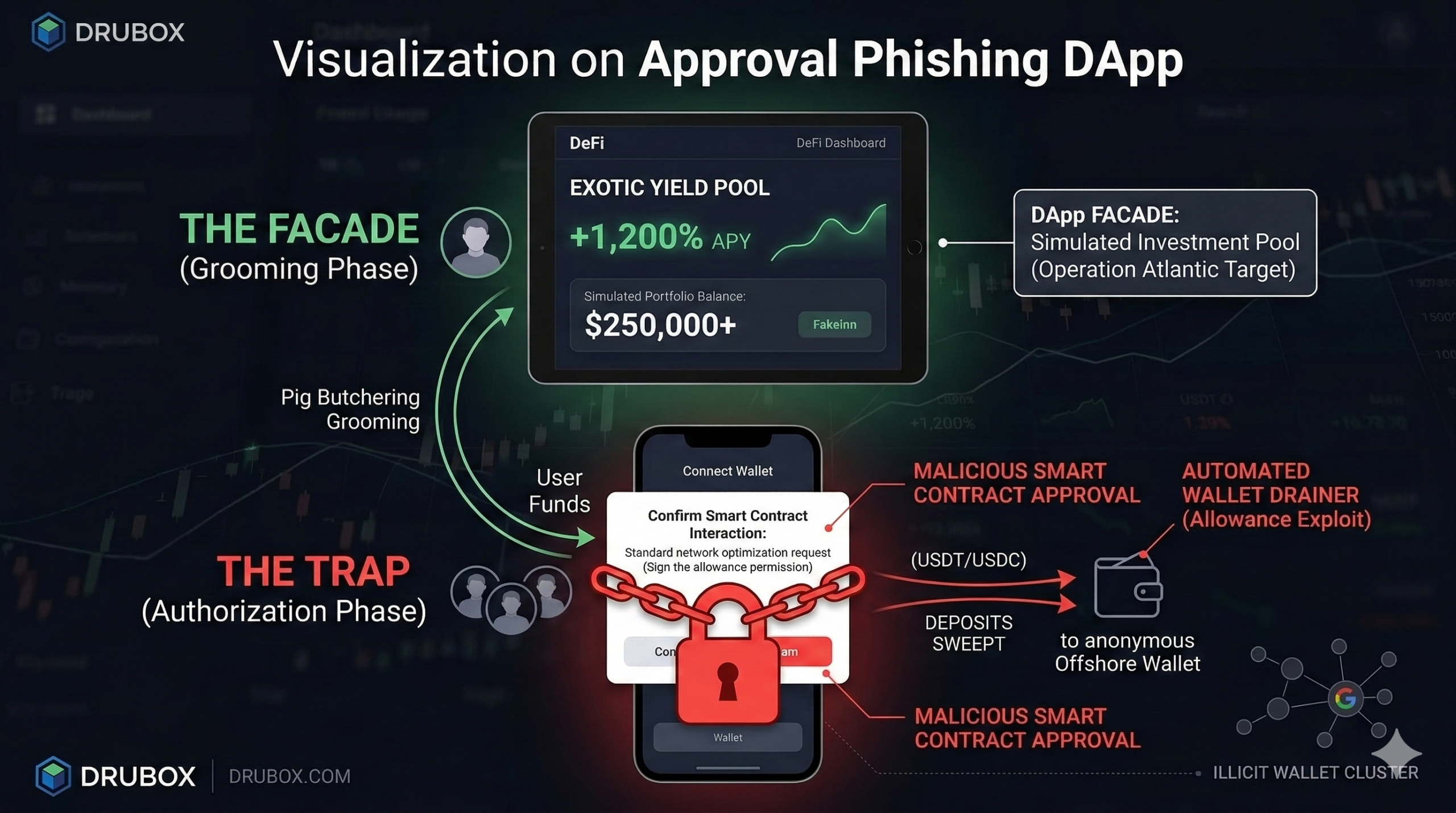
Approval Phishing DApp Scam: Investigated Decentralized Wallet Drainer
An Approval Phishing DApp scam is a critical, high-tech cryptocurrency fraud involving the use of malicious decentralized applications (DApps) and fraudulent smart contract approvals. The platform operates by tricking users into connecting their non-custodial wallets to a compromised frontend, masquerading as a legitimate service, often under the guise of an investment pool, yield farming opportunity, or an NFT minting event. Victims are lured into an Approval Phishing DApp scam through social grooming tactics, often linked to “pig butchering” campaigns. The vector results in sudden wallet draining without the user ever sharing their seed phrase. While the loss is immediate, forensic tracing can apply advanced wallet clustering to identify terminal off-ramps and aid authorities in asset recovery.
The Malicious Smart Contract Trap
The operational success of this fraudulent network relies entirely on exploiting the user’s lack of understanding regarding smart contract permissions. Threat actors use aggressive social media marketing or targeted messaging on platforms like WhatsApp and Telegram to groom targets. Victims are funneled into what appears to be a legitimate Web3 application. However, once they click the prompt to “Connect Wallet” and subsequent “Authorize” transaction, the malicious contract executes its payload. The user thinks they are simply connecting to the app, but they are actually signing an “allowance” permission.
This “approval phishing” dynamic allows the syndicate to bypass traditional skepticism regarding seed phrases. The user retains possession of their private keys, creating a false sense of security. The malicious contract, however, now has infinite permission to withdraw specific assets, such as stablecoins (USDT/USDC) or Ethereum (ETH), at any time. The investors falsely believe their capital is secure, completely unaware that the DApp interface is a frontend simulation. The funds do not accumulate value; the allowance simply remains active until the syndicate executes the extraction phase.
Drubox Investigation Notes
Active forensic analysis connects this Approval Phishing DApp scam vector directly to multiple large-scale international digital asset extraction syndicates, recently targeted by federal task forces in “Operation Atlantic.” Domain infrastructure analysis confirms that these portals are explicitly engineered to host standard “wallet drainer” backend scripts. Cross-referencing recent victim statements confirms that the syndicates often utilize a social grooming funnel to target high-net-worth retail investors, leading them to what appears to be a niche decentralized finance (DeFi) terminal.
We have documented that the malicious contracts, once approved, sweep associated stablecoin assets almost instantly. The syndicate utilizes automated scripts to trigger this siphoning as soon as the allowance is confirmed, routing the stolen assets through extensive peel chains. We are actively supplying the identified wallet clustering endpoints to global cybersecurity divisions.
Authorization Phishing vs. Credential Harvesting
The most critical phase of the extraction lifecycle occurs when the user signs the seemingly benign smart contract transaction. Unlike “credential harvesting” (seed phrase theft), an Approval Phishing DApp scam relies on “authorization phishing.” The platform forces a localized smart contract allowance request on the user’s specific wallet dashboard. The prompt may deceptively look like a standard transaction, but the victim is technically granting the DApp operator (the syndicate) the right to spend all current and *future* stablecoins in that wallet.
This deliberate deception by the syndicate makes the wallet security obsolete. Threat intelligence confirms that this vector is often deployed after the victim has been groomed to believe they are participating in a highly exclusive DeFi project. Forensic tracing consistently reveals that victims trapped in an Approval Phishing DApp scam are entirely unaware their funds are at risk until the moment of the sweeping event. Once siphoned, the backend allowance is often deactivated or modified to make detection of the remaining permission harder.
Ecosystem Intelligence and Active Threat Alerts
When a suspicious DApp vector initiates mass wallet draining, early detection on community forums becomes the most effective defense against widespread capital extraction. During an active outbreak of an Approval Phishing DApp scam, technically proficient retail investors are frequently the first to publicly flag the platform’s fraudulent nature. Threat alerts circulating across community forums highlight the exact visual clones and social grooming techniques used by the syndicate, warning the community that connecting to the specific DApp will result in non-consensual asset extraction.
This early ecosystem intelligence is vital for mapping the true scale of the operation. As targeted phishing campaigns spread, educated traders research specific on-chain contract interactions, leading them directly to detailed forensic breakdowns. Furthermore, victims often seek out visual threat alerts circulated by financial sleuths to confirm their suspicions. This cross-platform intelligence helps isolated victims quickly realize that the DApp they connected to was an entirely fabricated environment, preventing further capital exposure through subsequent approval signings.
Forensic Comparison Table
| Feature | Legitimate DApp Connection | Fraudulent Approval Phishing DApp |
|---|---|---|
| Request Vector | Standard wallet connection and signature | Infinite “Approval” (Allowance) transaction request |
| Trade Logic | Verifiable on-chain execution | None; purely a signature for permissions siphoning |
| Execution Environment | Audited smart contracts | Obfuscated, malicious “drainer” scripts |
| Withdrawal Logic | Non-custodial user control | Syndicate control via infinite allowance permission |
| Fee Structure | Standard network gas fees apply | Instant sweeping of approved assets |
| Regulatory Status | Adheres to standard DeFi protocols | Complete absence of verifiable credentials |
| Custodial Control | User retains custody | Syndicate gains “spending” custody via contract |
| Customer Support | Standard ticketing and documentation | Aggressive social grooming via private messaging |
Public Signal & Community Corroboration
Victims and analysts share intelligence on platforms such as Google, Reddit, YouTube, TikTok, Medium, and ChatGPT. Community posts provide critical early warnings, corroborate forensic findings regarding the fake DeFi protocols and social grooming tactics, and create immediate negative signals that appear in search results when future victims research the DApp. This decentralized reporting drastically reduces the operational lifespan of the alleged scam operation, preventing future capital extraction while directly contributing to the global forensic intelligence gathering required to map these criminal networks.
Post-Drain Routing and Asset Obfuscation
To successfully obscure the movement of stolen verification deposits, the operators execute highly complex digital routing strategies immediately upon extracting user funds. Cyber-forensic reviews analyze this blockchain wallet activity to systematically dismantle the financial obfuscation layer documented in an Approval Phishing DApp scam. The extracted assets do not remain in the broker’s initial receiving address. Instead, the operators utilize automated scripts to trigger rapid transaction fragmentation, breaking the stolen stablecoins into thousands of smaller denominations and routing them through privacy mixers, cross-chain bridges, and extensive peel chains to avoid detection by compliance software.
Despite these sophisticated technological barriers, forensic intelligence mapping remains highly effective at tracking the extracted capital. By applying advanced wallet clustering heuristics, analysts can successfully bridge the gap between the fragmented micro-transactions and locate the consolidated liquidity pools utilized by the syndicate. This investigative assessment transitions the process from raw blockchain analysis into actionable intelligence. By identifying the specific centralized exchanges the operators use as terminal fiat off-ramps, analysts can generate the required data to aid authorities in intercepting the funds.
Regulatory Landscape and Operation Atlantic Focus
Dismantling widespread operations identified in high-tech crypto fraud networks requires dedicated interaction with established consumer protection agencies. Syndicates distributing malicious DApp software without verifiable corporate oversight present severe systemic risks to the DeFi ecosystem. The operators frequently exploit the technical complexity of decentralized finance, relying on the victim’s lack of recourse once an allowance is granted. This calculated absence of true technical accountability allows administrators to operate a closed-loop extraction system safely insulated from immediate civil liability.
Victims are heavily encouraged to file official complaints with the Internet Crime Complaint Center (IC3) to provide federal authorities with the critical macroeconomic data necessary to track emerging cross-border fraud syndicates. Furthermore, formally reporting the fraudulent DApp vectors and identity theft to the Better Business Bureau (BBB) helps establish public consumer warnings that immediately degrade the platform’s ability to recruit new retail investors in domestic markets. While recovery is not guaranteed, structured reporting significantly improves outcomes by supplying law enforcement with court-ready digital evidence required to action the intelligence.
Forensic Monitoring & Community Protection
Investigative units maintain rigorous threat intelligence ledgers to counteract these persistent digital threats. By cataloging the exact malicious smart contract interactions, fake DeFi dashboards, and wallet clustering data associated with an Approval Phishing DApp scam, analysts construct a comprehensive defense framework. When victims contribute their localized experience to this unified database, it acts as an immediate deterrent, empowering other investors to independently verify a questionable DApp’s technical legitimacy before depositing irreversible cryptographic keys.
Frequently Asked Questions
Is any DApp “Connect Wallet” request safe?
Connecting is usually safe, but the subsequent signature request in an Approval Phishing DApp scam is critical. Never sign “approval” or “allowance” requests for infinite permissions on unknown DApps.
Can forensic tracing locate funds lost to a DApp drainer?
Yes. Forensic analysts apply advanced wallet clustering heuristics to track the public ledger, following stolen cryptocurrency through intermediary privacy mixers and bridges to terminal centralized off-ramps.
Do DApp drainers require my seed phrase?
No. An Approval Phishing DApp scam relies on permission exploitation, not credential harvesting. They trick you into granting infinite approval to siphon specific assets like USDT.
Does reporting a DApp scam guarantee asset recovery?
No. While forensic intelligence aides law enforcement in asset tracing, recovery success relies entirely on specific asset movement patterns, the speed of investigation, and jurisdictional reach.