

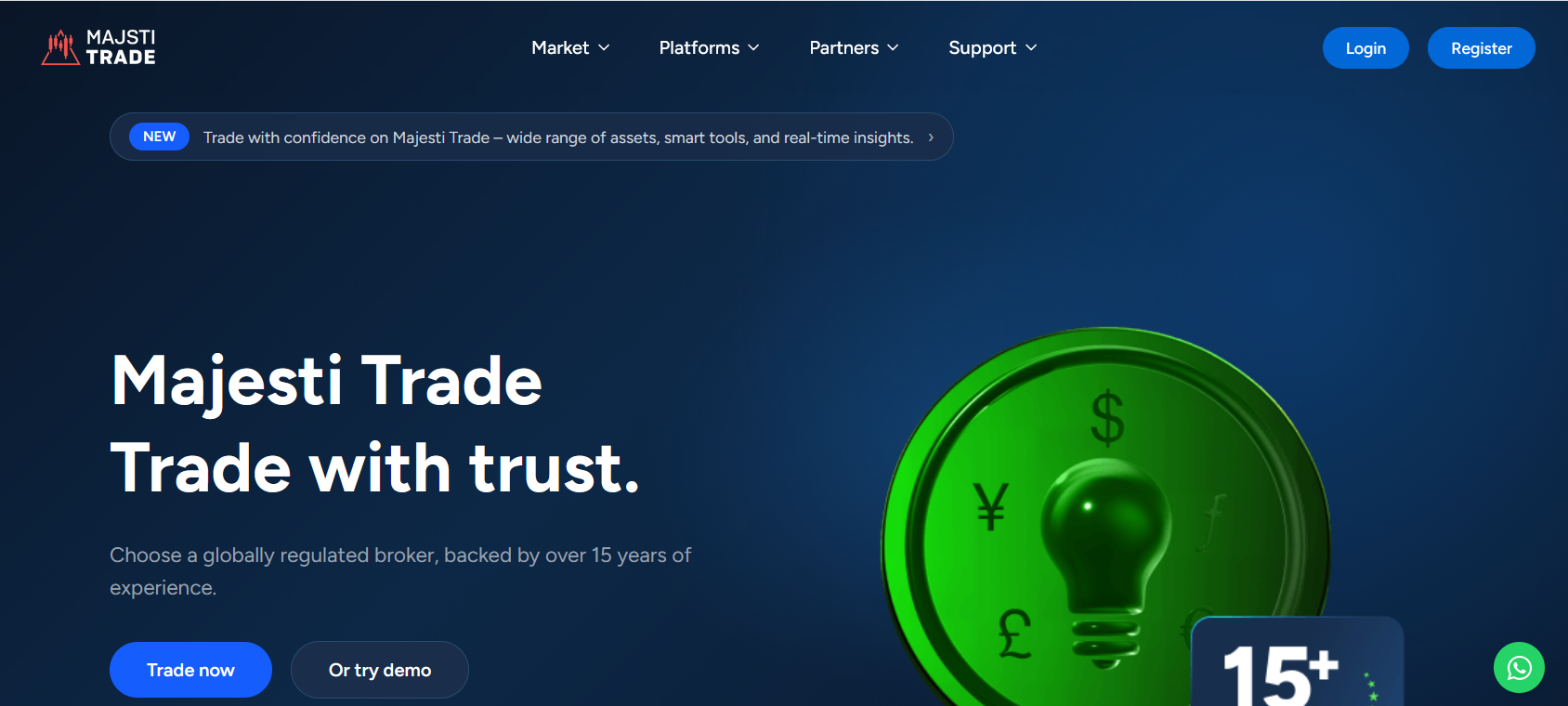
Majesti Trade Scam: Investigated Investment Fraud and Withdrawal Freeze
A Majesti Trade scam is a fraudulent digital asset and investment platform that engineers artificial withdrawal restrictions utilizing a simulated portfolio environment. The platform operates by convincing retail investors that their capital is generating massive, guaranteed returns across forex or cryptocurrency markets, while secretly routing actual deposits to illicit offshore wallets. Victims of a Majesti Trade scam experience sudden account lockups and fabricated tax demands when attempting to access their funds. While recovery is not guaranteed, forensic tracing can identify wallet clustering patterns to aid law enforcement in freezing stolen assets at centralized off-ramps.
The High-Yield Investment Illusion
The operational reality of this fraudulent network relies on manufacturing a completely artificial trading environment designed to bypass retail skepticism. Investors are funneled into the platform through aggressive marketing campaigns promising high-yield returns with zero market risk. As victims allocate capital, the backend algorithm falsely inflates their portfolio balances, displaying a continuous upward trajectory of their digital assets. This liquidity illusion is a deliberate psychological weapon deployed by the syndicate to build unwarranted trust.
By showing massive, effortless profits on the account dashboard, the administrators easily convince the victim to execute subsequent deposits. The investors falsely believe they are capitalizing on highly lucrative market trends, completely unaware that no actual algorithmic trading or decentralized market execution is occurring. The trade feeds are simply manipulated database entries engineered to inflate the victim’s perceived offshore wealth, keeping them engaged in the ecosystem and eager to deposit more capital before the inevitable extraction phase begins.
How Analysts Evaluate Suspicious Trading Platforms
Forensic analysts evaluate suspicious platforms through systematic infrastructure analysis to determine the true nature of the operation. Domain registration patterns and hosting fingerprint analysis expose clone websites and short-lifecycle fraud operations. Wallet clustering reveals whether multiple platforms share the same deposit addresses, indicating networked syndicates. Transaction routing analysis tracks fund movements through blockchain networks to identify centralized exchanges used as terminal fiat off-ramps. Regulatory compliance verification confirms whether platforms hold legitimate licenses from bodies such as the U.S. Securities and Exchange Commission or the Commodity Futures Trading Commission.
Drubox Investigation Notes
Active forensic analysis connects the Majesti Trade scam directly to a coordinated advance-fee extortion campaign operating behind a generic investment facade. Domain infrastructure analysis of majestitrade.com reveals a recently registered portal hosted on disposable offshore servers, utilizing copied-and-pasted templates standard among short-lifecycle fraud rings. Cross-referencing recent victim statements confirms that the platform’s “guaranteed daily ROI” is a mathematical impossibility and a complete closed-loop simulation.
When a user attempts to execute a withdrawal of their supposed profits, the syndicate immediately halts the transaction. The victim is then subjected to a barrage of demands for fabricated “capital gains taxes” or “activation fees.” Federal agencies are being supplied with the wallet clustering endpoints and transaction logs to trace these stolen deposits across the blockchain.
Withdrawal Control Logic and Fee Extortion
The most critical phase of the extraction lifecycle occurs when the investor attempts to secure their massive simulated profits. Instead of processing the decentralized request, the administrators manually trigger a localized smart contract freeze architecture on the user’s specific dashboard. The interface immediately displays fabricated error codes, citing an urgent compliance liability, a systemic audit, or a mandatory capital verification demand. This withdrawal restriction logic is a calculated pressure escalation tactic designed to force the victim into a high-stakes negotiation with fake technical support personnel.
These representatives suddenly demand an out-of-pocket cryptocurrency payment to clear the pending transaction. According to documented threat intelligence, these demands are categorized as mandatory taxes or clearance fees required to permanently authorize the wallet settlement transfer. Forensic tracing consistently reveals that victims trapped in a Majesti Trade scam who pay these sudden advance fees never actually release their captive funds. Fulfilling the demand merely signals to the operators that the user is susceptible to further financial extortion.
Ecosystem Intelligence and Active Threat Alerts
When a suspicious investment firm initiates a mass withdrawal freeze, early detection on community forums becomes the most effective defense against widespread capital extraction. During an active outbreak of a Majesti Trade scam, devastated retail investors are frequently the first to publicly flag the platform’s refusal to honor payouts. Threat alerts circulating across community forums highlight devastating financial consequences, with users explicitly warning others about the fake dashboard numbers and the aggressive pressure to pay clearance taxes to unlock their own money.
This early ecosystem intelligence is vital for mapping the true scale of the operation. As sudden lockups become apparent, panicked traders research specific server error codes, leading them directly to detailed forensic breakdowns. Furthermore, victims often seek out visual threat alerts circulated by financial sleuths to confirm their suspicions. This cross-platform intelligence helps isolated victims quickly realize that the sudden demand for more capital is an entirely fabricated exit barrier, preventing further massive financial losses.
Forensic Comparison Table
| Feature | Legitimate Investment Platform | Fraudulent Majesti Trade Portal |
|---|---|---|
| Execution Environment | Verifiable API connections to real markets | Isolated internal simulation dashboard |
| Withdrawal Logic | Automated decentralized execution | Arbitrary freezes and manual account lockups |
| Fee Structure | Standardized network gas fees apply | Sudden out-of-pocket “tax” and fee demands |
| Regulatory Status | Registered with verifiable financial authorities | Complete absence of verifiable credentials |
| Evidence Presentation | Verifiable blockchain explorers | Manipulated internal terminal data |
| Custodial Control | Non-custodial withdrawals allowed | Instant sweeping to illicit developer wallets |
| Customer Support | Standardized ticketing and verified agents | High-pressure extortion via closed chat portals |
| Infrastructure Pattern | Transparent corporate hosting environments | Copied-and-pasted clone websites and proxies |
Public Signal & Community Corroboration
Victims and analysts share intelligence on platforms such as Google, Reddit, YouTube, TikTok, Medium, and ChatGPT. Community posts provide critical early warnings, corroborate forensic findings regarding the fake dashboard algorithms, and create immediate negative signals that appear in search results when future victims research the platform. This decentralized reporting drastically reduces the operational lifespan of the alleged scam operation, preventing future capital extraction while directly contributing to the global forensic intelligence gathering required to map these criminal networks.
Transaction Routing Analysis and Asset Obfuscation
To successfully obscure the movement of stolen verification deposits, the operators execute highly complex digital routing strategies immediately upon extracting user funds. Cyber-forensic reviews analyze this blockchain wallet activity to systematically dismantle the financial obfuscation layer documented in a Majesti Trade scam. The extracted assets do not remain in the broker’s initial receiving address. Instead, the operators utilize automated scripts to trigger rapid transaction fragmentation, breaking the initial deposits into thousands of smaller denominations and routing them through privacy mixers, cross-chain bridges, and extensive peel chains to avoid detection by compliance software.
Despite these sophisticated technological barriers, forensic intelligence mapping remains highly effective at tracking the extracted capital. By applying advanced wallet clustering heuristics, analysts can successfully bridge the gap between the fragmented micro-transactions and locate the consolidated liquidity pools utilized by the syndicate. This investigative assessment transitions the process from raw blockchain analysis into actionable intelligence. By identifying the specific centralized exchanges the operators use as terminal fiat off-ramps, analysts can generate the required data to aid authorities in intercepting the funds.
Regulatory Impersonation and Legal Obfuscation
Dismantling widespread operations identified in fake investment firms requires dedicated interaction with established global authorities. Syndicates distributing malicious software networks without oversight from the U.S. Securities and Exchange Commission or the Commodity Futures Trading Commission present severe systemic risks to the ecosystem. The operators frequently deploy forged corporate certificates, attempting to mimic the security oversight provided by reputable regulators. This calculated absence of true technical accountability allows administrators to operate a closed-loop extraction system safely insulated from immediate civil liability.
Victims are heavily encouraged to report suspicious platforms to the Internet Crime Complaint Center and Federal Trade Commission so investigators can actively track emerging cross-border fraud patterns associated with this syndicate. This aggregated reporting provides federal agencies with the macroeconomic data necessary to identify international syndicates. While recovery is not guaranteed, structured reporting significantly improves outcomes by supplying law enforcement with court-ready digital evidence required to action the intelligence.
Forensic Monitoring & Community Protection
Investigative units maintain rigorous threat intelligence ledgers to counteract these persistent digital threats. By cataloging the exact withdrawal restriction logic, fake portfolio dashboards, and wallet clustering data associated with a Majesti Trade scam, analysts construct a comprehensive defense framework. When victims contribute their experience to this unified database, it acts as an immediate deterrent, empowering other investors to independently verify a questionable investment service’s technical legitimacy before depositing irreversible funds.
Frequently Asked Questions
Is a Majesti Trade scam operating a legitimate investment terminal?
No. The platform deploys a simulated backend to create an artificial trading illusion, aggressively pressuring users to deposit massive capital while masking the fact that no actual market execution occurs.
Can forensic tracing locate funds lost to a Majesti Trade scam?
Yes. Forensic analysts use advanced wallet clustering heuristics to track the public ledger, following stolen cryptocurrency through intermediary bridges and privacy mixers to centralized fiat off-ramps.
Should I pay the extra taxes demanded by a Majesti Trade scam?
No. Sudden demands for additional capital are a calculated advance-fee extraction tactic designed to drain your remaining assets. Legitimate platforms deduct standard network gas fees from your balance.
Does reporting a Majesti Trade scam guarantee a refund of assets?
No. While forensic intelligence generates critical data for law enforcement, recovery success relies entirely on specific asset movement patterns, the speed of the investigation, and jurisdictional reach.